
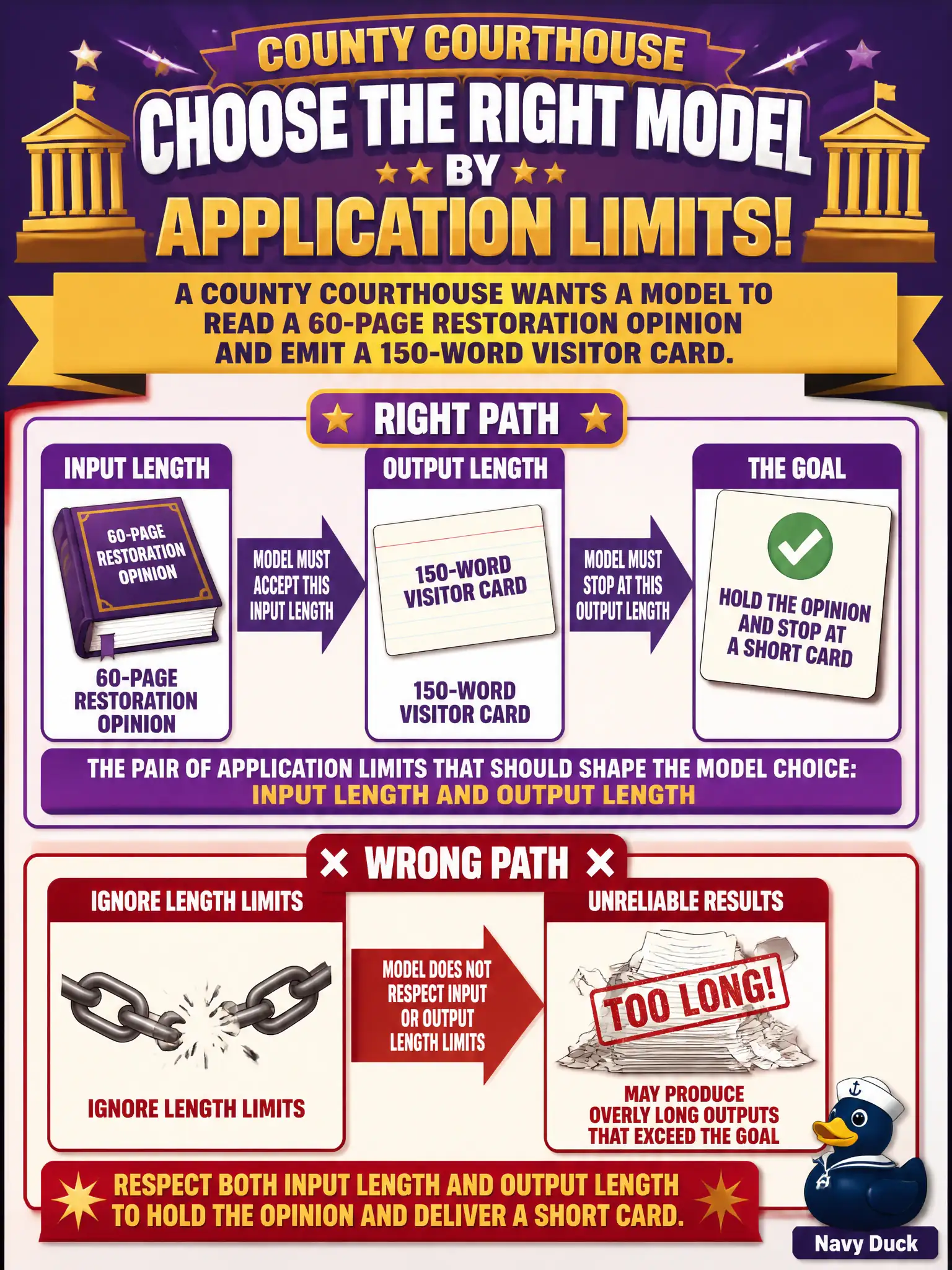
A county courthouse wants a model to read a 60-page restoration opinion and emit a 150-word visitor card. Which pair of application limits should shape the model choice?
Select an answer to reveal the explanation.
Short Explanation
Think of stuffing a 60-page opinion into a mailbox and asking for a 150-word card. Input length and output length pick the model. A short window cannot hold the opinion, and unbounded generation writes a booklet.
Full Explanation
The county courthouse wants a model that can read a 60-page restoration opinion and emit a 150-word visitor card. Those requirements are paired application limits: input length must hold the opinion, and output length must stop at a short card. Model choice therefore has to clear both token boundaries—enough context to ingest the opinion, and controllable generation so the card does not balloon into a booklet.
A short-window model fails because page count becomes a context limit; if the opinion does not fit, the card cannot be grounded in the full document. Unbounded generation fails because a visitor card should stay short; without an output limit the model tends to write far more than 150 words. Treating tokens only as vocabulary trivia fails because tokens are the practical units of both context capacity and billed generation, not exam wordplay.
Exam caveat: input and output length are independent levers—passing one does not satisfy the other when the job pairs a long source with a short deliverable. Operational check: measure the opinion’s token size against candidate context windows, set a max generation length near 150 words, and verify visitor cards stay inside that bound without truncating critical meaning.