
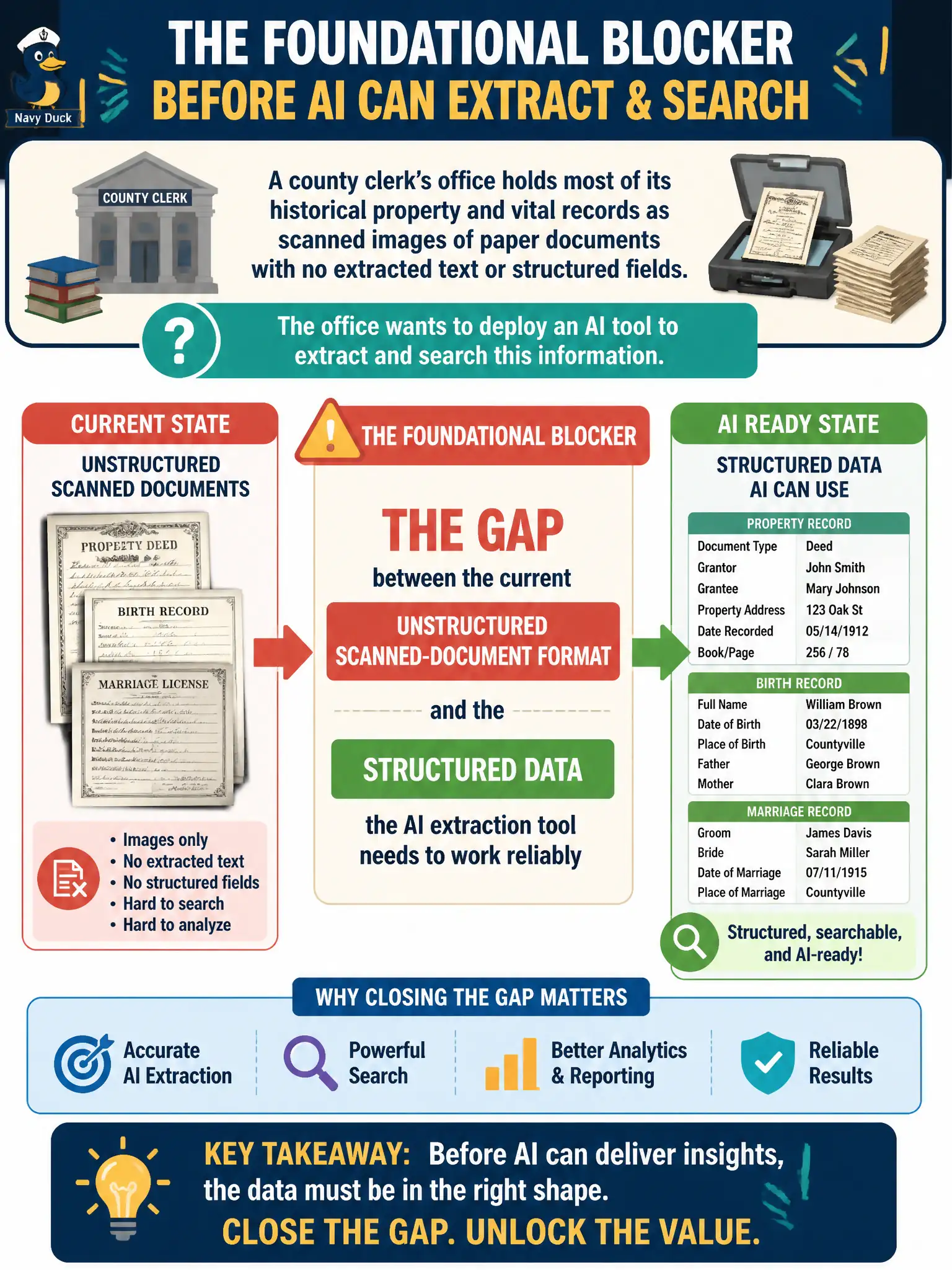
A county clerk's office holds most of its historical property and vital records as scanned images of paper documents with no extracted text or structured fields. The office wants to deploy an AI tool to extract and search this information. What is the foundational blocker the office must address first?
Select an answer to reveal the explanation.
Short Explanation
Picture a filing cabinet stuffed with photographs of documents rather than the documents themselves, you can flip through every photo, but nothing is searchable or sortable until someone actually reads and organizes what's in them. The clerk's office is sitting on exactly that kind of cabinet, scanned images with no extracted text or fields. That structured-versus-unstructured gap is what has to close before an extraction tool can do its job reliably.
Full Explanation
An AI extraction tool depends on being able to read and structure the information inside a document, so scanned images with no extracted text or defined fields represent a foundational readiness gap that has to close before the tool can perform reliably. Closing it typically means running optical character recognition and defining the structured fields the tool should populate, work that has to happen before extraction accuracy can be trusted for records as consequential as property and vital records. Choosing a vendor based on licensing terms is a procurement decision that matters far less if the underlying documents still can't be reliably parsed by whichever vendor is selected. Setting a rollout timeline for public search features gets ahead of the problem, since there's nothing dependable to search until the documents are structured. Training staff on query phrasing assumes the tool is already returning reliable results, which isn't true while the source documents remain unstructured images. This blocker applies specifically to record sets that are scanned images without extracted text; an office whose records already exist as structured digital data wouldn't face this particular gap. A concrete check is sampling a batch of scanned records to confirm extraction accuracy meets a defined threshold before any public-facing search feature launches.