
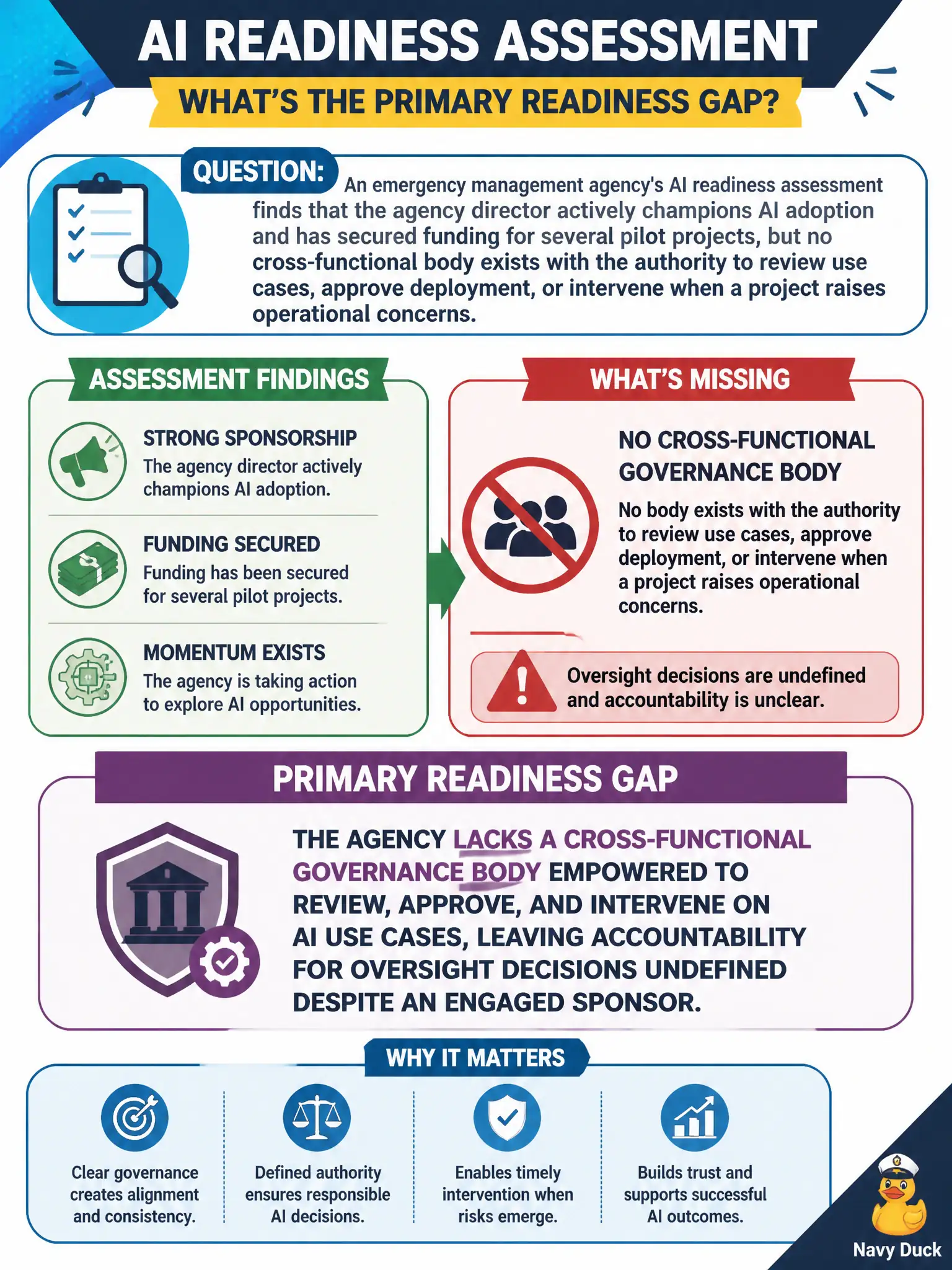
An emergency management agency's AI readiness assessment finds that the agency director actively champions AI adoption and has secured funding for several pilot projects, but no cross-functional body exists with the authority to review use cases, approve deployment, or intervene when a project raises operational concerns. What should the assessment identify as the primary readiness gap?
Select an answer to reveal the explanation.
Short Explanation
A champion at the top is great for getting a program funded, but it's not the same thing as a governance structure that can actually review and stop a bad use case before it ships. Sponsorship answers who wants this, while accountability answers who's allowed to say no, and this agency is missing the second piece entirely. Picture a fire chief who loves new equipment but has no one checking whether it's safe to deploy on a call.
Full Explanation
Readiness assessments typically evaluate several independent dimensions: leadership sponsorship, governance structure, technical infrastructure, and workforce capability. This scenario supplies clear evidence for only one gap: sponsorship is present and funding exists, so the problem is not a weak executive champion. Nothing in the scenario mentions infrastructure limitations or unvalidated data pipelines, so flagging technology is unsupported by the evidence given. Similarly, no staffing or skills shortfall is described, so recommending a training program addresses a gap the assessment never actually found. The evidence points specifically to a missing cross-functional oversight body: without one, decisions about which use cases proceed, how risk is weighed, and who can pause a deployment have no defined home, even though someone at the top wants the program to move forward. In practice, this kind of committee typically draws members from IT, legal, program operations, and community-facing staff so that oversight reflects more than one department's perspective. A scope caveat: sponsorship and governance are related but distinct dimensions, and an assessment should never assume one substitutes for the other. An operational check: confirm whether any documented body has met to review a specific AI use case in the past year.