
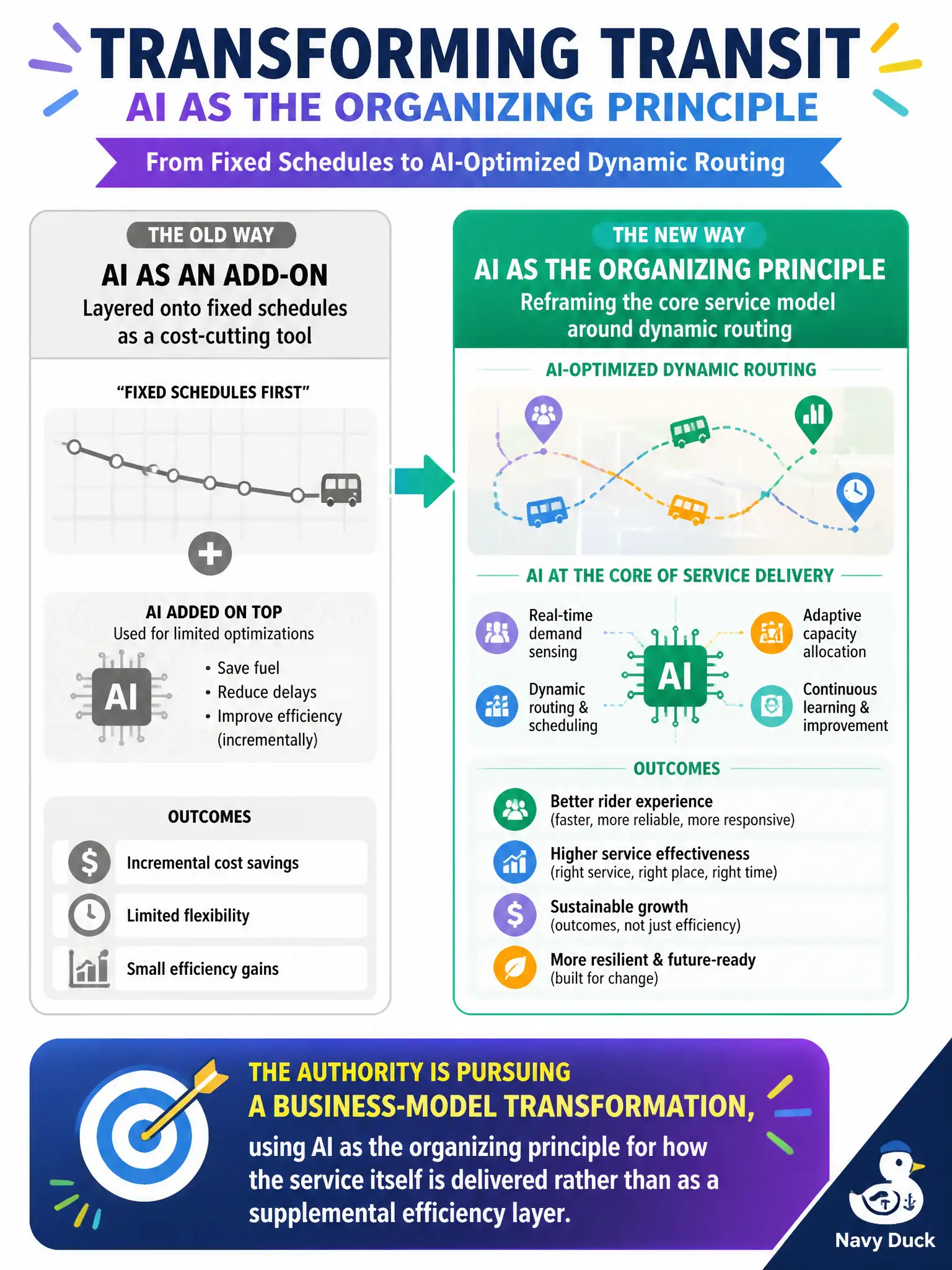
A transit authority reframes its core service model around AI-optimized dynamic routing, making it the organizing principle for how service is planned and delivered, rather than layering AI onto its existing fixed schedules as a cost-cutting add-on. Which characterization best captures what the authority is doing?
Select an answer to reveal the explanation.
Short Explanation
Think of it like the difference between adding cruise control to a car versus redesigning the car around self-driving. Bolting AI onto an existing process is efficiency work; making AI the thing the whole service is built around is transformation, a different and bigger strategic move.
Full Explanation
Business-model transformation happens when AI stops being a tool applied to an existing process and becomes the organizing logic of the offering itself. Here, dynamic routing driven by AI redefines what the transit service is, moving from fixed schedules with incremental tweaks to a service that continuously reshapes itself around demand, which is a fundamentally different value proposition than the old model with a faster engine underneath. Framing this as incremental process automation undersells the scope of the change; automation optimizes a step inside an unchanged model, while this authority is changing the model. Calling it a narrow proof-of-concept mischaracterizes the situation as described, since the stem describes an authority-wide reframing of the core service, not a limited pilot awaiting validation. Treating this as vendor outsourcing confuses the technology sourcing question with the strategic positioning question; who builds or hosts the routing engine is a separate decision from what the routing model organizes the service around. An exam-relevant distinction worth remembering: efficiency gains show up as lower cost per unit of existing output, while business-model transformation shows up as a changed value proposition or customer experience. A useful operational check is to ask whether removing the AI capability would just slow the old process down or would eliminate the service model entirely; the latter signals true transformation.