
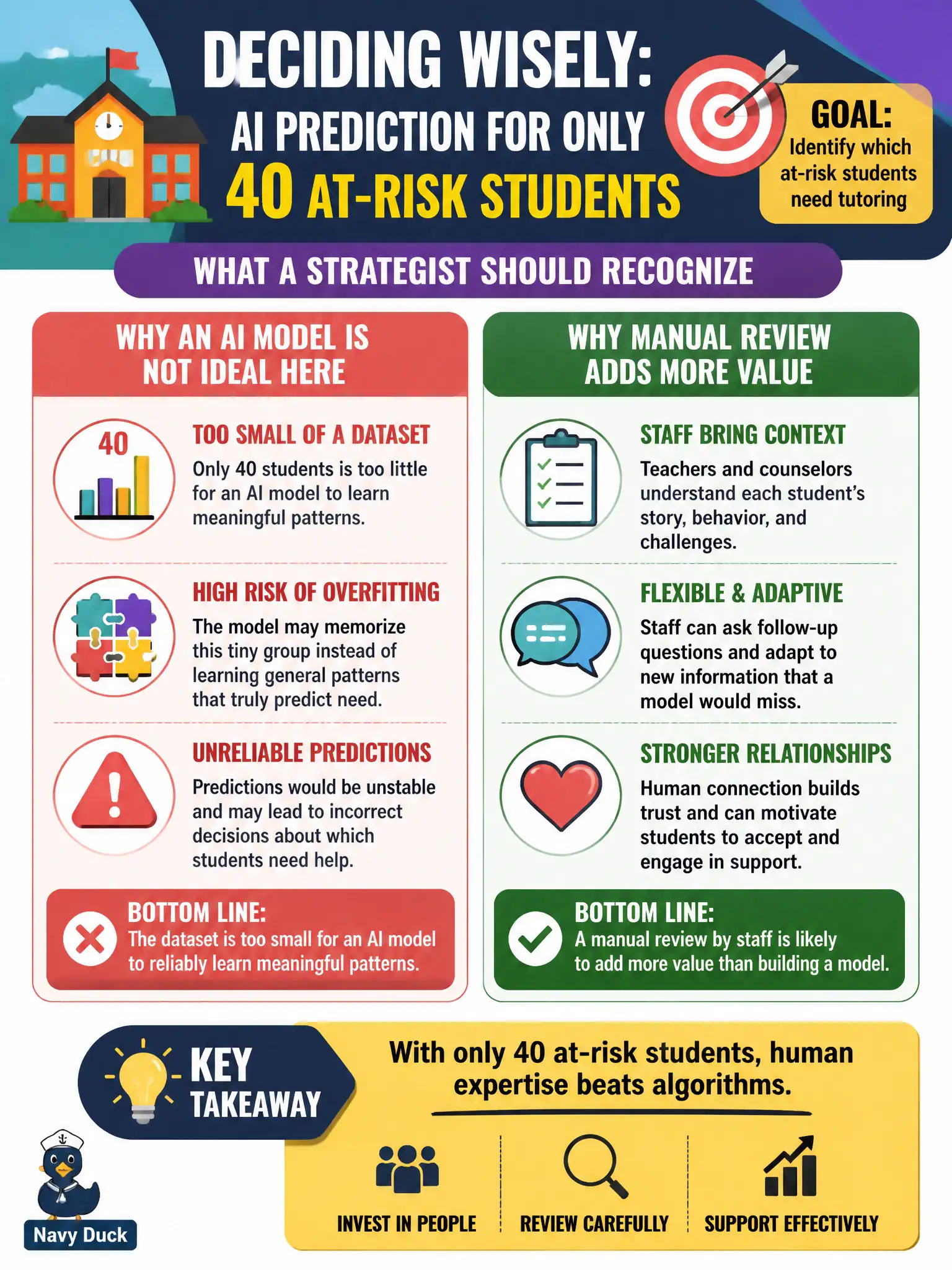
A school district is considering an AI model to predict which of only 40 at-risk students need tutoring. What should a strategist recognize about this scenario?
Select an answer to reveal the explanation.
Short Explanation
Forty students is a short enough list that a counselor could read through it over coffee and spot who's struggling, no model needed. Sometimes the right call isn't a fancier tool, it's recognizing the job is already small enough for people to just do it.
Full Explanation
AI models learn patterns from data, and with only 40 students, there simply isn't enough volume for a model to reliably distinguish real risk patterns from noise, which means its predictions are unlikely to be more trustworthy than a counselor or teacher manually reviewing the same small list. In cases this small, manual review is often faster to stand up, easier to explain to families, and just as accurate, making it the better use of limited district resources than building and maintaining a model. Claiming an AI model always outperforms manual review treats AI as universally superior regardless of scale, when in fact small-sample scenarios are a well-known case where AI adds little or even performs worse than a straightforward human process. Framing the small dataset as ideal because training would be faster confuses training speed with training quality; a model can finish training quickly on 40 records and still learn nothing generalizable from them. Asserting that dataset size is irrelevant to performance ignores one of the most basic constraints on machine learning, since insufficient data is a primary reason models fail to generalize. Before committing resources either way, the district should ask whether the 40-student list is likely to grow substantially in future years, since a genuinely small, stable population is a recurring case for manual review rather than a one-time exception.