
In a typical natural language processing (NLP) workflow that prepares raw text for modeling, which step is a standard early-pipeline operation?
Select an answer to reveal the explanation.
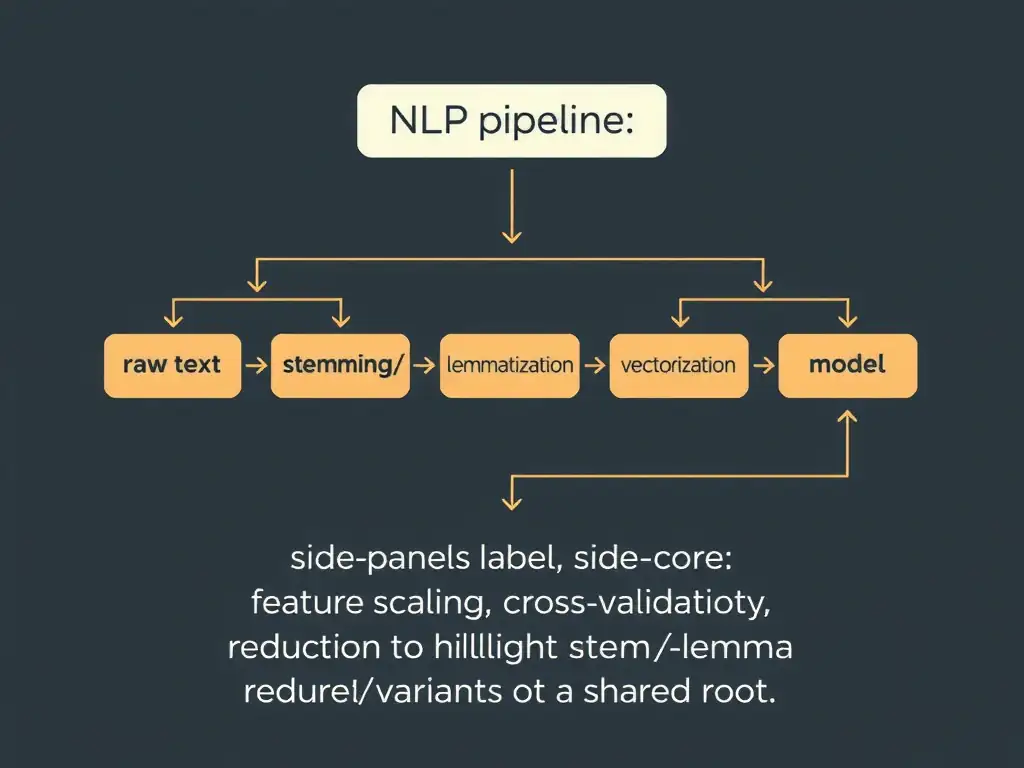
Short Explanation
Okay, let's dive in. You've got a pile of messy text—emails, tickets, reviews—and somehow that has to become something a model can chew on. Think of it like sorting mail at the post office: "running," "runs," and "ran" are the same letter with different stamps. Stemming or lemmatization peels those variants back toward a shared root so you don't treat them as totally unrelated words. Feature scaling? That's for numbers on a spreadsheet. Cross-validation? That's how you grade the model later. Dimensionality reduction? Cool trick, different job. Exam trap: don't grab every "preprocessing" buzzword you remember from tabular ML—NLP has its own early steps. Got it? Sweet. When you see "pipeline for text," look for tokenization-family moves like stem/lemma.
Full Explanation
A standard NLP pipeline turns unstructured language into model-ready inputs through linguistic and statistical preprocessing. After tokenization (and often lowercasing, punctuation handling, and stop-word decisions), stemming or lemmatization reduces inflected or derived word forms to a common base. Stemming applies rule-based truncation (for example, mapping "studies" and "studying" toward a stem), while lemmatization uses vocabulary and morphology to recover a dictionary lemma (for example, "better" → "good" in some setups). The goal is to shrink sparse vocabulary, improve feature sharing across related tokens, and stabilize bag-of-words, TF-IDF, or classic sequence features.
The correct option names this morphological normalization role. Feature scaling belongs primarily to numeric tabular workflows (min-max, z-score, and similar transforms) so gradient-based or distance-based learners are not dominated by large-magnitude columns; raw text does not start as that kind of continuous feature matrix. Cross-validation is an evaluation and model-selection protocol: it estimates out-of-sample performance by rotating train/validation folds, not by transforming word forms. Dimensionality reduction (PCA, SVD on term-document matrices, autoencoders) can follow vectorization when sparsity or multicollinearity is a problem, but it is an optional modeling step rather than a defining early NLP linguistic stage.
Underlying principle: early NLP stages normalize linguistic form before modeling; generic ML tools answer different questions. Best practice version-controls tokenization and stem/lemma choices with the model so train and serve match. Memory aid: pipeline stages answer how we clean language versus how we train or evaluate a learner. If the distractor could apply equally to house-price regression without any text, it is probably not the NLP-specific answer. On exams, associate classic NLP prep with tokenize, normalize via stem or lemma, then vectorize, and keep CV and generic numeric scaling in the general ML toolkit.
Prefer to study offline? Printable PDF study book + test engine ($7.50, unofficial). These questions stay free here.