
Your practice results show a clear weak spot on deep learning optimizers (for example SGD, Adam, and learning-rate schedules). What is the most effective way to improve before the certification exam?
Select an answer to reveal the explanation.
Short Explanation and Infographic
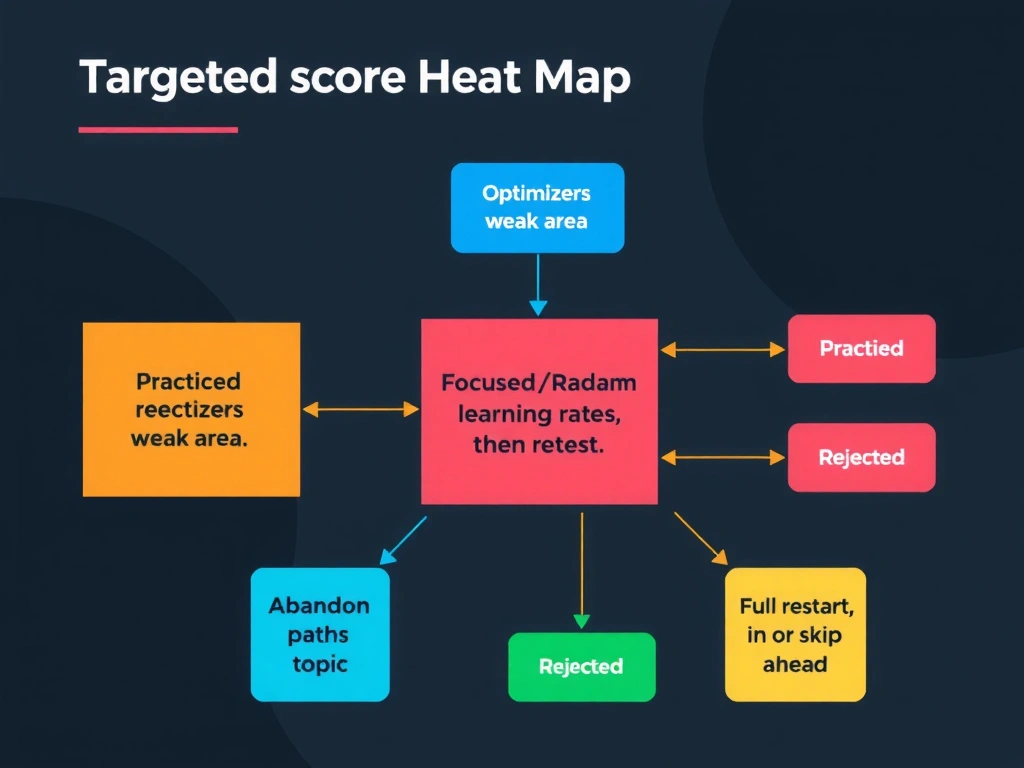
Okay—score was low on deep learning optimizers. Don't panic, and don't restart the whole universe of AI from page one. Here's the deal: practice tests are a map. They just circled optimizers in red. Think of it like a network cert where you're rock solid on switching but tank routing—you drill routing, not re-cable the entire lab from day one. Exam trap: "I'll just skip it" or "maybe it won't show up." Trust me, weak topics love to reappear. Another trap is endless full restarts that feel productive but burn time. Focus hard on SGD, Adam, momentum, learning rates—then recheck with a short quiz. Land the takeaway: fix the hole, don't abandon the ship or rebuild the whole dock.
Full explanation below image
Full Explanation
Adaptive study based on diagnostic feedback is more efficient than uniform re-coverage of all material. When practice results isolate a weak domain—here, deep learning optimizers—the most effective response is deliberate, concentrated study on that topic until performance improves. Optimizers control how parameters update from gradients; understanding gradient descent variants, momentum, adaptive methods such as Adam, learning-rate schedules, and common failure modes (too-high rates, poor initialization interactions, vanishing or exploding updates) is frequently tested and practically important. Candidates who treat a low subscore as a map for the next study block usually improve faster than those who study everything equally.
Abandoning the topic because it is difficult leaves a predictable exam liability. Certification blueprints often revisit core training mechanics; hope is not a strategy. Restarting the entire AI curriculum from scratch is usually wasteful: time spent re-studying already mastered areas delays closing the measured gap and can reduce total readiness under a fixed calendar. Likewise, moving immediately to an unrelated chapter without remediation freezes the deficit in place and often leads to repeating the same low score on the next practice set. Selective depth on the weak objective preserves time for mixed review later.
A practical plan: define sub-objectives (what SGD vs Adam change, when momentum helps, how schedules affect convergence), study with worked examples and small experiments if possible, summarize trade-offs in your own words, and retest with focused question sets before returning to mixed full-length practice. Spaced review afterward keeps the improvement durable. Compare optimizer behaviors on simple loss surfaces mentally or in a notebook so differences stick beyond rote names. Memory aid: practice scores allocate study time—put hours where the misses clustered, then reassess. Once optimizer questions stabilize, rejoin broader practice so the new knowledge holds under full-exam conditions.