
You have limited weeks left before an AI certification exam. The blueprint lists multiple domains with different percentage weights. Why should you study the exam structure and those topic weights carefully?
Select an answer to reveal the explanation.
Short Explanation and Infographic
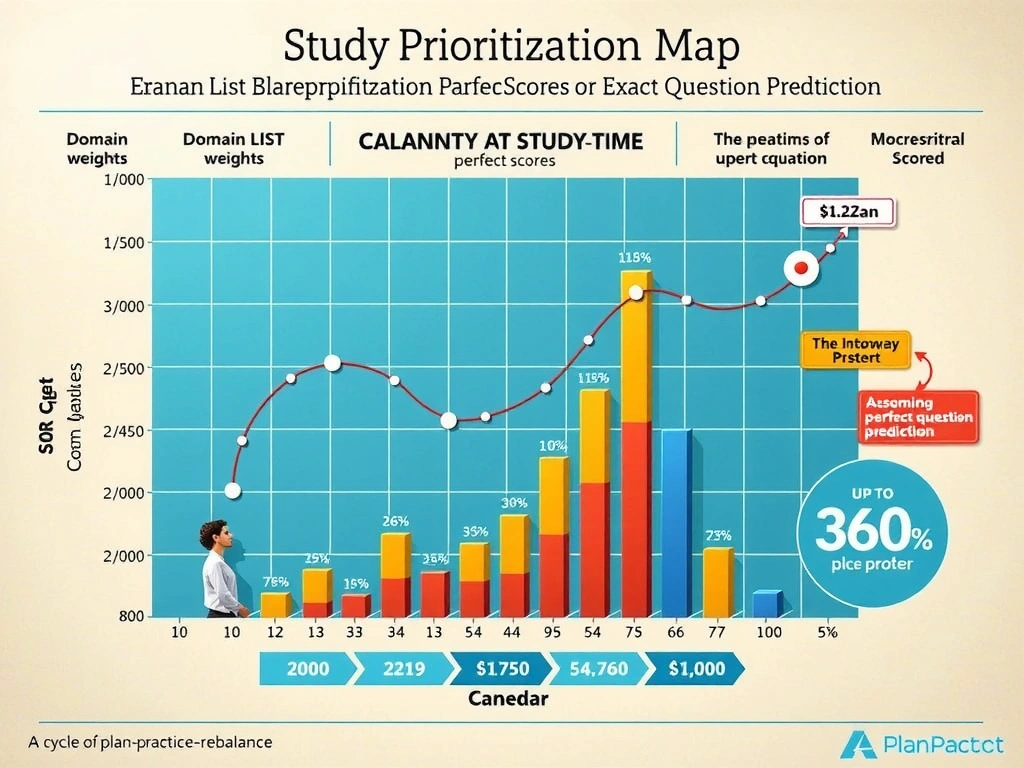
Here's the deal: the exam blueprint is your study map, not a crystal ball. Think of it like a project plan your boss drops on the desk—if security is 30% of the work and a tiny side topic is 5%, you don't spend equal hours on both. You still cover everything, but you allocate time where the score lives. People get burned two ways: they either try to guess exact questions from the outline, or they treat every bullet as equally important and run out of calendar. Neither works. Read the structure, note the weights, build a schedule that matches those priorities, and leave buffer for weak spots. Got it? Sweet. Study smart, not just hard—and you'll stack the odds in your favor on test day.
Full explanation below image
Full Explanation
Certification blueprints exist so candidates can plan deliberate practice rather than study every topic with the same intensity. When an exam publisher publishes domain lists and percentage weights, those figures describe how scoring mass is distributed across knowledge areas. A candidate with limited calendar time should therefore map study hours roughly to those weights: invest more deep practice, flashcards, and lab time in domains that carry larger fractions of the score, while still ensuring minimum competence in lower-weight domains that can still produce several items. This is prioritization under constraint, not a license to ignore material.
Understanding structure also clarifies item formats, time limits, and any hands-on or multi-select patterns so practice exams feel realistic. The correct approach is efficient allocation of effort aligned with how the exam measures mastery. Guaranteeing a perfect score is impossible from blueprint study alone; performance still depends on comprehension, recall under pressure, and application skill. Predicting exact questions confuses domain emphasis with item leakage—weights do not reveal stems, options, or scenarios. Skipping study entirely after reading the outline is self-defeating because structure only organizes effort; it does not install knowledge.
A practical workflow is to convert each domain into a checklist of objectives, estimate hours from the published weight, diagnose weak areas with practice sets, then rebalance the calendar weekly. Track progress with short quizzes per domain so you can see whether time spent is actually closing gaps. Many candidates reverse this logic: they camp on favorite topics and leave high-weight domains thin, then wonder why the score is lower than expected. Others over-index on obscure edge cases that appear once and ignore fundamentals that appear repeatedly. Blueprint study prevents both mistakes by making tradeoffs explicit.
Memory aid: weights answer "how much," objectives answer "what," and practice answers "can I do it under exam conditions." Candidates who treat the blueprint as a resource plan rather than a fortune-telling device typically reduce wasted study on trivia and improve coverage where it counts most for both the job and the exam score. That disciplined mapping of effort to score mass is the core reason understanding structure and weighting matters before you open the books and before you sit for the timed assessment.