
Which approach best reflects a core AI engineering practice for making a model service able to scale with demand?
Select an answer to reveal the explanation.
Short Explanation and Infographic
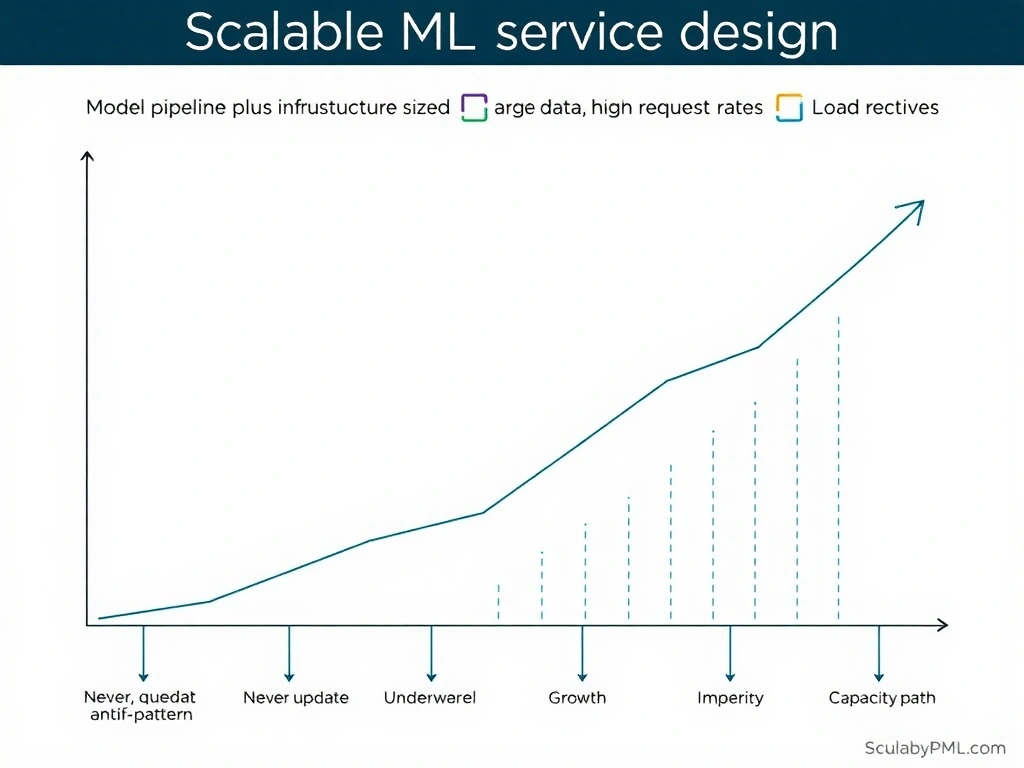
Here's where it gets real for you. Scalability isn't a sticker on a model card — it's how you design the whole path from data to API so growth doesn't melt you. Let me show you how this works in the real world: you plan for big data and busy endpoints up front — batching, replicas, queues, distributed jobs if you need them — instead of hoping one box holds forever. Think of it like building a stadium with expandable seating, not a closet. Your boss says Black Friday traffic is 10x baseline; you either designed for that or you're firefighting. Exam traps love "never update," "use a toy model," or "one machine only." Those miss the point. Design model service plus infrastructure for volume and load. That's the takeaway.
Full explanation below image
Full Explanation
Ensuring model scalability in AI engineering means deliberately designing both the learning or inference pipeline and the surrounding service infrastructure so the system can handle substantial data volumes and concurrent user or application requests without unacceptable degradation. Scalability is therefore a joint concern of algorithm choice and systems design: efficient batching, streaming ingestion, distributed training when needed, model packaging, load-balanced serving, autoscaling, caching, and capacity planning all participate.
A scalable design anticipates growth paths. Training may start on one GPU but should not assume that path is permanent if data grows orders of magnitude. Serving may begin with a single replica but should support horizontal scale-out, health checks, and graceful timeouts. Observability (latency percentiles, error rates, queue depth, GPU utilization) guides when to scale. Cost controls and quotas prevent runaway spend while still meeting SLOs. Documentation of resource profiles and load-test results makes scaling decisions repeatable rather than heroic.
Incorrect options confuse scalability with unrelated or opposite practices. Never updating a model addresses change management or risk aversion, not load capacity; frozen models can still require scaled infrastructure, and quality may drift as data shifts. Selecting an overly simple model that cannot capture complex structure targets bias or underfit, not request throughput or data scale. Permanently confining work to a single machine without expansion options is a classic bottleneck and contradicts the intent of scalability best practices.
Memory aids for exams: scalability answers usually mention large volumes of data and many requests plus infrastructure or system design; answers that lock you to one host, ban updates, or equate scale with tiny models are almost always wrong. In production, pair this mindset with progressive delivery (canaries, shadow traffic), dependency isolation, and clear SLOs so scale-out is safe. The principle is simple but easy to skip early: treat growth as a first-class requirement for both the model path and the platform that runs it, rather than a late-stage emergency rewrite.