
You are scoping a new AI project and must classify the learning paradigm before choosing algorithms. Which condition most clearly indicates that the problem is a supervised learning task?
Select an answer to reveal the explanation.
Short Explanation and Infographic
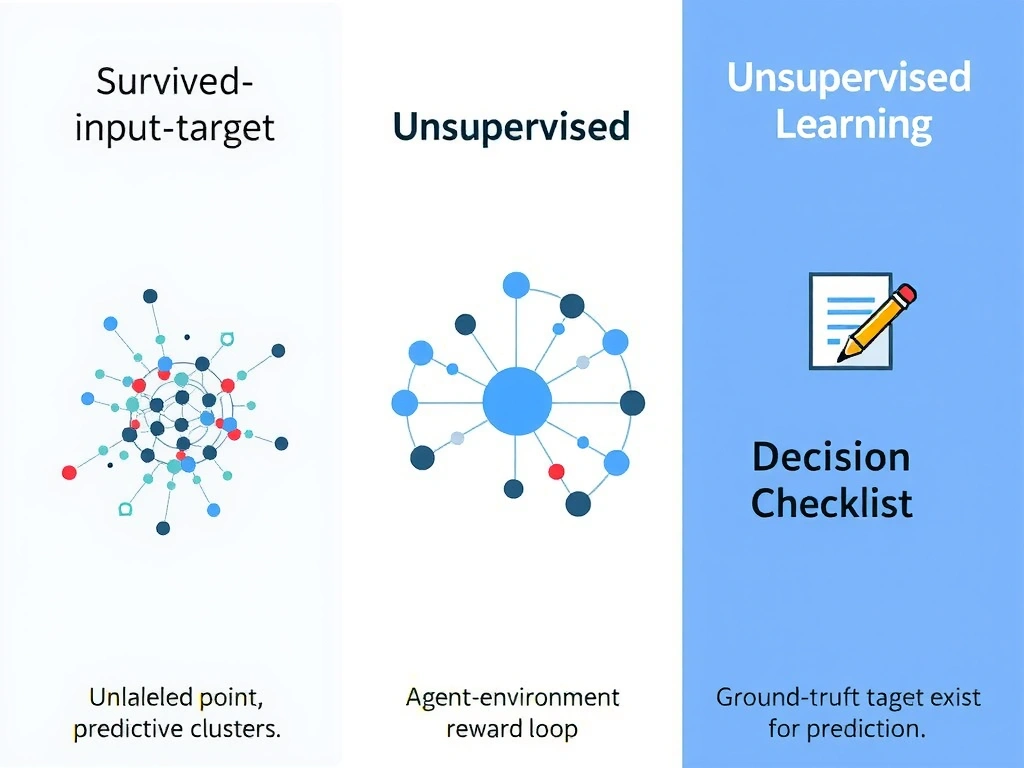
Here's the deal: supervised learning is the "show and tell" version of machine learning. You've got examples where someone already wrote down the right answer—spam or not, fraud or clean, price next month—and your model learns the pattern so it can guess on new stuff. Think of it like studying with an answer key: you see the question and the solution, then you practice until you can nail similar questions on test day. Clustering? That's unsupervised—no answer key, just "find groups." An agent chasing rewards? That's reinforcement learning. And if you truly have zero labels, you can't do classic supervised work. Exam trap: people mix up "we have lots of data" with "we have labeled data." Labels are the tell. Got it? Sweet—when the stem says labeled outcomes to predict, pick supervised.
Full explanation below image
Full Explanation
Supervised learning is the machine learning paradigm in which each training example pairs input features with a known target value, and the model is optimized to predict that target for unseen inputs. Classification (discrete labels such as approved or denied) and regression (continuous targets such as demand or risk score) are the two primary supervised problem types. The defining signal is supervision: ground-truth labels guide loss computation, gradient updates, and evaluation metrics such as accuracy, F1, or mean absolute error.
The correct choice states that historical data includes both inputs and known targets, and the business goal is prediction on new cases. That description matches the supervised setup end to end—training set construction, model fitting, and deployment-time inference. Without labeled targets, standard supervised objectives cannot be computed in the usual way.
Grouping similar points without outcomes is unsupervised learning (for example k-means or hierarchical clustering). Those methods optimize internal structure criteria such as within-cluster variance rather than agreement with a label column. Reward-driven agents that act in an environment and improve from delayed feedback implement reinforcement learning; the feedback channel is a reward signal, not a fixed label for every input. Claiming that no annotations exist describes a label-scarce or fully unlabeled setting better suited to unsupervised, semi-supervised, or self-supervised methods—not textbook supervised learning.
In practice, teams often blur paradigms: a project may start unsupervised for exploration, then become supervised once labels are collected, or use self-supervised pretraining followed by supervised fine-tuning. For exam and design decisions, ask one crisp question: Do we have (or can we obtain) ground-truth targets for enough examples that we will score predictions against those targets? If yes and prediction is the goal, treat it as supervised. Document the label definition carefully—noisy, delayed, or ambiguous labels still count as supervision but degrade quality—and reserve evaluation labels that never leak into training. That single labeled-versus-unlabeled distinction prevents the common mix-up among supervised, unsupervised, and reinforcement learning on certification items and in production scoping workshops.