
After a model is already trained, what is often the most significant ongoing challenge when an engineer runs it in a live production environment?
Select an answer to reveal the explanation.
Short Explanation and Infographic
Training was the mountain climb—production is the weather. Once the model is live, real users and real data change. Features drift, seasons shift, fraudsters adapt, and yesterday's great F1 quietly collapses. That's model/data drift, and handling it while keeping latency sane is the big job. Language choice? Already decided. Offline metrics? Important earlier. Hunting the first dataset? That's pre-train. Exam trap: answering with training-phase chores when the stem says "production." Imagine your boss walks in after a silent accuracy drop—monitoring, alerts, retraining triggers, and canaries save you. Trust me: ship is not the finish line; monitoring is. Keep rolling with drift on your radar.
Full explanation below image
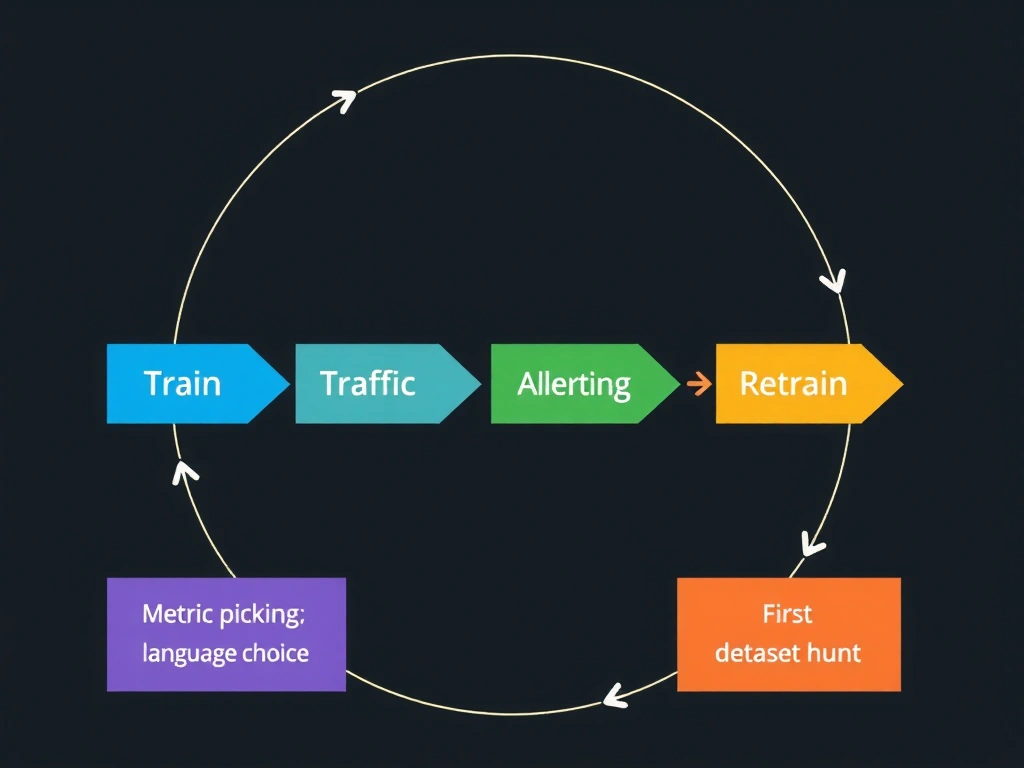
Full Explanation
Deploying a trained model into production introduces a different class of problems than offline experimentation. In live systems, input distributions evolve: user behavior changes, seasonal patterns appear, sensors age, product catalogs update, and adversaries adapt. These shifts—often discussed as data drift or concept drift—can degrade predictive quality even when the serving stack remains healthy. Engineers must therefore monitor online metrics, data quality signals, prediction distributions, and business KPIs; set thresholds and alerts; and maintain pathways for retraining, rollback, and canary or shadow deployments. Concurrently, production systems must satisfy latency, throughput, availability, and cost constraints for real-time or near-real-time inference.
By contrast, several options describe earlier lifecycle stages. Choosing a programming language is typically fixed during implementation and packaging; while interoperability matters, it is not the defining ongoing risk after go-live. Selecting evaluation metrics for offline model comparison is crucial during development and validation, but it does not capture the continuous battle against drift and operational reliability once traffic is live. Acquiring an initial training dataset is a prerequisite to building the model at all, not the primary challenge after deployment.
MLOps practices address production risk with logging of features and predictions, ground-truth delayed labels when available, automated retraining pipelines, model registries, and governance for safe updates. Teams also plan for feedback loops that can bias future data and for partial observability when labels arrive late. A helpful framing is: training optimizes a snapshot; production is a living process. Exam stems that emphasize production environments and long-term performance almost always point to drift, monitoring, and sustained reliability rather than language selection, offline metric choice, or initial data gathering.