
In a semantic segmentation problem, what does the model produce as its primary output?
Select an answer to reveal the explanation.
Short Explanation and Infographic
Picture this: your boss needs the road, sidewalk, and cars painted pixel by pixel on a dash-cam frame. That's semantic segmentation—every pixel gets a category. Not a sticky note on the whole photo, and not just a box around "car." Think of it like coloring in a coloring book where each color is a class. Exam trap: boxes = detection; one label for the whole image = classification; a list of numbers without a mask isn't the segmentation output. Dense pixel labels—that's your answer. Trust me on this; the naming is half the battle on CV exams.
Full explanation below image
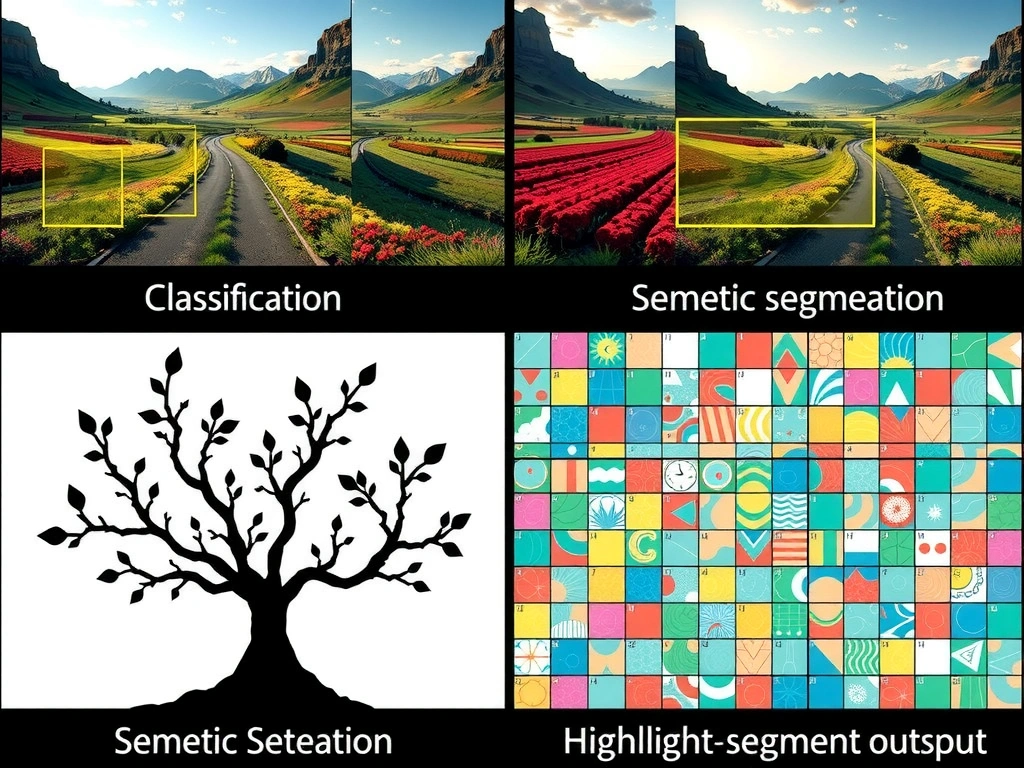
Full Explanation
Semantic segmentation is a dense prediction task in computer vision. Given an input image, the model outputs a spatial map—typically the same height and width as the input or a defined output resolution—where each pixel is assigned a categorical label such as road, sky, person, or background. Architectures often use encoder–decoder designs or specialized fully convolutional networks to recover fine spatial detail while leveraging deep semantic features. Skip connections, atrous convolutions, and multi-scale context modules are common design ingredients, but the defining product remains per-pixel classification across the image rather than a sparse set of object hypotheses.
Bounding boxes around objects describe object detection (and related localization tasks). Detection answers "what objects are present and where, roughly," not "what is every pixel." Instance segmentation further separates individual object instances with masks; semantic segmentation traditionally labels classes without distinguishing two adjacent cars as separate IDs, though exam items often contrast segmentation with boxes and whole-image labels. A list of numbers representing detections or embeddings without a spatial class map is insufficient: segmentation requires the dense label field aligned to the image grid. A single label for the entire image is image classification, which ignores spatial layout of categories inside the frame and cannot support pixel-accurate overlays.
Applications include autonomous driving perception, medical image delineation, satellite land-cover mapping, and photo editing mattes. Evaluation uses metrics such as mean Intersection-over-Union (mIoU) over classes, sometimes alongside pixel accuracy with awareness of class imbalance. Best practices include careful annotation guidelines, class imbalance handling, boundary-aware losses, and multi-scale training or inference. For certification-style questions, map the task names cleanly: classification yields one label; detection yields boxes and scores; semantic segmentation yields a pixel-wise class map. That vocabulary distinction is exactly what this item targets, so prefer the dense map whenever the stem says semantic segmentation.