
What is the primary objective of a generative AI model?
Select an answer to reveal the explanation.
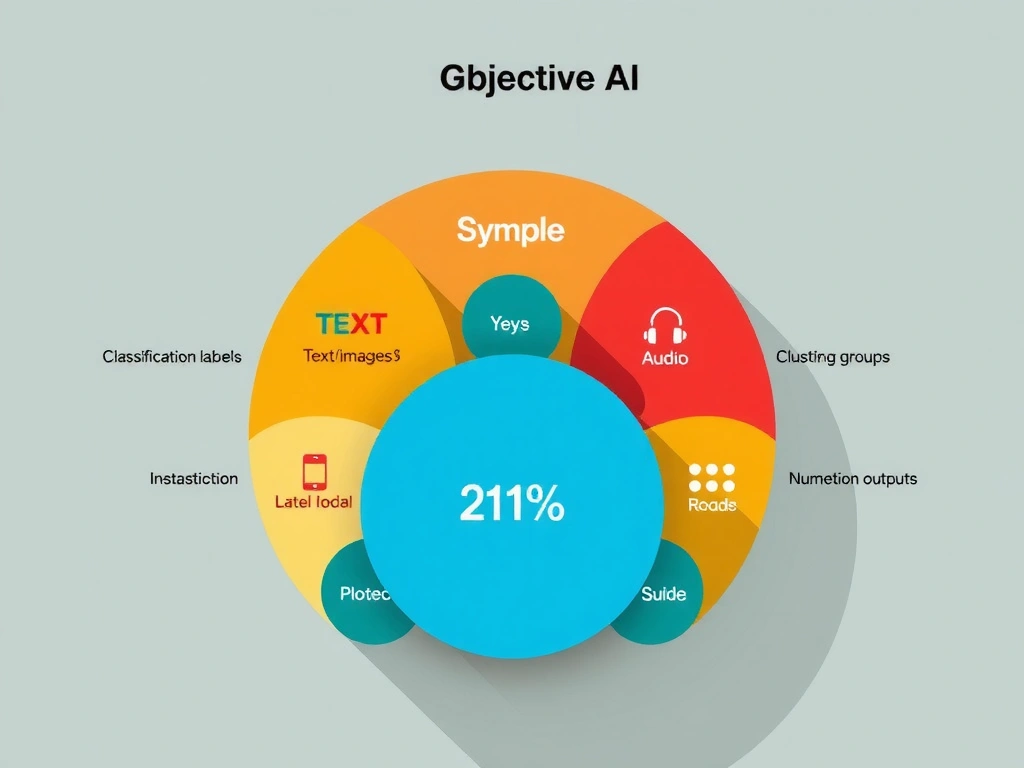
Short Explanation and Infographic
Here's the deal with generative AI: the job is to make new stuff that looks like what it learned—text, images, audio, code—not just slap a label on an existing row. Think of it like a chef who tasted a hundred soups and can invent a new one in the same style, versus a critic who only rates soups. Classification, pure clustering, and regression are different games. Sure, generative systems might use discriminators or embeddings under the hood, but the north star is sampling novel instances from the learned distribution. Boss wants marketing copy variants or synthetic product shots? That's generation. Exam trap: don't pick "find hidden patterns" alone—that's broader unsupervised learning without the create-new-data mandate. Create similar new data—that's the generative goal.
Full explanation below image
Full Explanation
Generative AI models aim to produce new data instances that are plausible under the distribution implied by training examples. Depending on the modality, that may mean sampling coherent text, synthesizing images, generating audio, or creating structured objects. Architecturally this includes GANs, variational autoencoders, autoregressive language models, diffusion models, and related families. The shared objective is not merely to score or partition existing points, but to capture enough structure—explicitly or implicitly—to draw novel samples. That creative synthesis is what product teams mean when they ask for synthetic data, draft content, or design variations at scale.
By contrast, discriminative models focus on decision boundaries: given x, predict label y. Unsupervised clustering seeks structure in x without labels and typically without emitting new full samples as the main product. Regression maps inputs to continuous targets. Generative models can support those tasks indirectly (for example, features from a generative backbone, or likelihood-based anomaly scores), yet the defining mission remains synthesis of new instances. Confusing generation with pure pattern discovery is a common multiple-choice mistake because both may be unsupervised in a broad sense.
In practice, quality is judged by fidelity to the domain, diversity of samples, and controllability via prompts, class conditions, or latent codes. Safety and governance concerns—copyrighted training data, deepfakes, biased outputs—sit on top of that technical goal but do not redefine it. Training often maximizes likelihood, matches adversarial criteria, or denoises toward the data manifold; evaluation uses human preference, distributional metrics, or task-specific benchmarks. Strong systems also need sampling strategies and filters so outputs remain useful and safe in production workflows.
Exam-oriented memory aid: if the success criterion is "create new examples that look real for this domain," you are in generative territory. If the success criterion is "label, cluster, or regress existing inputs," you are not—even when the same neural toolkit appears. Keep that objective clear when comparing model classes on certification questions, and always separate the learning setup from the generation goal itself.