
Why do practitioners insert a dropout layer while training a neural network?
Select an answer to reveal the explanation.
Short Explanation and Infographic
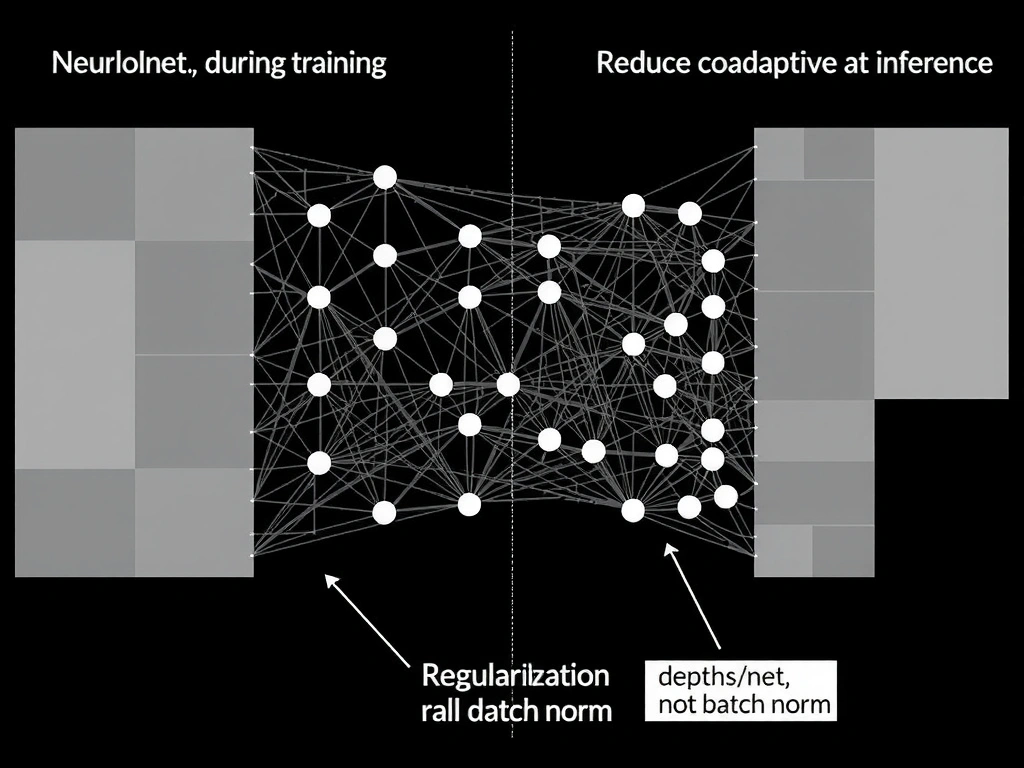
Let's talk dropout—this one bites people who memorize buzzwords without the "why." During training, dropout randomly knocks out neurons for a step. Think of it like forcing a sports team to practice without their star player sometimes: everyone else has to step up, so the whole team gets stronger. That stops co-adaptation and fights overfitting. At inference you usually keep all units and scale, so predictions are stable. Exam trap: dropout is not how you add depth, not your activation function, and not batch norm. Boss walks in worried the model memorizes the training set—dropout is one of the classic knobs you reach for. Got it? Random off-switch in training equals better generalization.
Full explanation below image
Full Explanation
Dropout is a regularization method that randomly deactivates a subset of neurons (or sometimes connections) on each forward pass during training according to a keep probability. Surviving activations are typically scaled so expected magnitudes remain consistent. Because different subnetworks are sampled over steps, the procedure approximates training a large ensemble of thinned networks that share weights. At evaluation time, units are usually left active with deterministic scaling, yielding a single averaged predictor. The intended effect is reduced overfitting: the model cannot depend on brittle co-adapted feature detectors that only appear together in the training set.
This purpose is distinct from architectural expansion. Dropout does not insert new layers or increase depth; it operates on existing units. It is also not a substitute for nonlinear activations. Without ReLU, GELU, sigmoid, or similar functions, stacked linear transforms collapse; dropout’s random masks do not provide that nonlinearity. Likewise, normalization layers such as batch norm, layer norm, or input standardization adjust the distribution of activations or features. Dropout’s mechanism is stochastic masking for regularization, not mean–variance alignment of mini-batch statistics.
Hyperparameters matter. High dropout rates can underfit by destroying too much capacity each step; very low rates may leave overfitting unchecked. Placement often targets dense layers that overfit easily; in convolutional stacks, spatial dropout variants may drop entire feature maps. Modern practice sometimes prefers alternatives or complements—weight decay, data augmentation, early stopping, stochastic depth—but dropout remains a foundational concept on exams and in many production networks.
When answering questions, connect three ideas: (1) random unit deactivation during training, (2) regularization / anti-overfitting goal, and (3) full network used at inference. Reject options that redefine dropout as depth injection, activation nonlinearity, or normalization. That separation keeps the concept clean for both theory and implementation choices.