
What is the primary goal of a sequence-to-sequence (seq2seq) model?
Select an answer to reveal the explanation.
Short Explanation and Infographic
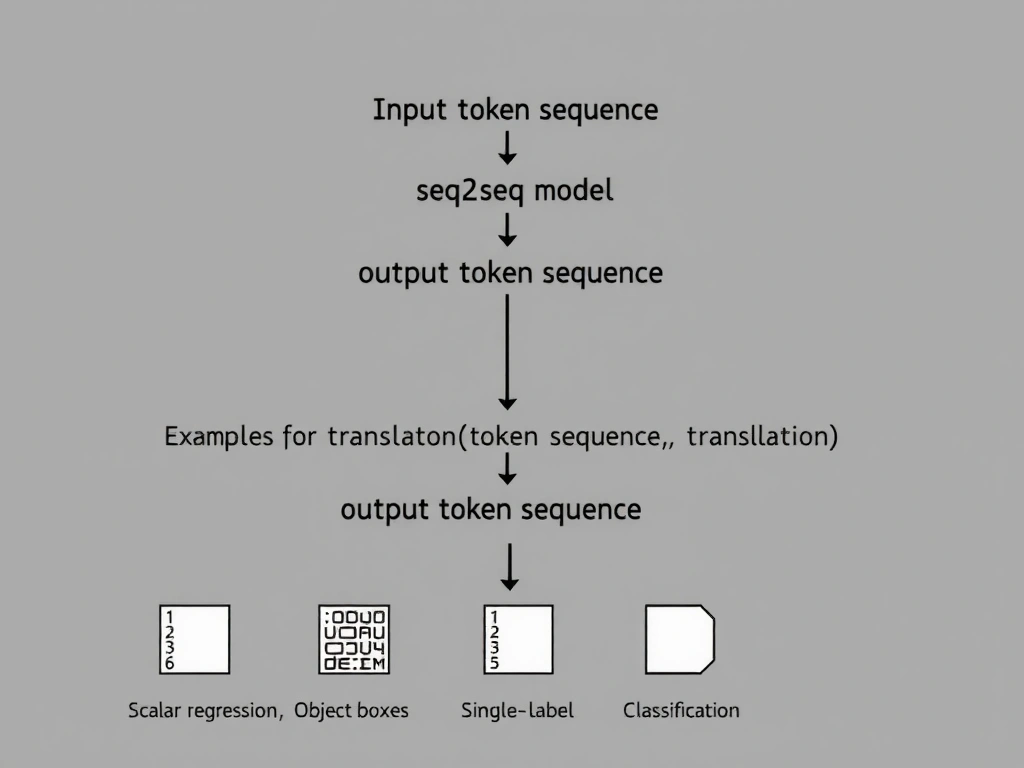
Here's the deal: seq2seq means sequence in, sequence out—possibly different lengths and vocabularies. Translation, summarization, some speech-to-text setups—they all fit. Think of it like converting a playlist of notes into a different arrangement, not stamping one sticker on the whole album. Boss says convert every support ticket into a short summary paragraph: that's seq2seq. Exam trap: folks pick "classify the sequence" because classification is also common in NLP. Land it: if both sides are sequences and you're generating the target, you're in seq2seq land. Nice and clean.
Full explanation below image
Full Explanation
Sequence-to-sequence models learn a mapping from an input sequence to an output sequence. Inputs and outputs may differ in length, vocabulary, and even modality, as in text-to-text translation or speech-to-text recognition. Architecturally this is usually implemented with an encoder-decoder stack: the encoder builds contextual representations of the source, and the decoder generates target tokens autoregressively, conditioned on prior outputs and encoder states. Canonical applications include machine translation, abstractive summarization, and certain dialogue response generators. Evaluation often uses BLEU, ROUGE, or other task-specific metrics rather than simple accuracy alone, because the outputs are structured sequences rather than single labels.
A one-to-one scalar mapping without sequential structure is ordinary regression or a trivial function fit, not sequence-to-sequence modeling. Object detection predicts boxes and classes on images; even when detection models are complex multi-stage systems, they are not defined as transforming one token sequence into another token sequence. Classifying a whole sequence into a single label—spam versus ham, topic labels, or sentiment—is sequence classification. The model may read a sequence as input, but it does not emit a new sequence as the primary output, which is the defining contract of sequence-to-sequence learning.
Modern sequence-to-sequence systems frequently use Transformers with cross-attention, large-scale pretraining, instruction tuning, and specialized decoding strategies such as beam search or nucleus sampling. Older systems used recurrent encoder-decoders, later augmented with attention to avoid a single fixed bottleneck. The examination-level invariant remains the input-output contract: ordered inputs produce ordered outputs of potentially different length. A practical memory aid is that classification stamps one label, detection draws boxes, and sequence-to-sequence rewrites a sequence into another sequence. When a stem emphasizes transforming sequences—especially translation or summarization—choose the sequence-to-sequence purpose statement over single-output or vision distractors.