
In computer vision, what does image segmentation specifically mean?
Select an answer to reveal the explanation.
Short Explanation and Infographic
Image segmentation is pixel-level labeling—every little square on the grid gets a class: road, car, sky, tumor, whatever. Think of it like a coloring book the model fills in automatically. Not "is there one object?" Not "this whole photo is a cat." Not "make me a new picture from a prompt." Those are detection-ish presence checks, classification, and generation. Boss wants a mask for the autonomous car's free space? Segmentation. Exam trap: mixing it with detection because both talk about objects—detection boxes, segmentation paints. Land the takeaway: segmentation = label each pixel to map regions.
Full explanation below image
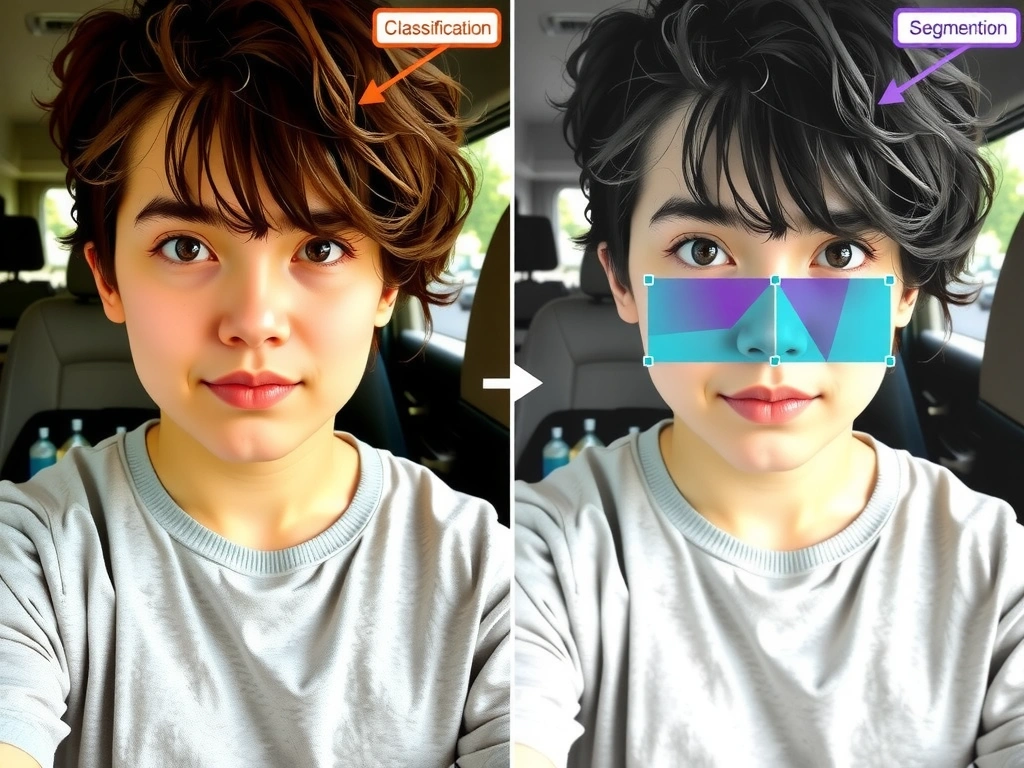
Full Explanation
Image segmentation is the computer vision task of partitioning an image into meaningful regions by predicting a label (or a set of instance IDs) for each pixel. Semantic segmentation assigns class IDs without distinguishing two cars as separate instances; instance segmentation separates object instances; panoptic segmentation unifies both into a single coherent scene parse. Outputs are typically full-resolution masks used for autonomous driving free-space estimation, medical lesion delineation, satellite land-cover mapping, industrial defect inspection, and photo editing mattes where soft edges matter.
Detecting a single object’s presence does not require dense labels and may be solved with binary classification or a detector that returns one box—useful for alerts, but insufficient when area, shape, or boundary precision drives the decision. Whole-image classification emits one global category and discards spatial structure entirely, so two images with the same class can have completely different layouts. Text-to-image or other generative models synthesize new pixel values from latent noise and conditioning signals; they answer a different question ("create") than segmentation ("partition what is already there"). Confusing generation with segmentation is a common exam trap because both involve pixels, yet only one analyzes an existing image into regions.
Models often use encoder–decoder designs with skip connections (U-Net family), DeepLab-style atrous convolutions for multi-scale context, or transformer-based segmentation heads on patch tokens. Training uses pixel-wise cross-entropy, Dice loss, or focal variants to handle severe class imbalance (tiny lesions on large backgrounds). Evaluation relies on mean IoU, Dice, pixel accuracy (with caution), and boundary-aware metrics. Memory aid: "Segmentation colors every pixel; classification stamps the whole photo; detection draws boxes; generation invents pixels." When a definition question asks what image segmentation is, choose per-pixel labeling of objects or regions.