
In deep learning frameworks, what does the term tensor most accurately refer to?
Select an answer to reveal the explanation.
Short Explanation and Infographic
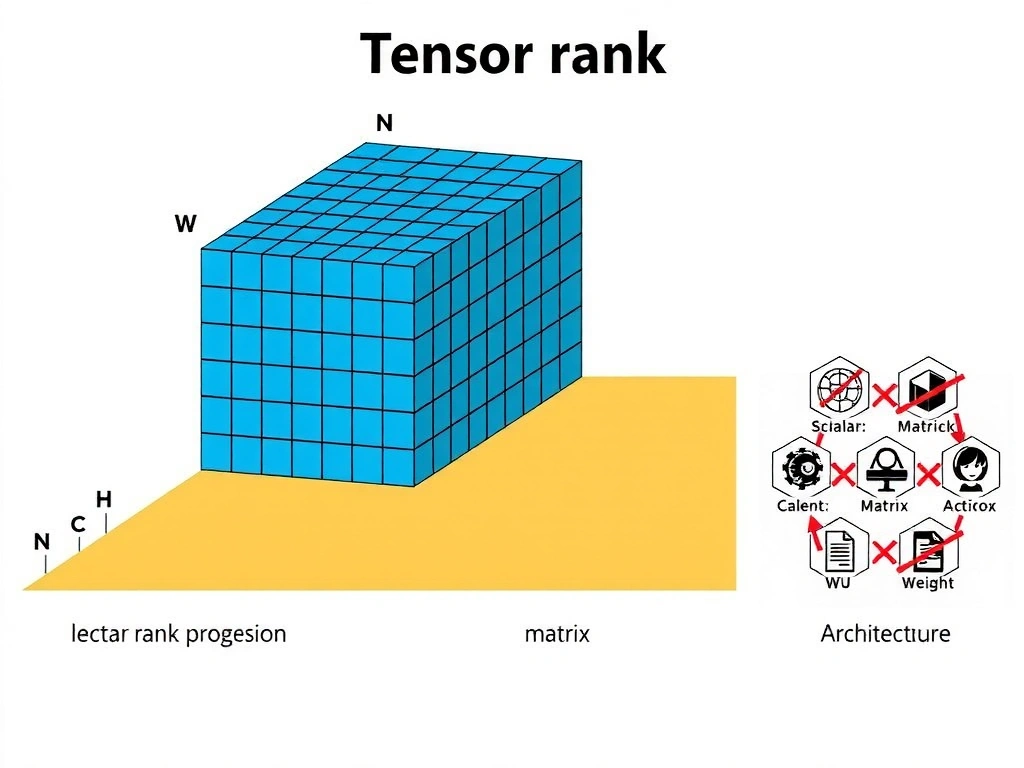
Let's keep this simple. A tensor is just a multi-axis box of numbers—scalar is 0-D, vector 1-D, matrix 2-D, and higher ranks hold batches, channels, sequence length, you name it. Your whole training loop shuffles tensors around. It's not "the answer of one neuron," not the learning rate, and not a network type like "tensor net." Imagine a warehouse pallet: the pallet layout is the tensor shape; the goods are the values. Exam trap: people overthink the physics definition—on this exam, think array with shape. Land it: tensor = multidimensional array for DL data and weights.
Full explanation below image
Full Explanation
In machine learning engineering, a tensor is the fundamental multi-dimensional array used to represent batches of inputs, intermediate activations, model parameters, and gradients. Rank (number of axes) and shape describe how data is laid out: a grayscale image batch might be shaped (N, H, W), an RGB batch (N, C, H, W), and token embeddings (N, sequence_length, embedding_dim). Frameworks such as PyTorch and TensorFlow provide tensor operations—matmul, convolution, reduction, broadcasting, indexing—that run efficiently on CPUs, GPUs, and accelerators while tracking autograd information when needed for backpropagation.
Equating a tensor solely with one neuron's output is too narrow. That output may be stored as a tensor of shape (), or as one element in a larger activation tensor for a whole layer and batch. The learning rate is a scalar hyperparameter controlling step size; calling it a tensor confuses training configuration with data representation (even if you wrap it as a 0-D tensor in code, conceptually it is not "what a tensor means" in deep learning parlance). A tensor is also not an architecture: residual networks, transformers, and MLPs all consume and produce tensors, but the architecture is the computational graph of layers and connections, not the array type that flows through that graph.
Practically, practitioners reason about dtype (float16, bfloat16, float32, int64 for indices), device placement, and contiguous memory layouts because those choices affect speed, memory footprint, and numerical stability. Shape bugs—misaligned batch dimensions, channel-last versus channel-first conventions, forgotten squeeze or unsqueeze operations—are among the most common implementation errors during model integration. Debugging often starts by printing tensor.shape after each major block. Memory aid: "If it has a shape in the framework, it's a tensor." When asked what a tensor is in deep learning, answer with multidimensional array for data and computation, not a single neuron, not the learning rate, and not a network class.