
A studio wants a model that predicts the next frame in a video given preceding frames. Which architecture family is the most appropriate starting point?
Select an answer to reveal the explanation.
Short Explanation and Infographic
Next frame in a video? You're forecasting time. That means sequence machinery—RNNs/LSTMs historically, transformers more and more—usually with CNN bits for the spatial stuff inside each frame. Pure “classify this still photo” CNNs miss motion. A random GAN that just paints pretty pictures isn't conditioned next-frame prediction. And a plain feedforward net with no memory? It'll blank on dynamics. Boss wants predictive video buffers for compression or simulation—think temporal models. Trap: picking CNN because “video is images.” Images plus time. Land it: RNN or transformer-style sequence models for next-frame tasks.
Full explanation below image
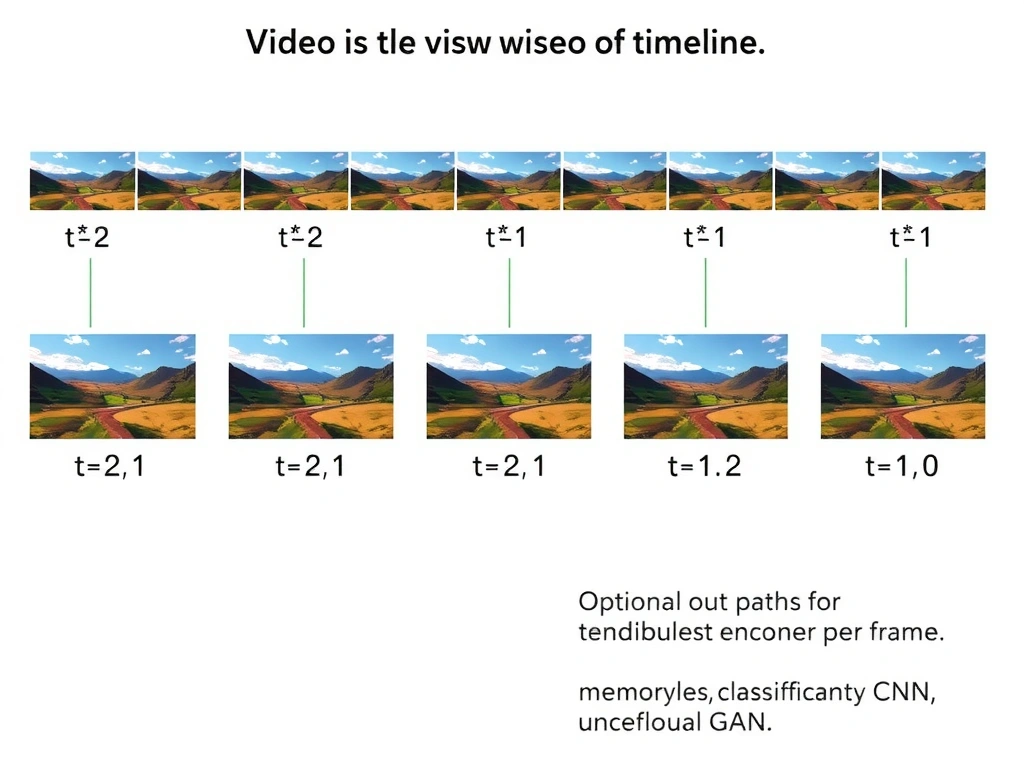
Full Explanation
Predicting the next frame is a spatio-temporal forecasting problem. The model must capture how visual content evolves: object motion, lighting changes, camera movement, and scene dynamics. Architectures that maintain or attend over temporal context are therefore the natural fit. Recurrent networks (including LSTMs and GRUs) process frame-level features step by step, carrying a state that summarizes the past. Transformers model temporal (and sometimes spatial) dependencies with self-attention over tokens or patches extracted from recent frames. In practice, hybrid designs are common: CNN or vision-transformer encoders produce spatial embeddings per frame, and a temporal RNN/transformer head predicts future embeddings or pixels. The exam-correct category is that temporal sequence family—not a memoryless still-image classifier.
A shallow feedforward network without temporal state treats inputs as isolated, so it cannot systematically leverage ordered history or motion continuity across the video. Generative adversarial networks can be components in video generation systems, but an unconditional image GAN that ignores prior frames is not the right conceptual answer for conditioned next-frame prediction; without conditioning on the past, there is no “next” relative to a given sequence. Likewise, a CNN used only for single-image classification solves a different task—labeling a still—although convolutional feature extractors frequently sit inside larger predictive video models as spatial front ends rather than as the complete solution.
Training often minimizes pixel-wise or perceptual losses between predicted and true future frames, sometimes with adversarial or optical-flow-based refinements to sharpen motion. Evaluation may include PSNR, SSIM, FVD, or task-specific metrics tied to downstream uses such as compression, anomaly detection, or simulation. Engineers also watch error accumulation when rolling predictions multiple steps into the future. For certification-style questions, map “next frame in a sequence” to recurrent or transformer sequence modeling (with optional spatial encoders), not standalone classification CNNs, memoryless feedforward nets, or unconditioned image GANs. Cue: time-ordered frames imply a sequence model first.