
In model development, what are grid search and random search primarily used for?
Select an answer to reveal the explanation.
Short Explanation and Infographic
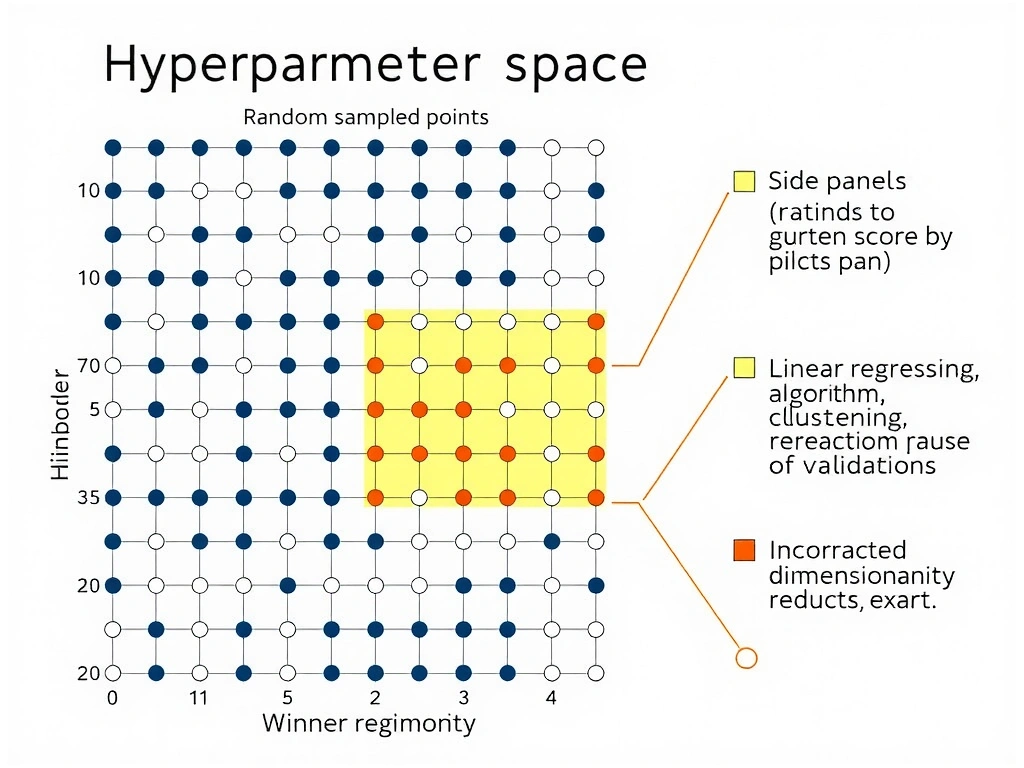
Check this out. Your model has knobs—learning rate, tree depth, regularization strength—and guessing them is a bad career move. Grid search tries every combo on a menu you define; random search sprinkles trials across the space and often finds good settings with less waste. Think of tuning a guitar: grid is checking every fret combination on a chart; random is trying smart scattered guesses until it sings. Boss wants a better F1 by Monday without hand-tweaking all night—this is how teams systematize it. Exam trap: these are not “the regression algorithm,” not clustering, not PCA. Land it: grid/random search = hyperparameter hunting with validation scores. Got it? Sweet. Nest the search inside solid cross-validation so you don't fool yourself.
Full explanation below image
Full Explanation
Hyperparameters are configuration choices set outside the core parameter-fitting loop—examples include maximum tree depth, number of estimators, regularization strength C, learning rate, and kernel width. Model quality can be highly sensitive to these choices, so practitioners treat hyperparameter selection as an explicit search problem rather than a one-shot guess. Grid search evaluates a Cartesian product of discrete candidate values supplied by the practitioner, scoring each combination with held-out validation or cross-validation. Random search draws configurations from specified distributions or ranges and can explore important dimensions more efficiently when only a few hyperparameters dominate performance, often finding competitive settings with fewer total trials than a huge dense grid.
Thus the primary purpose of both methods is hyperparameter optimization and model-selection support: train a candidate under each configuration, measure validation performance, and retain the best settings, sometimes refitting on a larger training set afterward. They are not themselves ordinary least-squares linear regression algorithms, even though you can use them to tune a linear model’s regularization. They are not clustering algorithms for grouping unlabeled observations. They are not dimensionality-reduction methods, although you might include the number of principal components inside a search space if PCA is part of a pipeline.
Related modern approaches include Bayesian optimization, successive-halving and Hyperband-style early stopping of weak trials, and population-based training. Certification exams still emphasize the classic contrast: grid is exhaustive over a mesh you define; random samples the space. Common pitfalls include tuning on the final test set and leaking optimistic metrics, defining an impractically large grid that wastes compute, and ignoring interactions among hyperparameters. Best practice uses nested or carefully structured cross-validation, search spaces grounded in experience, reproducible logging of every trial, and a clear distinction between training parameters and evaluation protocols.
Memory aid: grid means systematic mesh; random means sample the space; both answer which knobs work best under validation. If an option describes fitting coefficients as the algorithm definition, grouping unlabeled points, or compressing features as the defining purpose, it misses the role of grid and random search in the modeling workflow.