
Which description correctly defines model overfitting?
Select an answer to reveal the explanation.
Short Explanation and Infographic
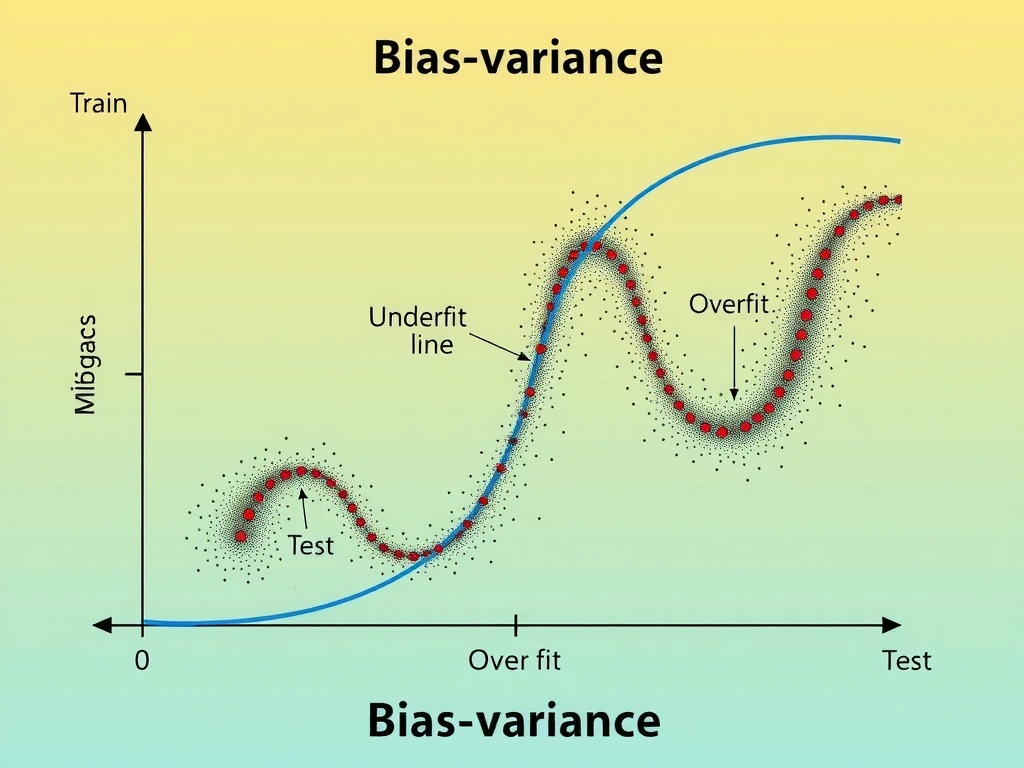
Overfitting is the classic aces-the-homework, bombs-the-real-exam problem. Your model memorizes training quirks — noise, weird outliers, one-off patterns — so training metrics look amazing and then unseen data falls apart. Think of it like studying only last year's exact quiz questions: perfect score on those, lost on a new quiz. Underfitting is the other side — too simple, misses the real trend entirely. Not finding a loss minimum? That's an optimization headache, not the definition of overfit. Exam trap: options that sound like good generalization or underfitting. You want the train-good / test-bad story. Regularize, simplify, get more data, early-stop — but first, name the disease right.
Full explanation below image
Full Explanation
Overfitting occurs when a model captures idiosyncrasies of the training sample—including noise—so thoroughly that its decision surface fails to represent the broader data-generating process. Empirically this appears as a large gap between strong training metrics and weaker validation or test metrics. High-capacity models such as deep nets, high-degree polynomials, and unpruned trees are especially prone when data are limited or features are noisy.
Underfitting is the complementary failure mode: the hypothesis class or training procedure is too constrained to represent the underlying signal, so both training and test performance remain poor. Confusing the two is a frequent exam error. Separately, optimization difficulties—such as poor initialization, pathological learning rates, or non-convergence—may prevent low training loss, but that is not the definition of overfitting; an overfit model typically drives training error very low.
Mitigations include collecting more representative data, reducing capacity, applying regularization such as L1, L2, dropout, or weight decay, early stopping on a validation curve, data augmentation, and cross-validation for honest model selection. Learning curves that plot train versus validation error help diagnose the regime: a wide, persistent gap signals overfit; both errors high and close often signal underfit. For certification items, select the statement that pairs excellent training performance with poor performance on unseen data. That operational definition is more reliable than vague talk about global minima or generalizing well, which point elsewhere.
In short, overfitting is a generalization failure after a successful fit to the training sample, not a failure to optimize training loss and not a synonym for good deployment performance. Keeping that contrast clear separates overfitting from underfitting and from pure optimization bugs. On the exam, if train looks great and test looks poor, choose overfitting every time.