
A retail analytics team is using K-means to group shoppers for a loyalty campaign. Which statement best captures a primary limitation of this algorithm?
Select an answer to reveal the explanation.
Short Explanation and Infographic
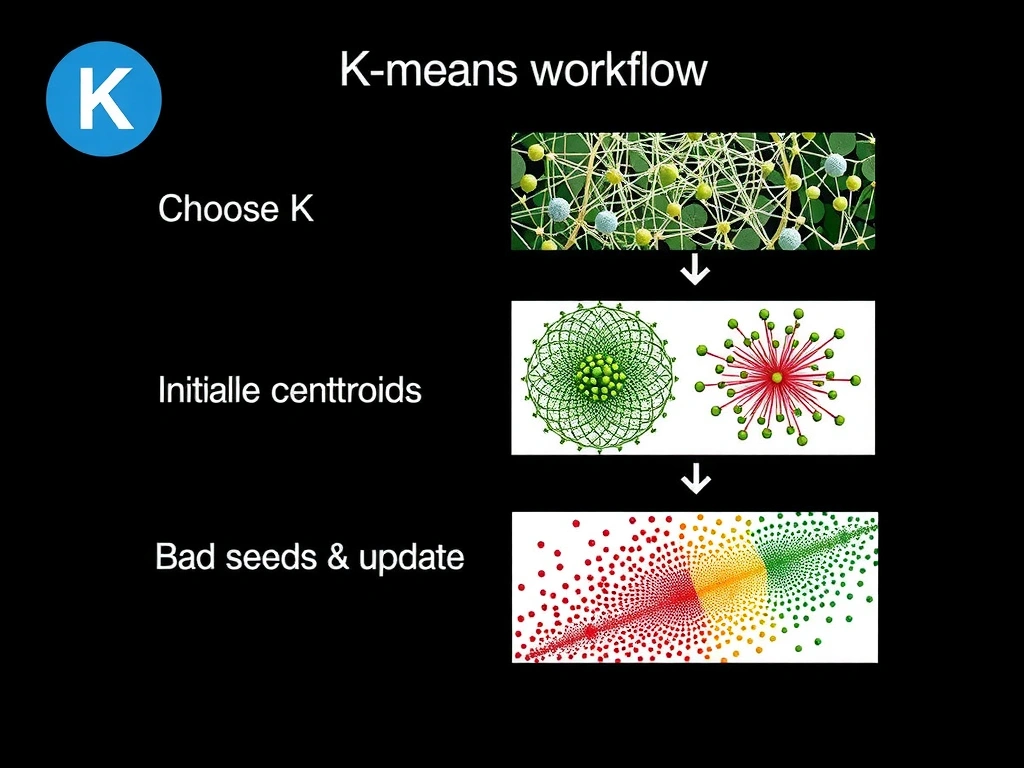
Here's the deal with K-means. You tell it how many groups you want—K—before it ever sees a point, and those first random centroid guesses matter more than people think. Bad starts, weird K, and you get junk segments that look fine until marketing acts on them. Think of it like seating people at K tables before you know the room: pick the wrong number or drop the tables in the wrong spots and the party never settles. Trap: folks say it needs labels, only works on images, or is always slower than deep nets. Nope. Remember—prechoose K, watch initialization, maybe run k-means++ and elbow or silhouette checks. Trust me on this.
Full explanation below image
Full Explanation
K-means partitions observations into K groups by alternating assignment of points to the nearest centroid and updating each centroid as the mean of its assigned points until assignments stabilize. Because K is an external hyperparameter, the algorithm cannot discover the right number of clusters by itself. Practitioners must supply K using domain knowledge or selection procedures such as the elbow method, silhouette scores, gap statistics, or stability analysis across repeated runs. A second structural issue is sensitivity to initialization. The objective is non-convex, so different starting centroids can lead to different local minima with very different business interpretations for a loyalty campaign. Standard mitigations include multiple random restarts, smarter seeding such as k-means plus plus, and careful scaling of features so Euclidean distance remains meaningful across dimensions with different units.
The distractors reflect common misconceptions that appear on exams and in hallway conversations. K-means is not restricted to image data. It operates on any feature space where a distance, classically Euclidean distance, is defined, including customer demographics, transaction aggregates, and behavioral metrics. Claiming it is always more expensive than deep network training reverses typical practice. For many segmentation tasks K-means is a lightweight baseline that trains far faster than large neural models on the same hardware. Finally, requiring labeled examples confuses unsupervised clustering with supervised classification. K-means never sees class labels during fitting. Labels, if available later, are used only for validation, naming segments, or profiling the discovered clusters for marketing copy.
Additional practical caveats include an assumption of roughly spherical, similarly sized clusters in Euclidean space, vulnerability to outliers that pull means away from dense regions, and the need to encode or transform categorical variables carefully before distance computation. When those assumptions fail, alternatives such as Gaussian mixture models, density-based methods like DBSCAN, hierarchical clustering, or deep embedding clustering may fit better. For exam and production readiness, lock in this limitation pair. K is user-specified, and centroid starts can change the outcome, so validate K and initialization strategy rather than trusting a single run inertia score as if it were ground truth about your customers.