
In an NLP preprocessing pipeline, raw text must be broken into discrete pieces the model can index or embed. What does tokenization accomplish?
Select an answer to reveal the explanation.
Short Explanation
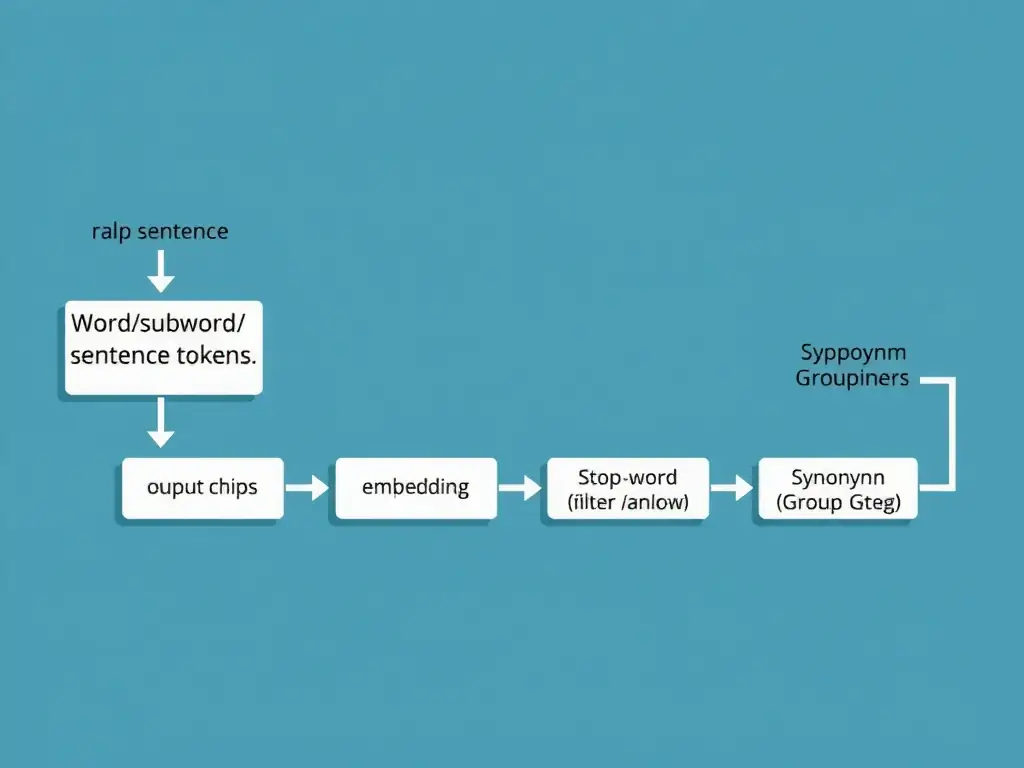
Here's the deal. Before any fancy transformer does its magic, you've got a blob of text—and models don't nibble paragraphs whole. Tokenization chops that string into pieces: words, subwords like “token” + “ization,” characters, or even sentences depending on the scheme. Think of it like slicing a loaf so each slice can get buttered (embedded). Exam trap: mixing tokenization with stop-word removal or with “group synonyms.” Those are different kitchen stations. Another wrong turn is thinking it's about digital templates for printing. Nope. You tokenize first so everything downstream—vocab IDs, attention, NER—has clean units to work with. Pay close attention: if the answer says divide text into smaller units, that's your winner. Got it? Sweet.
Full Explanation
Tokenization is the foundational segmentation step in natural language processing. It converts a continuous character stream into a sequence of tokens. Classic whitespace or rule-based tokenizers produce word-like units; modern neural NLP frequently uses subword schemes (BPE, WordPiece, SentencePiece) that balance vocabulary size with rare-word coverage; sentence tokenizers split documents into sentence spans for tasks like translation or summarization preprocessing.
Why it matters: nearly every subsequent stage—vocabulary mapping, embedding lookup, sequence modeling, alignment for labeling—assumes a token sequence. Bad tokenization can shatter multiword expressions, mishandle punctuation, or explode sequence length, hurting both accuracy and cost. In multilingual and code-mixed settings, tokenization choices strongly affect model quality. Production systems therefore version tokenizers with models so train and serve pipelines stay aligned.
The incorrect options describe neighboring but distinct operations. Grouping similar meanings is closer to synonymy, clustering, or embedding-space analysis. Removing stop words is optional filtering after (or sometimes integrated with) tokenization and is not the definition of tokenization itself. Converting text into a digital print template confuses document layout with linguistic segmentation. Those steps may appear nearby in a pipeline, but none define tokenization.
Underlying principle: models operate on discrete units; tokenization defines those units. Best practice documents the tokenizer scheme, measures sequence-length impact on cost, and evaluates rare-word handling on real traffic. Memory aid: tokenize means cut text into units; normalize or filter means clean those units; embed means turn units into vectors. On exam items, prefer the definition that centers splitting text into smaller processable pieces. In practice, document the decision criteria you used so teammates can reproduce the evaluation. Prefer metrics and checks that match the business risk, not vanity scores. When reviewing distractors on an exam item, name the misconception each option encodes: wrong learning paradigm, wrong evaluation stage, or a metric that optimizes the wrong objective. A reliable memory aid is to restate the concept in one sentence, then ask which option alone matches that definition without adding unrelated goals. Finally, connect the idea to a production workflow step—data prep, training, validation, or monitoring—so the correct answer stays grounded in how systems are actually built and governed.