
What is the primary application of reinforcement learning from human feedback (RLHF) in modern AI systems?
Select an answer to reveal the explanation.
Short Explanation and Infographic
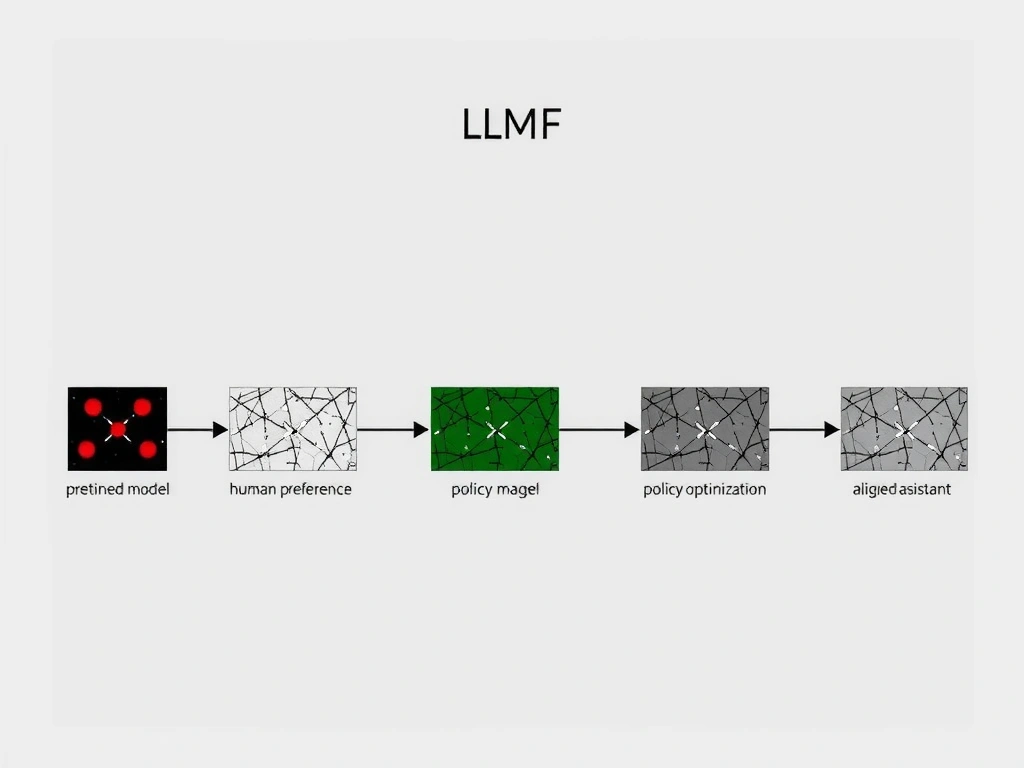
Here's the deal: after you pretrain a big language model, it can still ramble, sass, or say things you would never ship. RLHF is how teams pull it back toward “what humans actually prefer.” Think of it like a coach ranking two answers and teaching the model to chase the better one. Pay close attention—exam writers love distractors about robots, pretty pictures, or plain classification. Those can use other ML, but RLHF’s marquee win is aligning chat models with human values and prefs. When your boss says “make it helpful and safe without rewriting the whole pretrain,” RLHF (or close cousins) is the playbook. Land the takeaway: preferences in, better-aligned LLM out.
Full explanation below image
Full Explanation
Reinforcement learning from human feedback (RLHF) is a fine-tuning paradigm widely used for large language models. After unsupervised or self-supervised pretraining, a model is further trained so that generations better match human judgments of quality, style, and safety. Typically, humans compare candidate completions; those comparisons train a reward model; a policy optimization step (for example PPO or related methods) then updates the language model to increase expected reward while remaining close to a reference policy to limit drift and collapse.
The primary, exam-relevant application is alignment of major language models with human preferences and values—improving helpfulness, reducing harmful content, and following instructions more reliably. Although reinforcement learning more broadly powers robotics and control, that is not what “RLHF” denotes in the generative-AI literature. Photorealistic image and video synthesis is dominated by generative models such as diffusion, not by RLHF as the defining technique. High-accuracy image classification remains a supervised learning problem with categorical labels.
Related ideas include constitutional AI, direct preference optimization (DPO), and other preference-tuning methods that may reduce or replace the explicit RL loop while still targeting human preference alignment. Practical pipelines also invest heavily in preference data quality, red-teaming, and evaluation suites that go beyond the reward model itself.
Underlying principle: pretraining teaches broad prediction; preference optimization steers behavior toward human-endorsed outputs. Best practice separates capability training from alignment tuning, monitors reward hacking, and validates with human and automated safety evaluations. Memory aid: for the exam, associate RLHF with preference-driven LLM alignment rather than with any use of rewards in robotics or with purely generative image pipelines. Preferences in, better-aligned language model out.