
A compliance team asks you to document how a credit-scoring model reached a denial decision so auditors can review the reasoning. Which AI ethics concept describes a system's ability to provide clear, human-understandable reasons for its outputs?
Select an answer to reveal the explanation.
Short Explanation and Infographic
Okay, let's dive in. Your boss walks in and says, "Legal needs to know why the model said no on this loan — today." That's explainability. Think of it like a junior engineer who doesn't just ship a config change — they also leave a note: "I blocked this rule because it violated policy X." The system should be able to do the same for its outputs. Exam trap: people mix this up with full automation (no human needed), learning from errors, or reading emotions. None of those answer the auditor's question. If you can't justify the decision in plain language, you've got a black box — and that fails ethics, compliance, and the test. Remember: explainability = clear reasons for the decision.
Full explanation below image
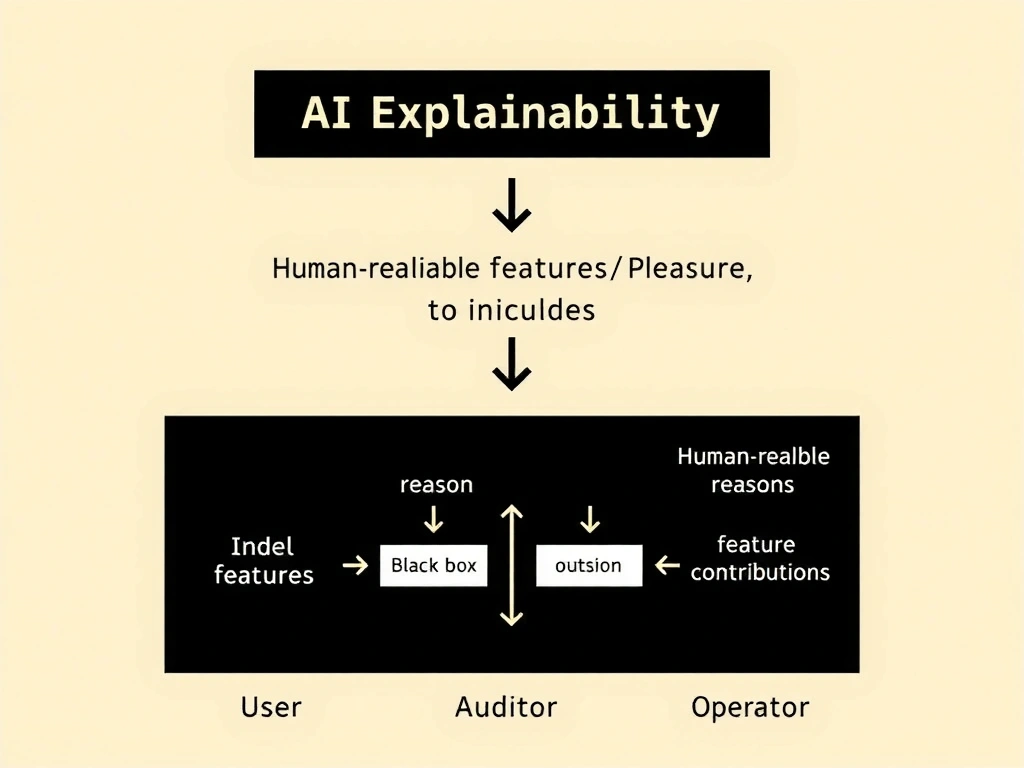
Full Explanation
Explainability in AI ethics is the property that allows stakeholders—users, regulators, auditors, and operators—to understand the reasons behind a model's prediction or action. In high-stakes settings such as lending, healthcare, and hiring, simply reporting an outcome is insufficient; organizations must often document which features, rules, or intermediate signals drove the result and present that story in human-comprehensible form.
The correct option captures this definition: the system can justify its decisions with transparent, interpretable reasons. Techniques that support explainability include inherently interpretable models (linear models, decision trees), post-hoc methods (feature attributions, counterfactuals, local surrogates), and process documentation (model cards, data lineage). The goal is accountability and trust, not merely higher accuracy.
Autonomy is a common distractor because many AI systems are automated, but automation answers "who runs it," not "why did it decide that." A fully automated black box can still be opaque. Adaptivity confuses learning dynamics with communication of rationale; a model that retrains after mistakes may still offer no usable explanation of a single denial. Affective computing addresses emotion sensing and response and is orthogonal to decision justification.
In practice, teams often pair performance metrics with explainability requirements in model risk management: document intended use, known limitations, and how local or global explanations will be generated and reviewed. Underlying principle: explainability is about human-understandable reasons for outputs, not automation level or emotion sensing. Best practice pairs model performance with faithful local or global explanations and stakeholder review. Memory aid: if a regulator asks why this outcome and you can answer with evidence, you are addressing explainability; if you only say the model is accurate and runs by itself, you are not.