
A school-district integration reads a Cisco API that uses limit and offset query parameters. After receiving the first full page, how is the next request constructed?
Select an answer to reveal the explanation.
Short Explanation
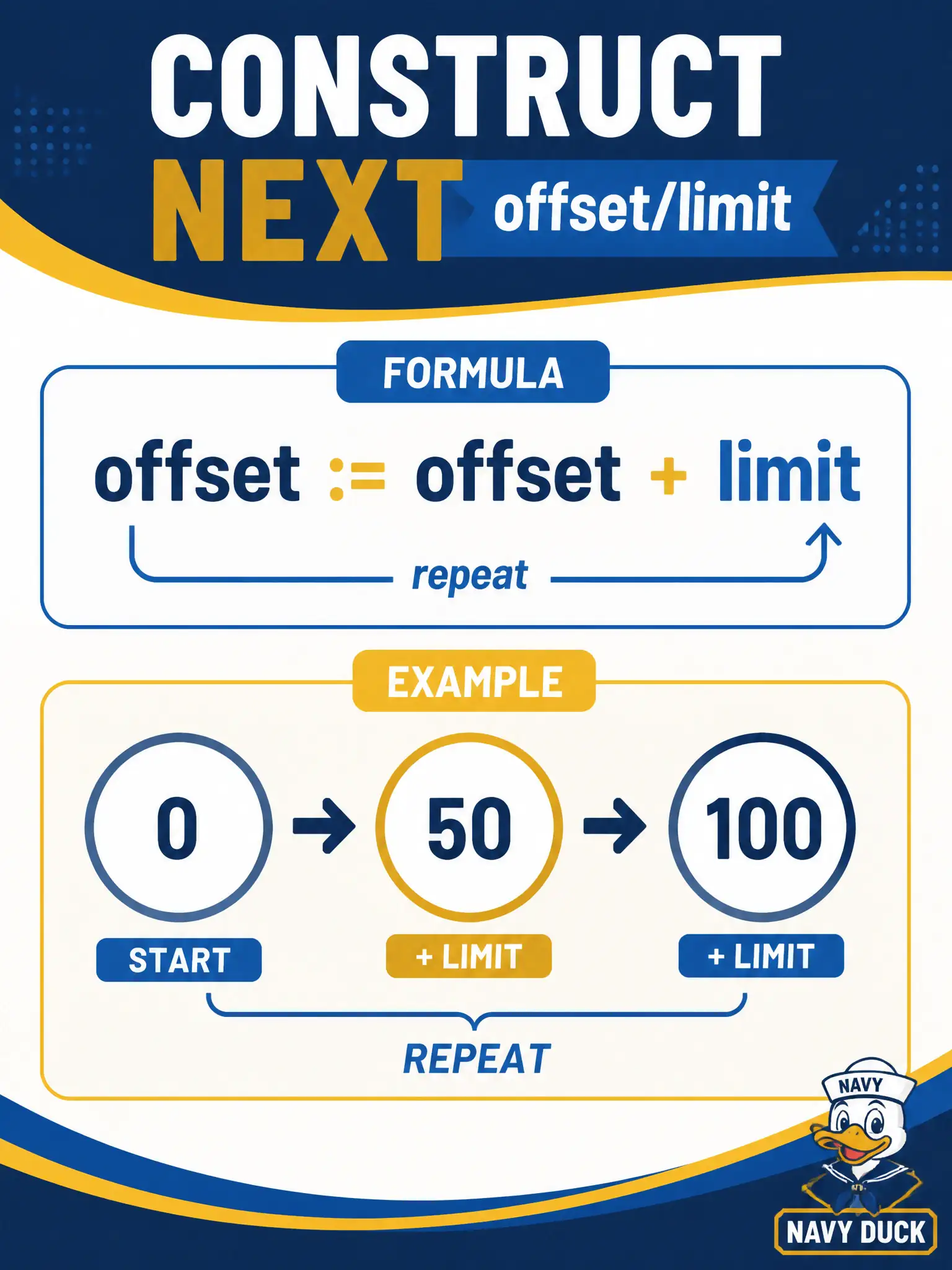
After reading seats 1–50 in the auditorium, the next block starts at seat 51—not seat 1 again. Bump offset by the page size and call again; stopping after the first window leaves rows unread.
Full Explanation
Offset/limit pagination advances the window arithmetically. After a school-district integration receives the first full page from a Cisco API that uses limit and offset, the next request adds the prior page size to offset and requests again with the same limit until the collection is exhausted (typically signaled by a short or empty page). That walks the entire municipal dataset without skipping or permanently overlapping windows when the API is stable.
Repeating the same offset forever so the platform eventually rotates newer rows into view fails: you re-read the same slice and never advance. Omitting limit and offset on the second call and relying on cookies for pagination state fails when the API is stateless query pagination—cookies are not the contract. Hard-coding offset=1000 because most Cisco collections never exceed that window fails for larger estates and skips everything before that offset if used incorrectly as a first hop.
Exam caveat: concurrent inserts/deletes can shift offset windows; some APIs prefer cursors for that reason—still use offset+=limit when that is the documented mechanism. Keep limit constant unless the API documents otherwise.
Operational check: log each (offset,limit) pair, confirm offsets advance by page size, and stop when a response returns fewer than limit items, with no duplicate-only loops on a fixed offset.