
The municipal transit team wants to hand operations a rebuildable DNA Center health exporter for the weekend change window. Which statement best describes a proper release package?
Select an answer to reveal the explanation.
Short Explanation
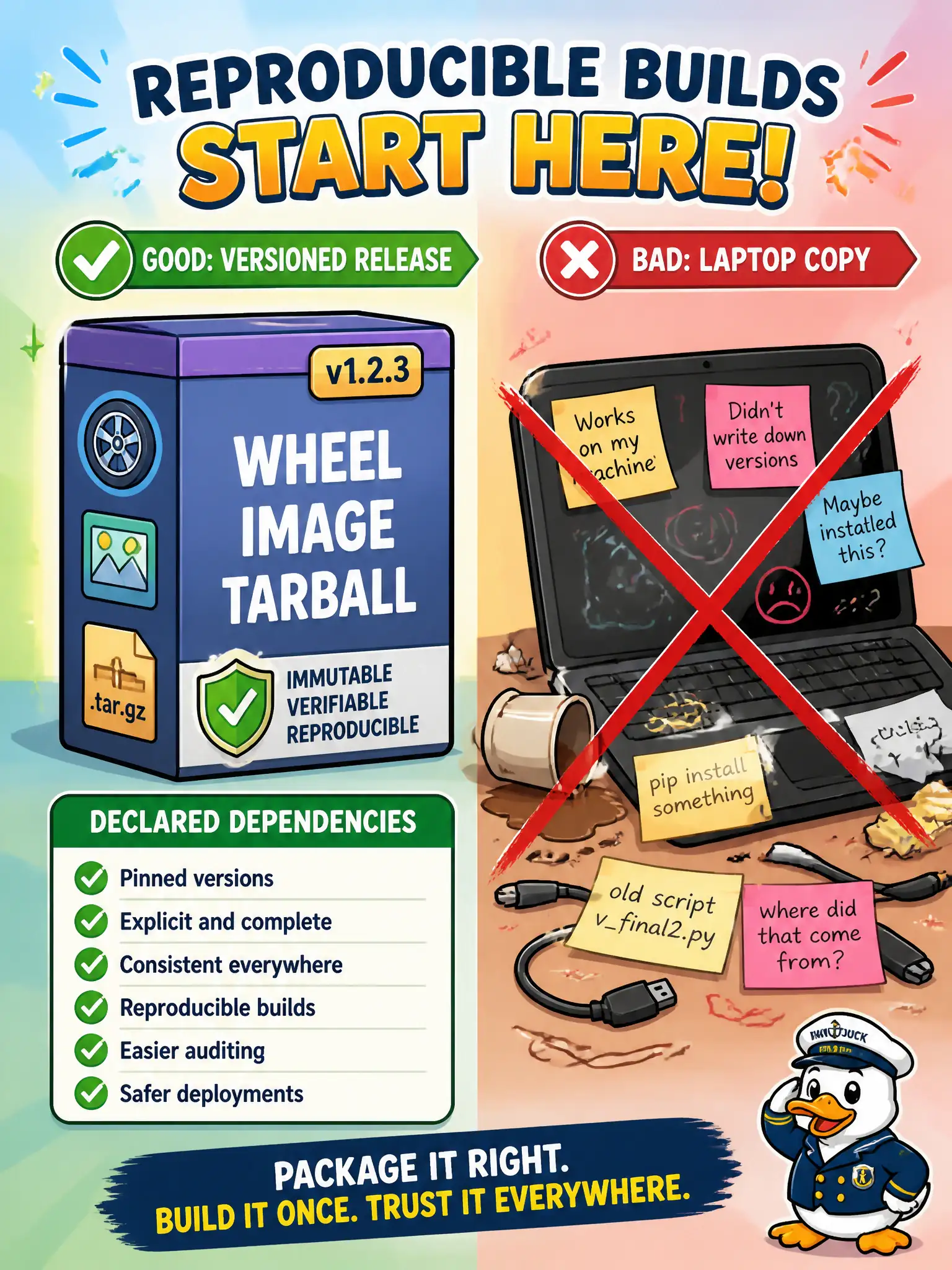
A release is like a sealed meal kit with a version label and a shopping list of ingredients—not leftovers from someone's counter. Packaging names the artifact and pins what it needs so anyone can rebuild it.
Full Explanation
A proper release package for operations is a named, versioned artifact whose dependency set is declared so the DNA Center health exporter can be rebuilt the same way on any approved runner. Version identity lets the weekend change window pin what was tested; declared dependencies (requirements, lockfile, or equivalent) make the install graph explicit rather than ambient. Rebuildability is the contract: ops should be able to reproduce the binary or installable from source and metadata without reverse-engineering a laptop.
Zipping whatever Python files sat on one engineer’s laptop lacks version identity, dependency pins, and provenance—two morning copies can diverge silently. Copying a live Kubernetes Deployment object from the staging console captures a cluster mutation snapshot, not a rebuildable application release with its library graph. An undocumented folder share that ops scp onto a jump host provides neither checksum-backed versioning nor a declared dependency set, so weekend rebuilds become tribal knowledge.
Exam caveat: container images and charts can be release artifacts only when they are versioned and built from declared inputs—an ad-hoc export from a running cluster is still not a release. Operational check: before handing the package to ops, verify the artifact name/version tag, install from a clean environment using only the declared dependency set, and confirm the exporter still talks to DNA Center health endpoints as in the change-window runbook.