
After a failed SSID change, the portal UI log says 10:00:01, the back-end says 09:59:40, and the controller syslog says 10:02:12, with no shared request id. Why is a “who failed first” story from these lines unreliable?
Select an answer to reveal the explanation.
Short Explanation
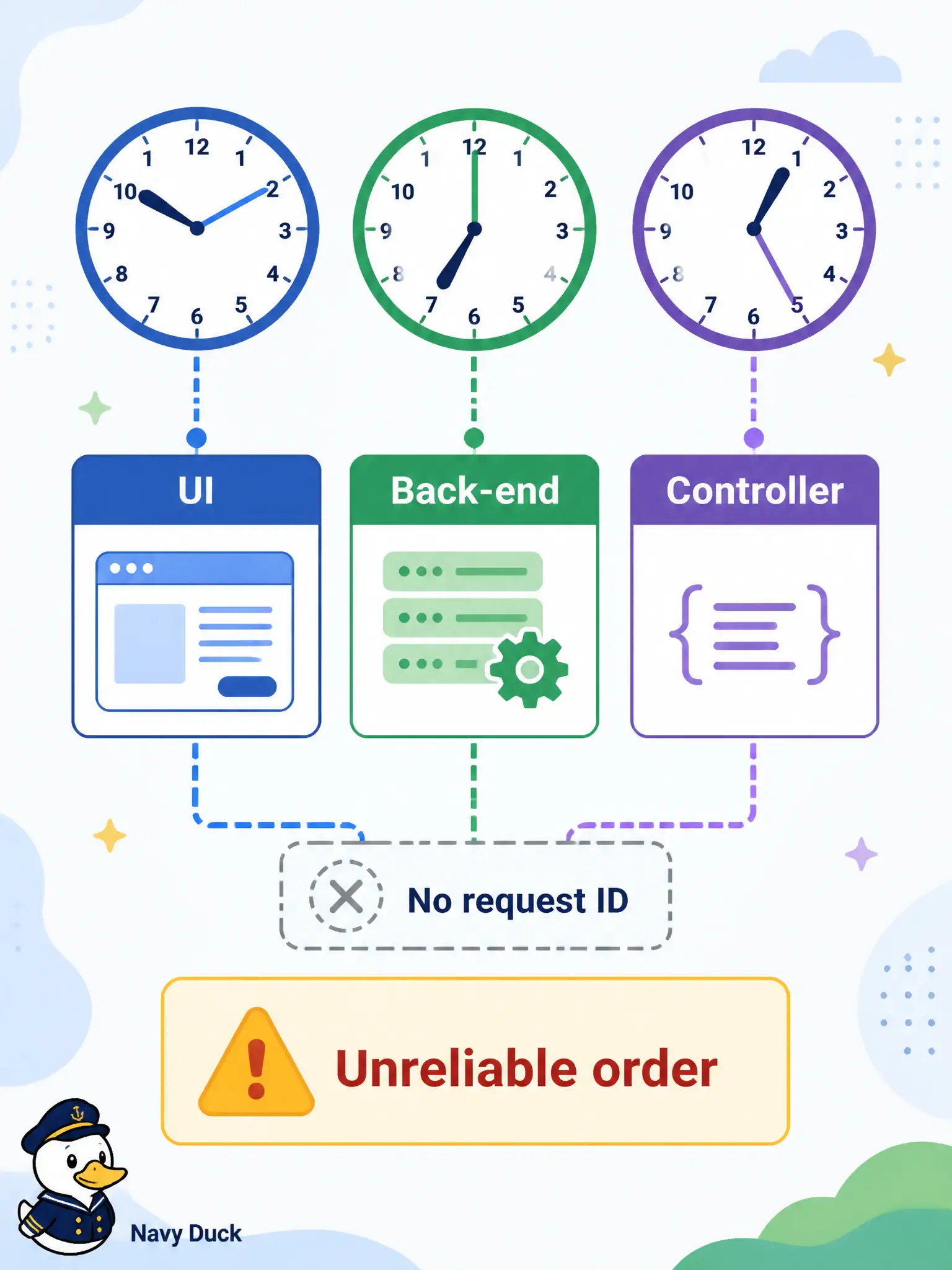
Three wristwatches that disagree cannot referee a race—especially with no race bib. Without a monotonic request id, wall-clock stamps across UI, back-end, and controller mislead. Fix time sync and carry an ID before trusting “who first.”
Full Explanation
A who-failed-first narrative from three disagreeing wall-clock lines with no shared request identifier is unreliable because order and causality cannot be inferred from unsynchronized timestamps alone. Portal UI, back-end, and controller hosts may drift, use different time zones, or apply different logging delays. Without a monotonic correlation or request ID tying the three records to one SSID-change attempt, sorting by stamped time invents a story the evidence does not support. Fix time synchronization and carry a shared ID before trusting cross-hop sequence claims.
Assuming controller syslog is always UTC and portals always local so conversion alone proves order still fails when clocks drift within a zone and when log write delay differs per hop; conversion without a join key does not prove causality. Declaring back-end logs authoritative by definition and ignoring UI and controller timestamps discards useful signals and still cannot order events that lack a shared ID. Sorting any three-line excerpt by filename alphabetically is unrelated to time or causality and invents an arbitrary order.
Exam caveat: even with NTP, small skew and batching can reorder near-simultaneous events—correlation IDs remain mandatory for multi-hop municipal integrations. Operational check: enable NTP or chrony drift alerts on UI, app, and controller logging sources, then reproduce one failed SSID change and verify a single request ID appears in all three logs before using timestamps only as secondary context.