
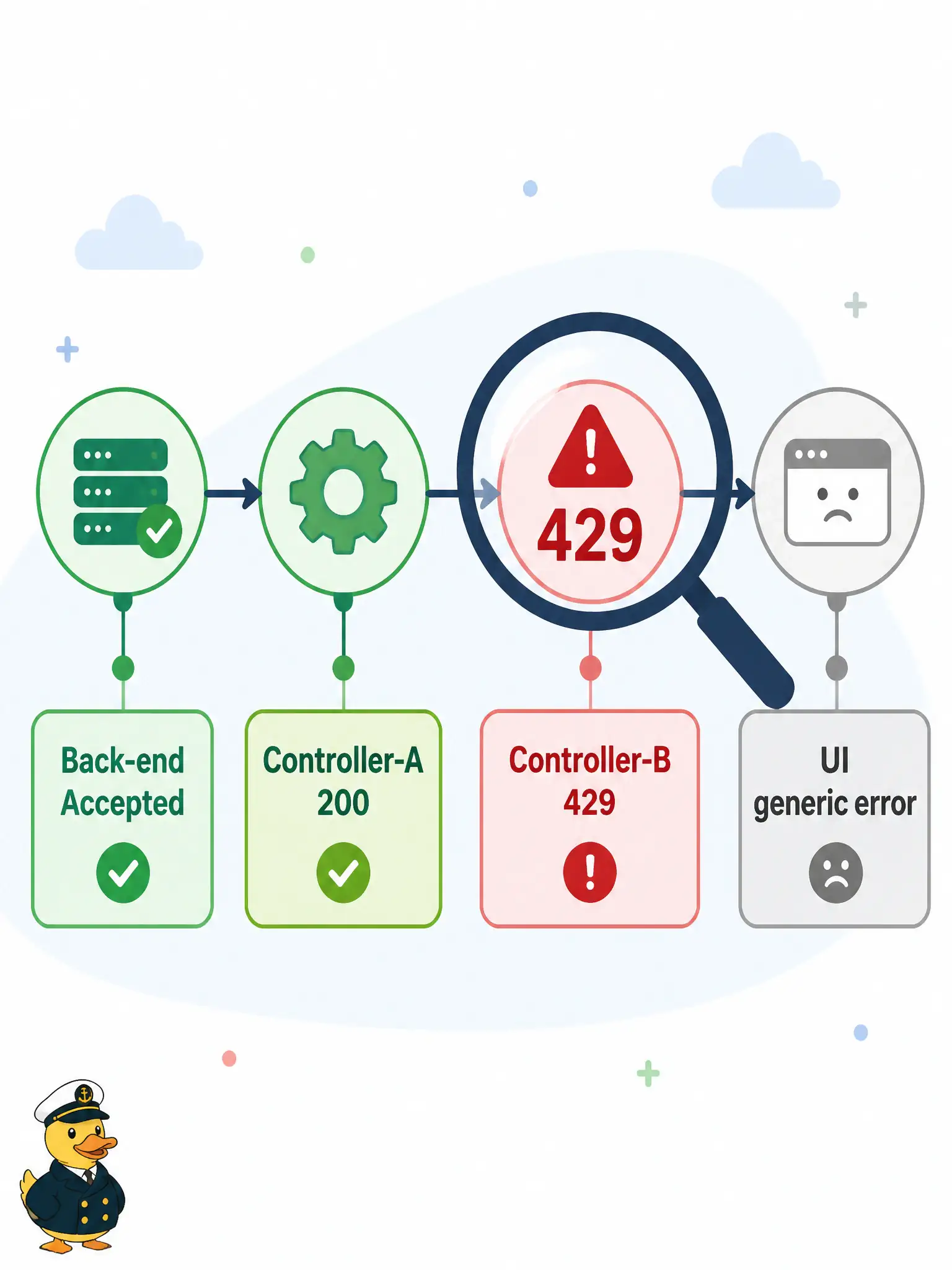
A library Wi-Fi enable request produces this short event log: back-end accepted req-8821; controller-A returned 200; controller-B returned 429; UI showed a generic failure. Where should diagnosis focus first?
Select an answer to reveal the explanation.
Short Explanation
Like reading a delivery trail—warehouse OK, truck A OK, truck B rejected for too many stops—you fix the rejected hop. The 429 on controller-B is the smoking gun. A generic UI error is just the last shout.
Full Explanation
Diagnosis should isolate the failing hop—controller-B’s HTTP 429—rather than declaring the whole library Wi-Fi enable application down. The event trail already shows the back-end accepted req-8821 and controller-A returned 200, so acceptance and at least one controller path worked. A 429 is a specific rate-limit or admission-control rejection on controller-B; fixing or backing off that hop is the highest-signal next step. The generic UI failure is only the last presentation of that partial success plus one rejected hop.
Rewriting the UI skin because a generic failure message appeared treats presentation as root cause; the UI merely surfaced an upstream problem and does not prove the front-end is down. Ignoring the 429 and rebooting controller-A because it answered 200 first attacks a healthy hop and wastes change risk on the wrong device. Assuming DNS failure on the back-end contradicts the log: acceptance happened and controllers were reached, so name resolution for the enable path already succeeded far enough to obtain HTTP responses.
Exam caveat: a 429 can be transient or policy-driven—retry-after and per-controller budgets matter; do not blast identical retries that deepen the limit. Operational check: correlate req-8821 or the equivalent correlation ID across back-end and both controller logs, confirm only controller-B returned 429, then validate rate-limit counters or admission settings on that controller before broader rollback.