
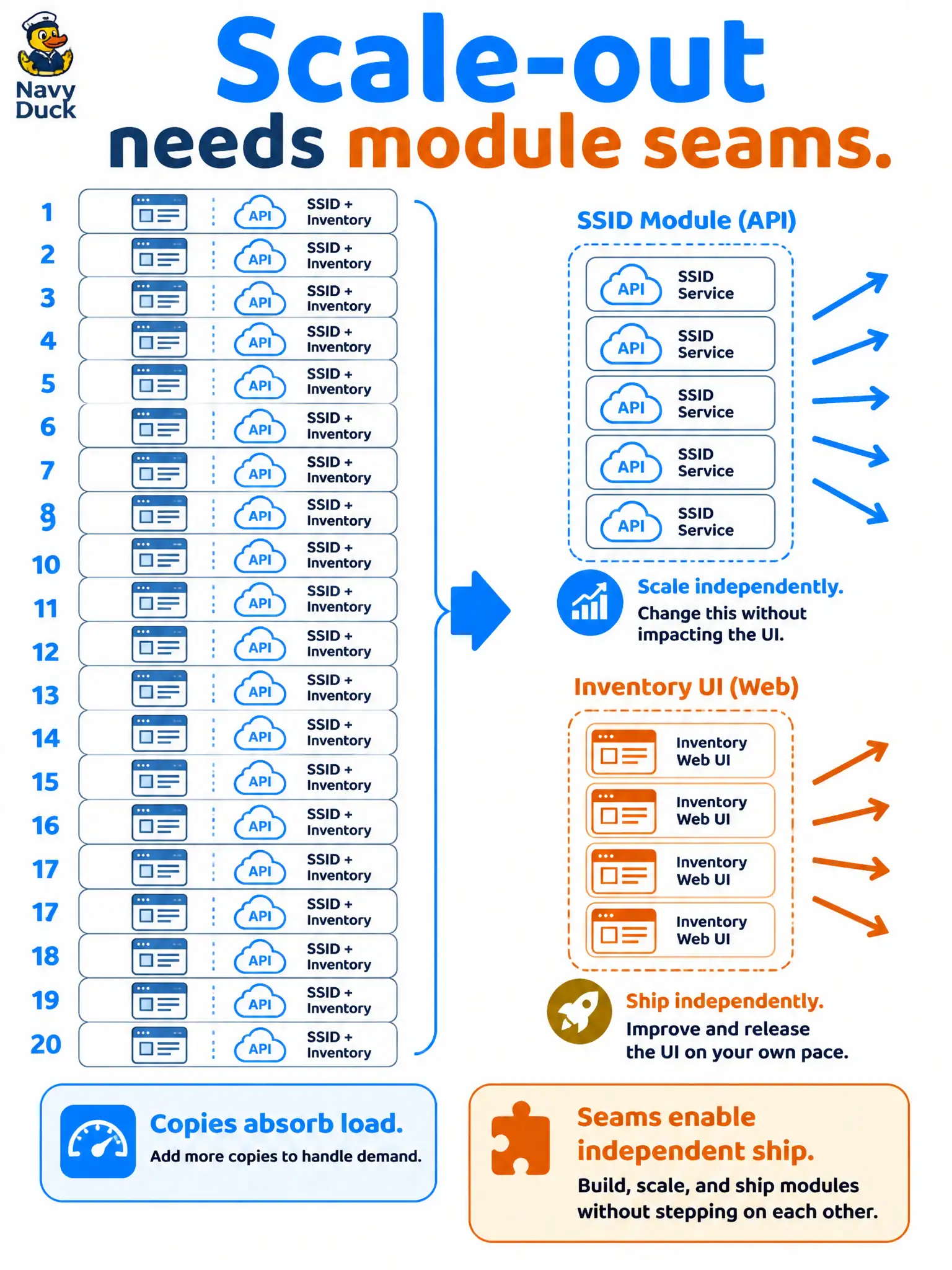
A library-network team runs twenty copies of one deployable that absorbs Meraki load, yet every SSID-enable change still requires rebuilding the inventory UI. What does that design still lack?
Select an answer to reveal the explanation.
Short Explanation
Twenty photocopies of a tangled notebook still force every edit through the whole book. Horizontal copies absorb load but are not enough without module seams. Independent boundaries let SSID work ship without rebuilding inventory UI.
Full Explanation
Twenty identical copies of one deployable can absorb Meraki load for a library network, but if every SSID-enable change still rebuilds the inventory UI, the design lacks module seams. Horizontal replication scales capacity of a blob; it does not create independent ship and scale boundaries between SSID integration and inventory presentation. True modularity lets teams release and scale the Meraki hop without rebuilding unrelated UI.
Adding more identical copies of the same tangled deployable fails because contention of change rate remains—every edit still crosses the whole artifact. A larger single VM fails by trading horizontal copies for vertical scale without solving coupling. Sticky sessions that force Meraki calls through one UI process fail by reintroducing a bottleneck and confusing scalability with affinity.
Exam caveat: running many replicas is not evidence of modularity; ask whether unrelated features can deploy on different clocks.
Operational check: ship an SSID-integration change as its own artifact or service version and confirm inventory UI images are unchanged in the release pipeline.
Capacity replicas answer how much Meraki traffic you can absorb; module seams answer how fast SSID work can change without inventory risk. On the exam, horizontal scale without decomposition still scores as incomplete. Draw the boundary so SSID enablement, inventory reads, and presentation deploy as separate units with explicit contracts between them.