
A Catalyst 9000 has only bootflash available. Operators want to host several additional Docker apps beyond Guest Shell. What storage constraint applies?
Select an answer to reveal the explanation.
Short Explanation
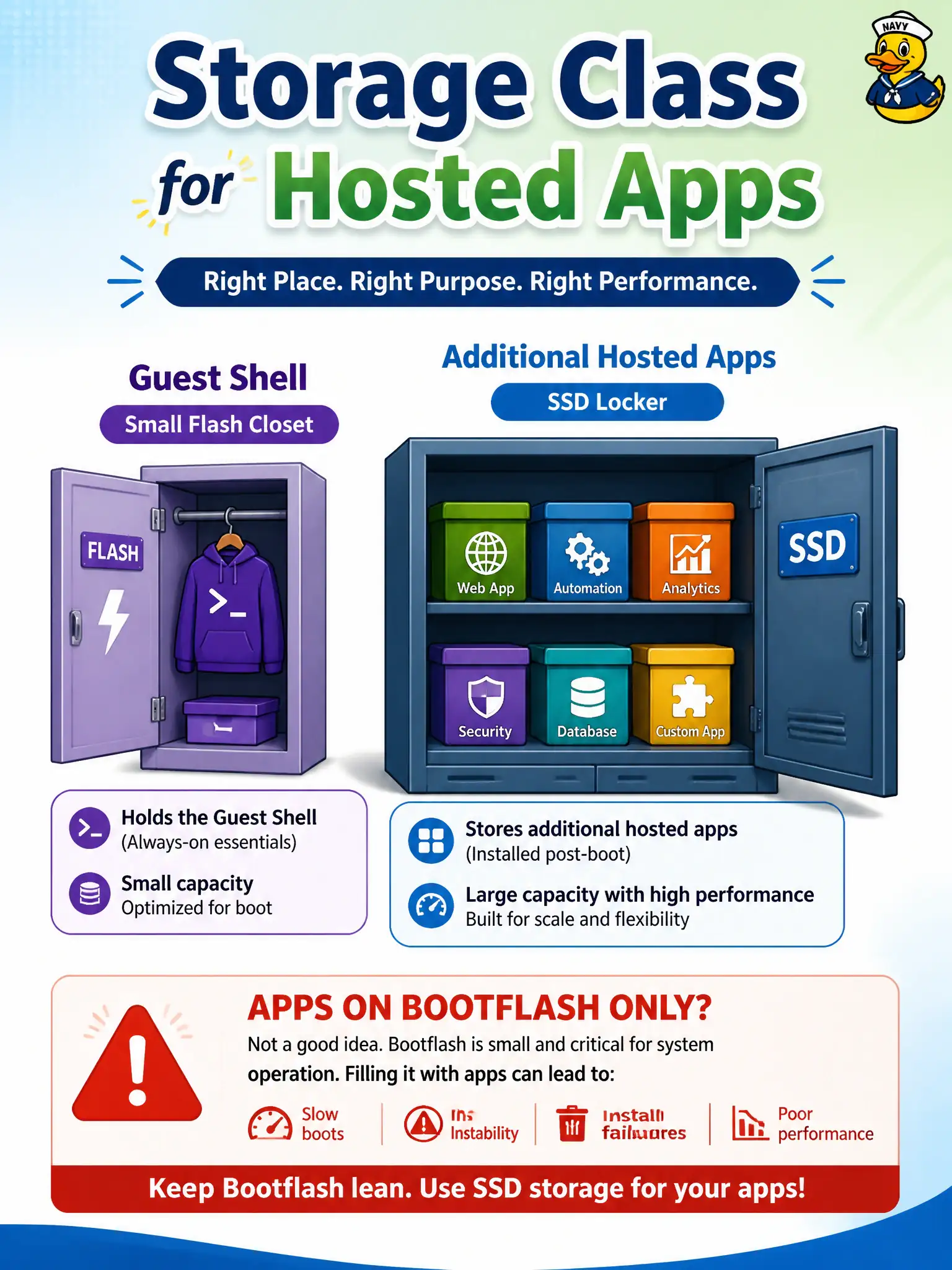
Guest Shell can live in the small closet (flash); extra apps usually need the bigger locker (supported SSD). Copying three Docker apps onto bootflash fights that constraint.
Full Explanation
Storage constrains how many applications a Catalyst 9000 can host. With only bootflash available, flash typically supports Guest Shell, while additional Docker-style apps usually need supported extra storage such as an SSD. Municipal operators planning several apps beyond Guest Shell must budget that media in the hardware BOM rather than assuming unlimited packing onto bootflash alone beside IOS images.
Claiming bootflash always hosts unlimited Docker apps with no extra storage needed fails platform guidance and risks exhausting space required for IOS images, core dumps, and system files. Saying UCS blade SSD profiles replace Catalyst storage rules for IOx apps points at the wrong product line for this campus switch question. Saying flash is enough for any number of apps if STP is disabled invents a false dependency between spanning-tree state and storage capacity.
Exam caveat: exact free-byte requirements vary by app size and IOS XE version—read the hosting storage notes for your software release before promising density. Plan SSD SKUs when app-hosting is a stated civic deliverable.
Operational check: check free bootflash, attempt a second non-Guest-Shell app per documentation, and if it fails for space, install supported SSD media and redeploy the app successfully.