
Transit staff must remove a previously added static route on an IOS XE router using RESTCONF. Which action is correct?
Select an answer to reveal the explanation.
Short Explanation
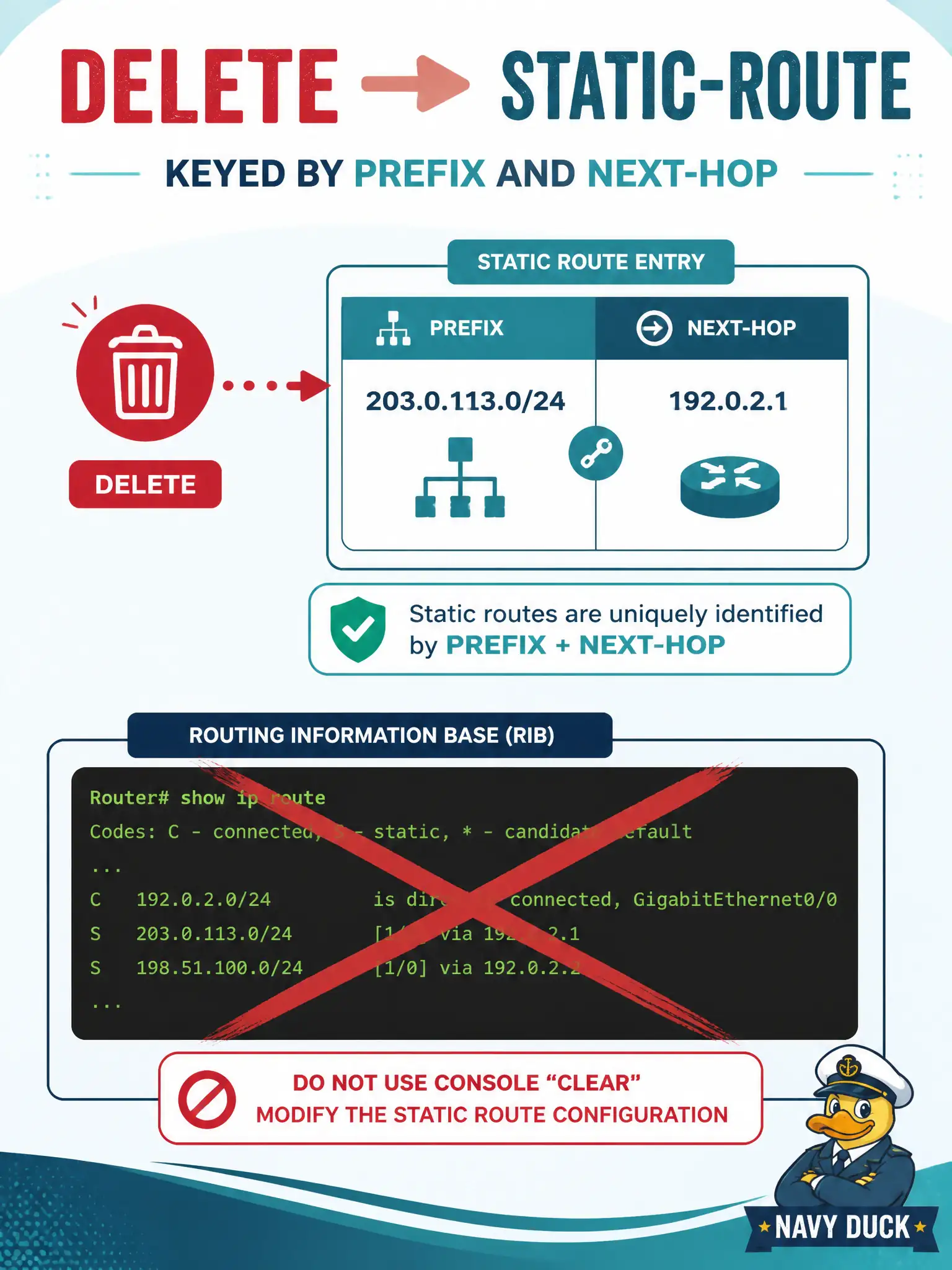
To retire a static route, delete that keyed filing card—prefix and next-hop—don’t bulldoze the whole RIB from the console or wait for GET to invent a delete.
Full Explanation
Removing a previously added static route on an IOS XE router with RESTCONF means DELETE (or an equivalent edit) against the static-route resource addressed by its prefix and next-hop keys. That action is correct because RESTCONF treats the route as a keyed list entry: identifying the same keys used at create time lets transit staff remove exactly that municipal route without rebuilding the whole routing table. Structured delete keeps automation reversible and auditable.
Clearing the entire RIB from the console and rebuilding all dynamic protocols fails because it is destructive overkill unrelated to deleting one static-route YANG object and risks wider outages. Issuing a Meraki Dashboard firewall rule delete and assuming the router updates fails conceptually: Meraki cloud firewall APIs do not remove IOS XE static routes on a campus/edge router. Repeatedly GETting the route until IOS XE deletes it automatically fails because GET is read-only and never triggers deletion.
Exam caveat: keys must match how the route was created (prefix plus next-hop and/or interface as modeled); deleting with incomplete keys returns not-found or removes the wrong entry. Operational check: GET the keyed route to confirm it exists, DELETE it, GET again to confirm absence, and verify forwarding for the affected civic prefix behaves as intended before closing the change.