
Operations wants GigabitEthernet1/0/5 administratively shut and a new description applied on an IOS XE switch via RESTCONF. Which statement is correct?
Select an answer to reveal the explanation.
Short Explanation
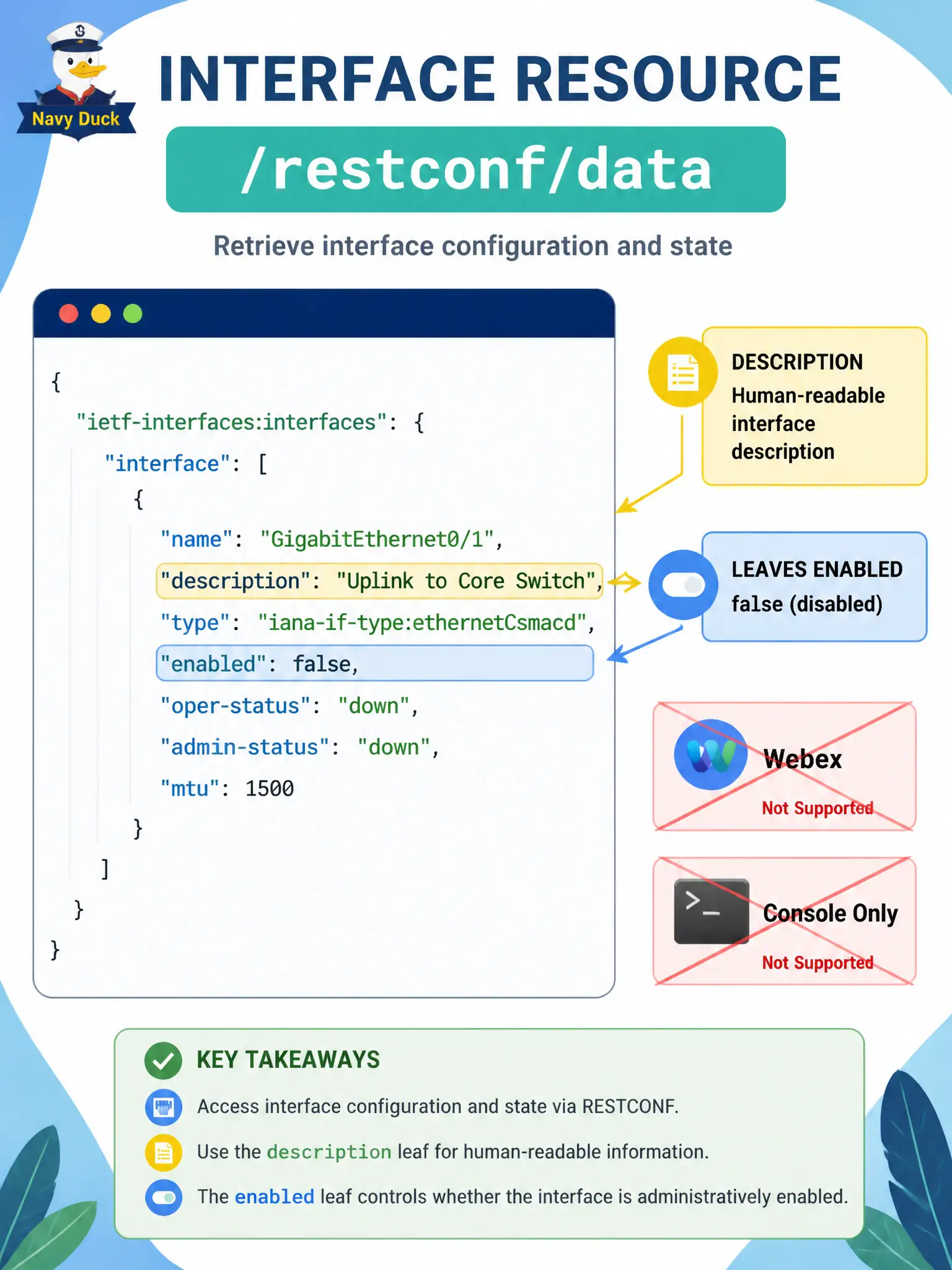
Shutdown and description are still stickers on the same interface locker—same RESTCONF resource, not a different protocol or a Webex chat message.
Full Explanation
Administratively shutting GigabitEthernet1/0/5 and applying a new description on IOS XE via RESTCONF is still ordinary interface configuration: enabled/shutdown and description are leaves on the same RESTCONF interface resource. That statement is correct because YANG interface models expose administrative state and descriptive text alongside other interface config; one authenticated PATCH (or equivalent edit) against the keyed interface can set both leaves. City operations therefore treat shutdown and description as co-located config, not as special cases that escape the API.
Claiming admin-state and description require a separate proprietary binary protocol outside RESTCONF fails because those leaves are standard interface configuration in the YANG datastore, not a side-channel protocol. Saying only IP addressing is allowed via RESTCONF while shutdown must be done from the console fails conceptually: shutdown/admin-state is modeled configuration, not console-only magic. Routing description edits through the Webex API because they are human-readable text fails because Webex collaboration APIs do not write IOS XE interface YANG leaves.
Exam caveat: leaf names differ slightly across IETF versus native models (enabled versus shutdown-style representations); the scored idea is that both properties live on the interface resource via RESTCONF. Operational check: PATCH both leaves in one change window, GET the interface resource to confirm description and admin state, and verify the port shows administratively down in operational status before closing the municipal ticket.