
A municipal network team must push YANG-modeled configuration to a Catalyst switch running IOS XE without opening an interactive SSH session. Which approach correctly uses the official device-config API for this DEVCOR task?
Select an answer to reveal the explanation.
Short Explanation
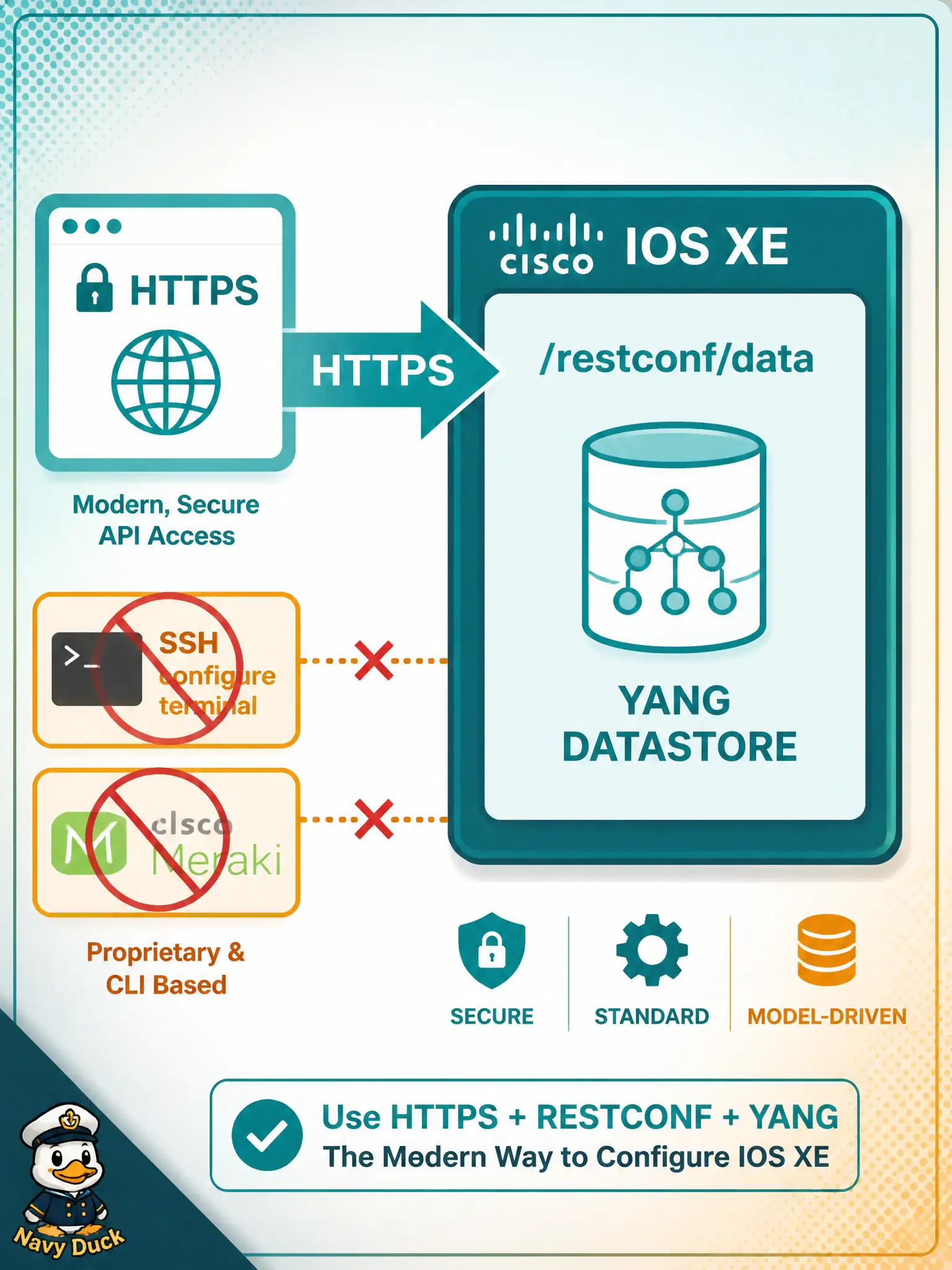
Think of RESTCONF as the city’s official web counter for device config—HTTPS to /restconf/data on IOS XE—not a back-room SSH console or a Meraki ticket taped to the wrong building.
Full Explanation
Pushing YANG-modeled configuration to a municipal Catalyst switch without an interactive SSH session means using IOS XE’s official device-config API path: HTTPS RESTCONF against the datastore under /restconf/data. That approach works because RESTCONF is the structured, YANG-bound edit interface DEVCOR expects for IOS XE—authenticated over TLS, addressable by module and resource, and capable of create/merge/replace/delete without opening a configure-terminal session. City automation can therefore treat the switch like any other HTTPS datastore client instead of a human console.
Opening SSH and pasting CLI under configure terminal fails the stated constraint conceptually: it is interactive device administration, not the official YANG device-config API, and it does not give structured leaf-level REST edits. Sending SNMP SET PDUs against proprietary MIB objects fails because SNMP is a separate management plane with MIB semantics, not YANG RESTCONF datastore edits, and proprietary MIB leaves are not the scored RESTCONF construction. Calling a Meraki Dashboard SSID endpoint and assuming the Catalyst inherits the change fails because Meraki cloud WLAN APIs do not write IOS XE Catalyst running-config; different product family, different control plane.
Exam caveat: RESTCONF must be enabled and reachable (HTTPS, AAA, and the correct VRF/management path); knowing /restconf/data does not help if the feature or certificates are missing on the civic switch. Operational check: from the automation host, confirm a successful authenticated GET or OPTIONS against /restconf/data on the target IOS XE address before the first PATCH, and verify the change appears under the intended YANG resource rather than only in an operator’s SSH history.