
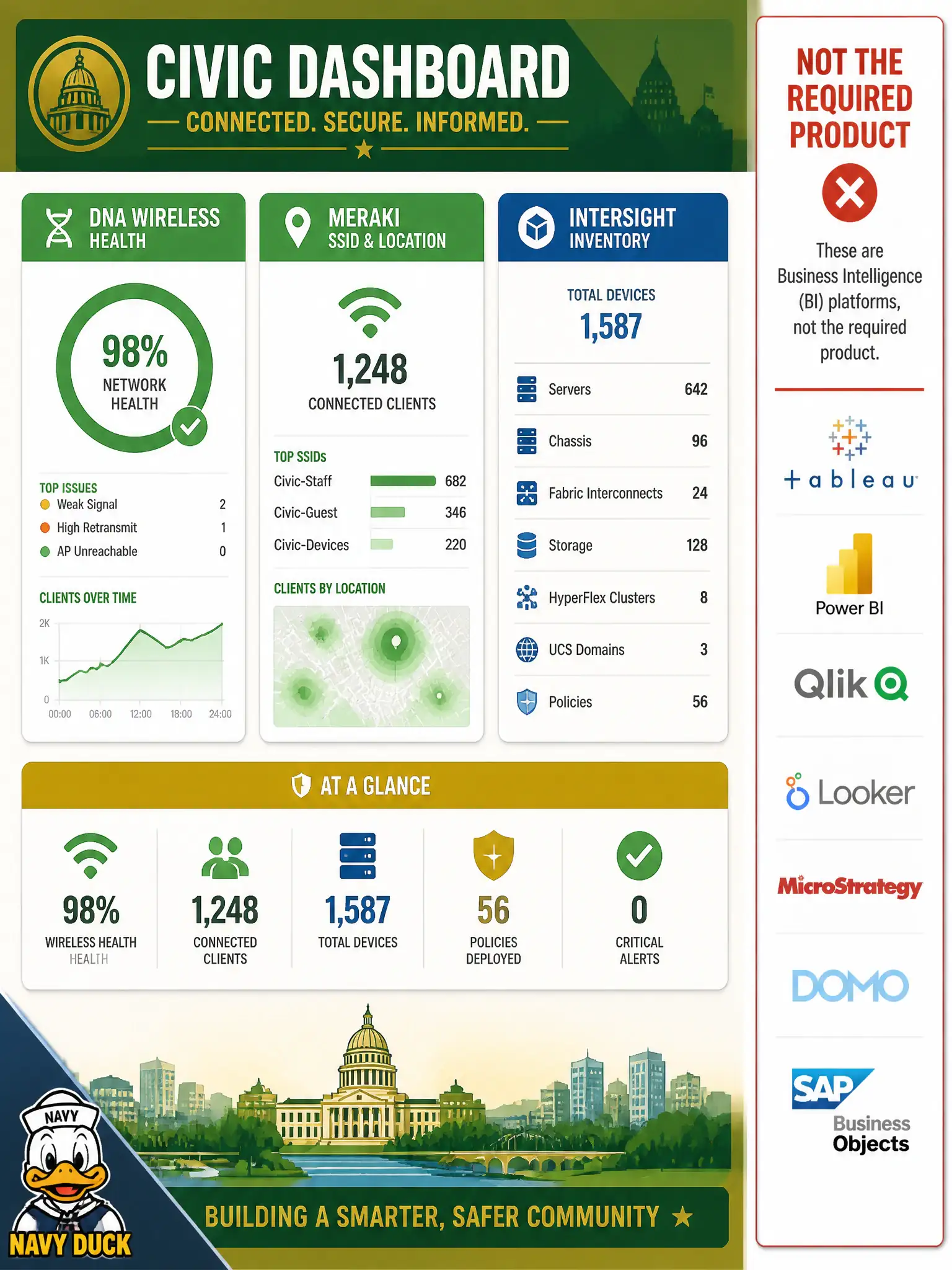
City IT must demonstrate a constructed dashboard that presents data collected from official Cisco platform APIs. Which outcome satisfies that requirement?
Select an answer to reveal the explanation.
Short Explanation
The graded artifact is a board that shows Cisco API data—scores, SSIDs, locations, inventory—not a shopping list for a BI SKU. Grafana or Splunk may decorate, but they are not the 3.8 answer by themselves.
Full Explanation
The requirement is satisfied when the city can show a constructed dashboard that presents wireless health scores, SSID state, location counts, or Intersight inventory obtained through the numbered Cisco platform APIs. The graded artifact is the board that displays that Cisco-sourced data after auth, collect, transform, and present—not a purchase order for an unrelated observability stack.
Buying Grafana Cloud and deferring Cisco API integration leaves the construction incomplete: the tool may exist, but no Meraki, DNA, or Intersight data path was built. Standing up Kibana only to graph syslog without calling those platforms likewise fails the objective—syslog visualization is not a Cisco-platform API consumer. Licensing Splunk Enterprise Security as a “mandatory deliverable” with no Cisco API consumer confuses a SIEM SKU with the DEVCOR construction task.
Exam caveat: third-party dashboards are fine as presentation shells only if they still consume the official Cisco platform APIs; the exam cares that you built that consumer path. Operational check: open the municipal board and confirm at least one tile shows wireless health, SSID state, location counts, or Intersight inventory backed by live authenticated calls—not placeholder demos or only non-Cisco log graphs.