
What professional benefit do continuous testing and static analysis in CI primarily deliver for the civic automation team?
Select an answer to reveal the explanation.
Short Explanation
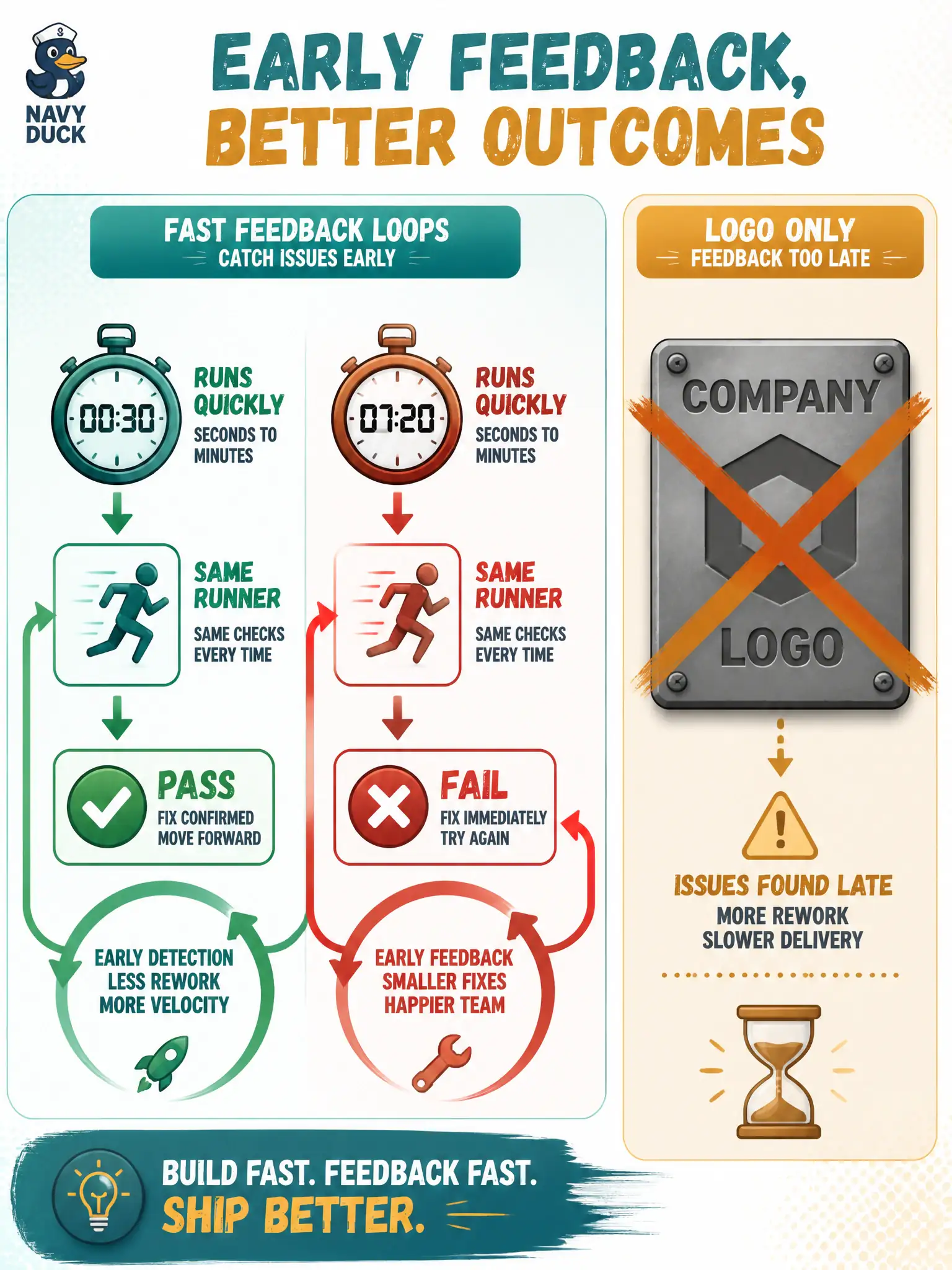
Same stopwatch, same track, every lap—you get a comparable signal in minutes. That early, cheap, repeatable loop is the benefit, not a logo on the wall.
Full Explanation
Continuous testing and static analysis in CI primarily deliver repeatable early feedback in minutes from the same suite on the same runner, catching issues sooner and cheaper for the civic automation team. Comparable signals on every change let engineers fix defects while context is fresh, before images reach Kubernetes or production users. That early, cheap, repeatable loop is the professional benefit—not a logo on a wiki.
Proof that purchasing a scanner logo alone satisfies the pipeline without running jobs confuses procurement with engineering practice; unused tools produce no feedback. Permission to skip reviews because a vendor billboard appeared on the wiki similarly substitutes marketing for gates. Waiting until production users report defects before any analysis runs inverts the value proposition—late, expensive discovery instead of early CI feedback.
Exam caveat: the benefit is timing and repeatability of feedback in CI, not a mandate for a particular commercial product name. Operational check: measure that Meraki or Webex automation commits receive test and static-analysis results within the normal CI window, that red jobs block promote, and that the same jobs run consistently on the shared runners.