
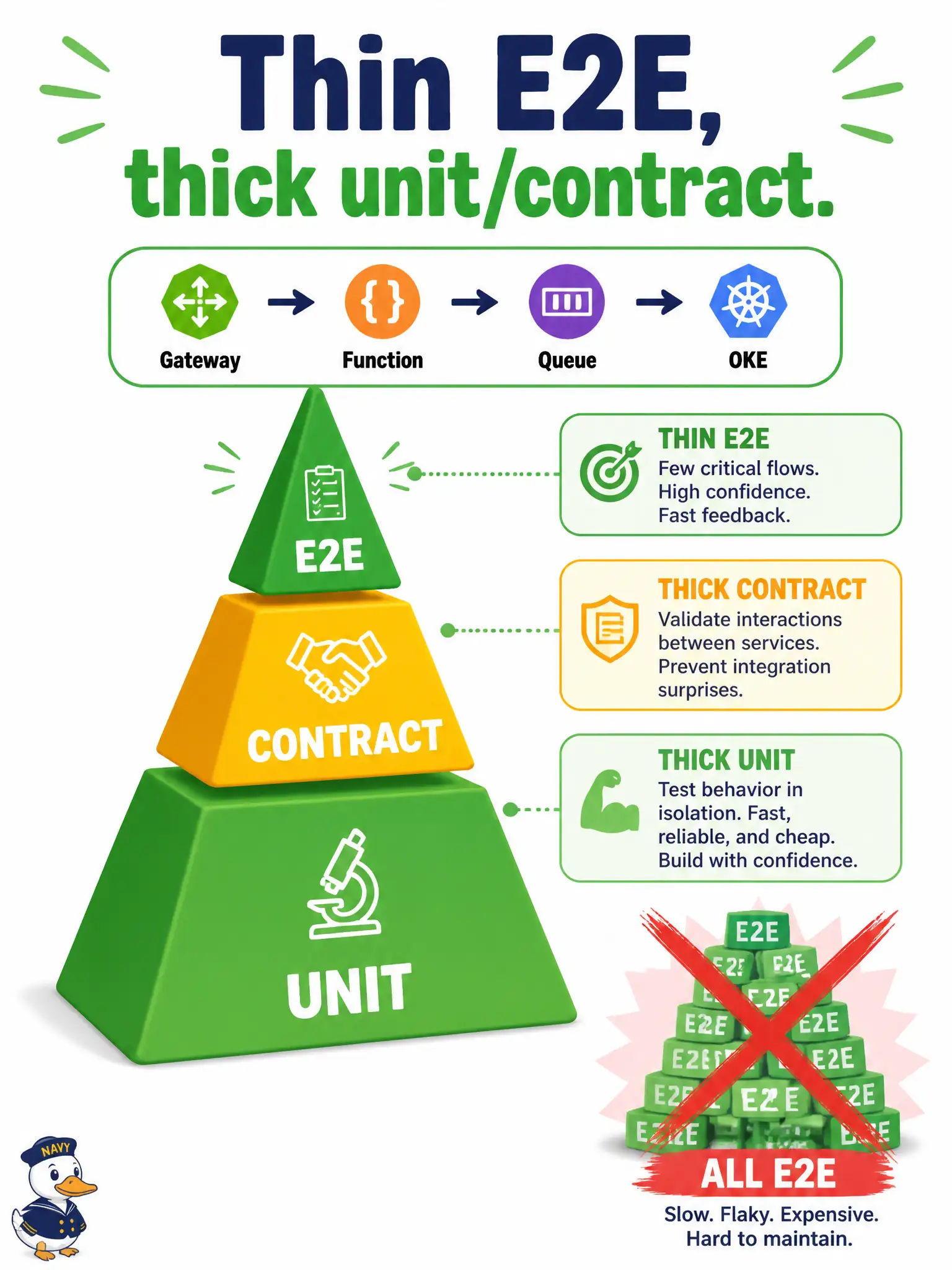
A recreation booking path crosses API Gateway → Function → Queue → OKE worker. How should end-to-end journeys be sized in the suite?
Select an answer to reveal the explanation.
Short Explanation
A parade across four city systems is expensive and brittle. Keep a few to prove the wires connect; catch most bugs at the desk that changed with unit and contract tests.
Full Explanation
A recreation booking path that crosses API Gateway, Function, Queue, and an OKE worker is expensive and brittle if every regression is forced through that full parade. Keep a few thin end-to-end journeys to prove the wires connect—route reaches Function, message lands, worker processes—while placing most regressions in unit and contract tests of the service that actually changed. That sizing keeps feedback fast where logic lives and reserves cross-service journeys for wiring confidence, not bulk bug hunting.
Replacing all unit and contract tests with one ten-service scenario on every commit fails by concept: it maximizes flakiness and runtime while starving precise local feedback. Making cross-service journeys the bulk of every pull-request gate regardless of which service changed fails for the same reason—unchanged neighbors should not dominate the cost of a booking-fee tweak. Deleting all automated tests and relying solely on citizen bug reports after deploy fails because production discovery is not a substitute for a deliberate suite.
Exam caveat: pyramid thinking on the exam means few E2E, many unit/contract—not “E2E is always better.” Operational check: for a Function-only change, ensure CI runs Function unit/contract suites by default and only a thin wiring smoke against Queue/OKE on a schedule or release candidate, not on every commit.