
A parking-fine fee calculator changed overnight. Which test layer best gives fast feedback on that logic alone?
Select an answer to reveal the explanation.
Short Explanation
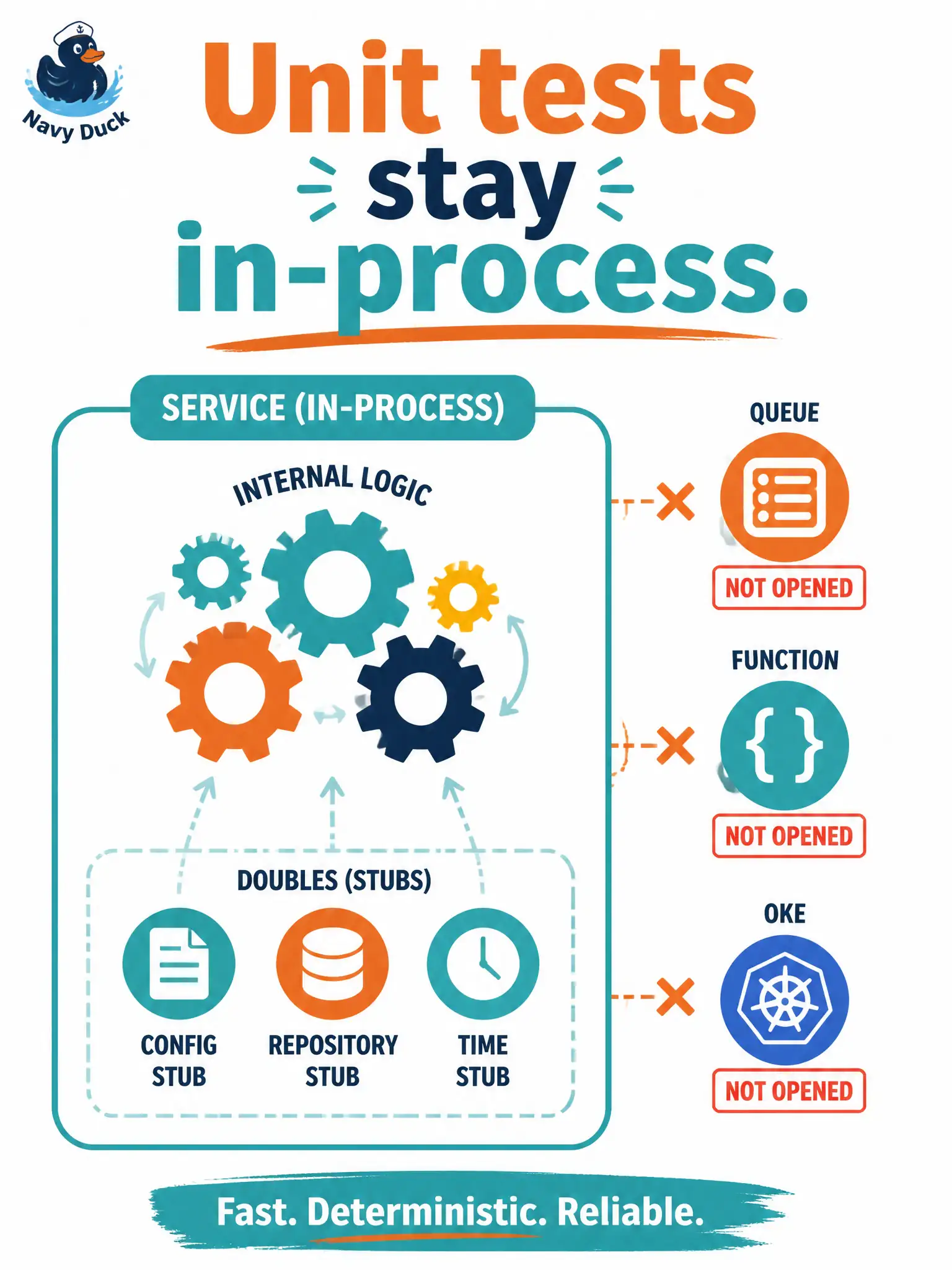
Unit tests are the desk calculator on the counter—same math, fake neighbors. They stay in one process so the fee change is checked in seconds, not after spinning up a cluster.
Full Explanation
Unit tests are the right layer for overnight parking-fine fee calculator changes that need fast feedback on the service’s own logic. They exercise calculation paths with in-process doubles, never open a real Queue or live Function, and return in seconds so a fee tweak can be validated before any cluster spin-up. That speed and isolation make unit tests the first net for pure logic regressions inside the calculator.
An end-to-end journey that requires a live OKE cluster, real Queue, and a deployed Function before any assert runs fails by concept for this need: it is slow, environment-coupled, and mixes infrastructure health with fee math. Relying only on production Monitoring alarms after citizens hit the new fee path fails because alarms are after-the-fact detection, not pre-merge feedback. A full multi-tenancy soak that provisions every OCI service in the architecture for each commit fails on cost and latency—it answers capacity questions, not “did the fee formula change correctly?”
Exam caveat: match the test layer to the blast radius of the change—pure logic → unit; seam → contract; protocol/runtime → integration. Operational check: add or adjust a unit test for the new fee path with fixed inputs and doubles for collaborators, run it locally and in CI, and confirm failure when the formula is deliberately broken without provisioning OCI resources.