
The permitting service must ask a separate provisioning service to create a field tablet record, while Object Storage createobject events should invoke a Function. Which pairing is correct?
Select an answer to reveal the explanation.
Short Explanation
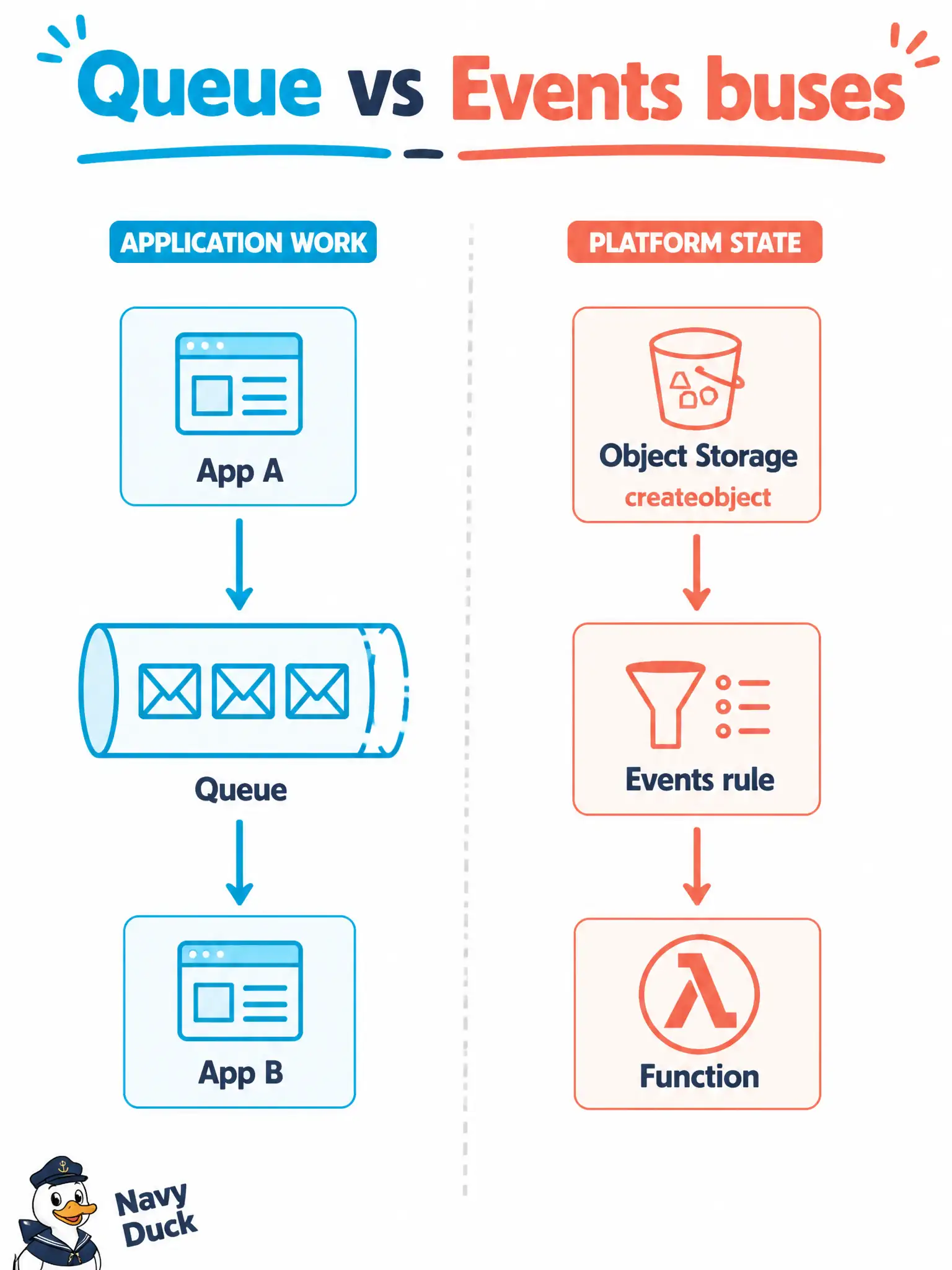
App A asking App B to do work is a queue message. A bucket shouting “new object” is Events. Do not invent a bridge that makes Events target Queue.
Full Explanation
Application-to-application work and platform event reactions are different buses. The permitting service should publish the tablet-provisioning request onto OCI Queue so the peer provisioning app can GetMessages, process, and delete. Separately, Object Storage createobject should be wired through OCI Events rules that invoke a Function. That pairing keeps discrete microservice tasks durable in Queue while letting Cloud-native resource events drive Functions without inventing a bridge that makes Events target Queue as a general app inbox.
Putting the tablet request on OCI Events with an Events rule whose action target is OCI Queue fails by concept: Events is not the documented path for arbitrary app-to-app task handoff into Queue, and inventing that bridge conflates notification rules with a work queue. Subscribing an Events rule to the Queue channel so createobject traffic and app messages share one bus likewise fails—Queue channels are not Events rule sources for mixing platform object creates with application tasks. Replacing both paths with OCI Streaming partitions because “Events cannot invoke Functions” is factually wrong on the Function path and still mixes two concerns into a replay log that neither peer needs for a one-shot tablet record.
Exam caveat: Events → Function (or Notifications) for resource lifecycle; Queue for durable peer work. Do not assume every OCI product can be an Events action target for app messages. Operational check: publish a test tablet message to Queue and confirm the provisioning consumer drains it; separately upload a test object and confirm the Events rule invokes the Function without requiring Queue as an intermediate.