
A 311 request-reply API and fair work distribution across producers share one OCI Queue. Which Queue feature provides ephemeral destinations for fairness and caller-specific replies?
Select an answer to reveal the explanation.
Short Explanation
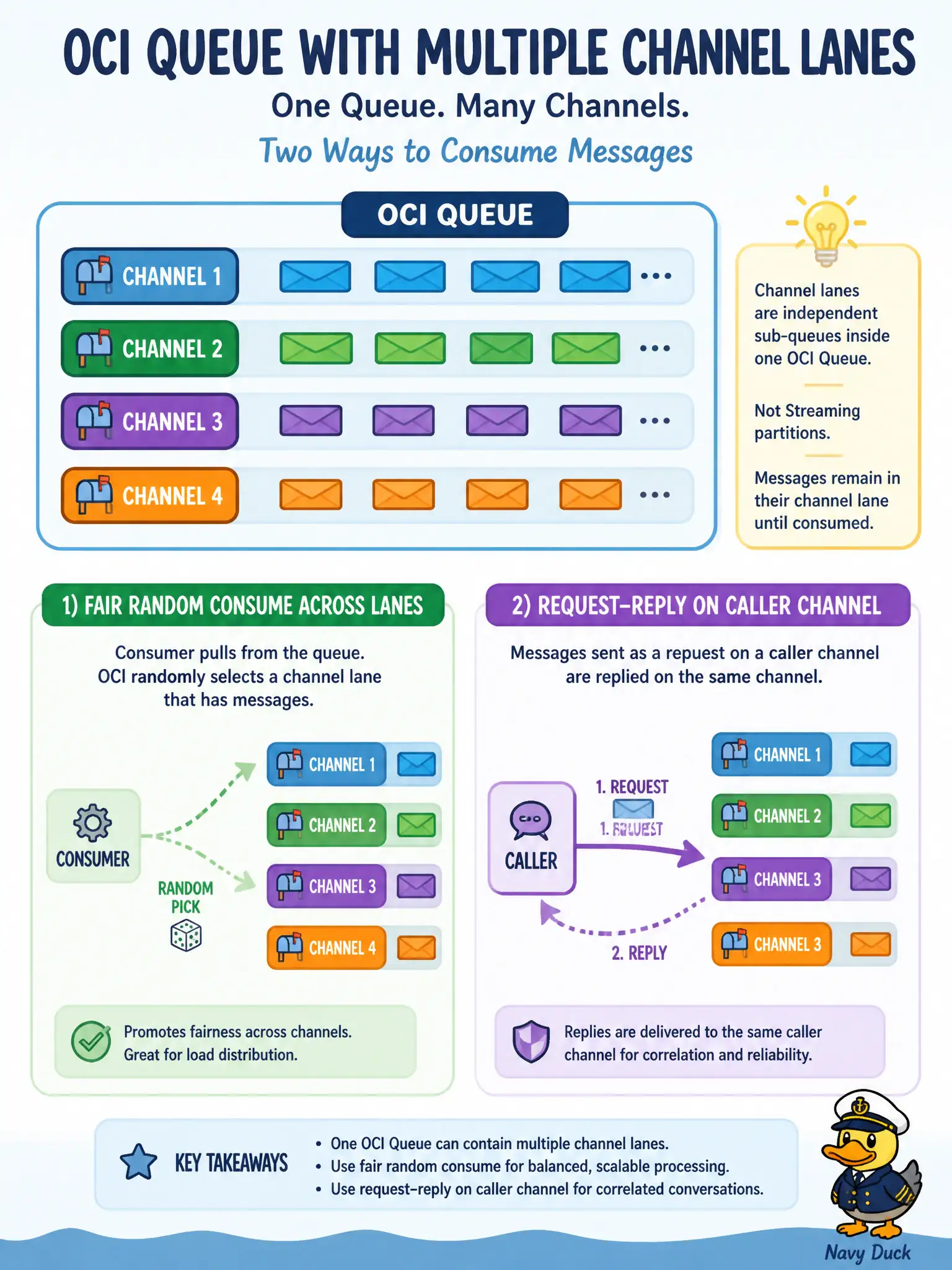
Channels are lightweight destinations inside a queue—up to 256, created on demand. Producers can target a channel; consumers can drain the whole queue fairly or read a specific channel for request-reply. They are not Streaming partitions.
Full Explanation
When a 311 request-reply API and fair work distribution across producers share one OCI Queue, channels provide ephemeral destinations inside that queue—up to 256—for targeted publish and consume, fairness, and caller-specific replies. Producers can address a channel; consumers can drain the queue fairly across channels or read a specific channel when implementing request-reply correlation for a given caller or workflow. Renaming Streaming partitions as Queue partitions with Kafka consumer groups imports Streaming concepts that Queue does not use for this feature—channels are Queue-native ephemeral destinations, not Kafka partitions. Events rule filters attached to each Queue message as mandatory channel substitutes confuse Events matching with Queue addressing; Events is not how you create per-caller reply paths inside a queue. Vault compartments that isolate each message into its own encrypted queue replica invent a security topology unrelated to Queue channels. Exam caveat: channels are ephemeral and capped (256 per queue)—design correlation IDs and channel lifecycle so long-lived municipal integrations do not leak channel usage or assume infinite channel cardinality. Operational check: publish a request on a dedicated reply channel ID, have the worker consume the work and publish the response to that channel, and confirm only the waiting API consumer reading that channel receives the reply while fair consumers still drain other work from the shared queue.