
Microservice A in a city payments mesh must ask microservice B to process a refund job. Separately, a bucket change should start automation. Which producer distinction guides Events versus Queue?
Select an answer to reveal the explanation.
Short Explanation
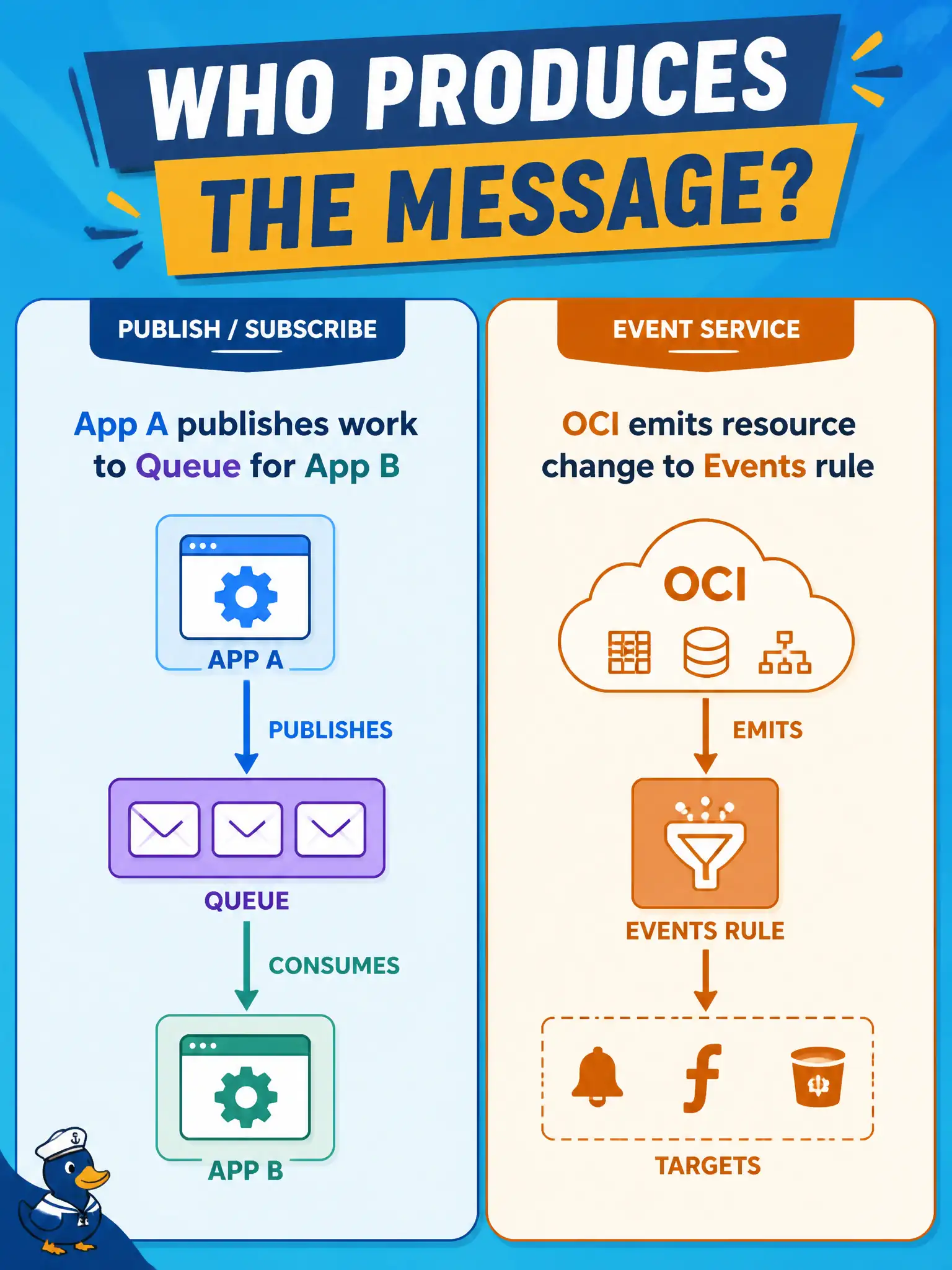
If service A asks service B to do a job, that is Queue (or Streaming)—you publish the work. If a bucket or database changed, OCI publishes that state change and Events delivers it. Events is not “the OCI queue.”
Full Explanation
In the city payments mesh, when microservice A must ask microservice B to process a refund job, the producer is your application: publish a work item to OCI Queue (or, for different shapes, Streaming) for a worker to consume and complete. Separately, when a bucket change should start automation, OCI itself publishes the resource-state CloudEvent and Events delivers it via rules. Producer distinction guides the choice: your services publish work to Queue; OCI publishes resource changes to Events. Using Events for the refund job because Events is the OCI work queue for microservices mislabels Events—it is not a general microservice job inbox and does not replace Queue for application-published work. Publishing the bucket change yourself onto Queue because OCI never emits Object Storage state changes is false once object events are enabled; reinventing emission on Queue duplicates what Events already provides. Using Streaming only and claiming neither Events nor Queue applies ignores both documented paths for jobs and resource automation. Exam caveat: teams sometimes put application work on Streaming for replayable analytics-style buses; that can be valid, but it is still your producers publishing—not Events—and Queue remains the managed transactional inbox for consume-update-delete workflows. Operational check: for refunds, publish a test message to Queue and confirm the worker deletes after success; for the bucket path, enable emit events, match create-object with a rule, and confirm a Function runs without any application code publishing the CloudEvent.