
A records office wants first-party and third-party systems to exchange data with OCI Streaming without writing a custom pump for every product. Which documented integration path fits?
Select an answer to reveal the explanation.
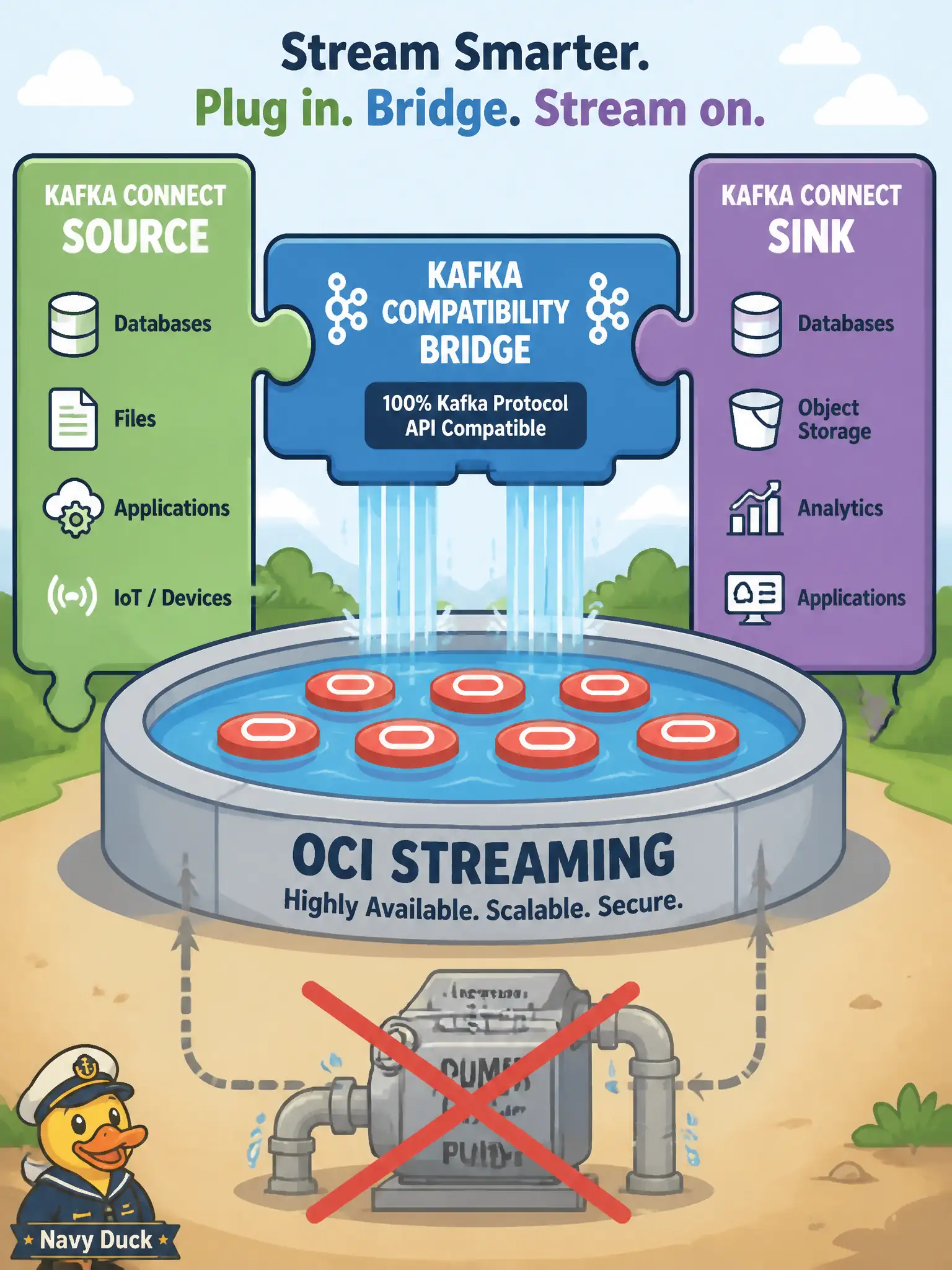
Short Explanation
Kafka Connect is the adapter shelf at city hall—plug in a source or sink instead of soldering a custom cable for every vendor. Connectors in the ecosystem talk to Streaming via Kafka compatibility so you avoid a one-off pump for each product. It remains Streaming; designing a Connect worker farm on OKE is not the core of the item.
Full Explanation
For first-party and third-party systems that must exchange data with OCI Streaming without a custom pump for every product, the documented integration path is Kafka Connect source and sink connectors speaking to Streaming through the same Kafka compatibility layer. Connectors in the ecosystem treat the stream pool like a Kafka-compatible cluster endpoint, so the records office can plug in adapters instead of soldering a one-off transfer process per vendor. Conceptually the answer remains Streaming’s compatibility enabling Connect—not a prompt to redesign platform plumbing.
Building a bespoke OKE worker farm as the core answer ignores Kafka Connect as the integration model the question targets. Using only API Gateway request validation to move bulk files into Streaming partitions misuses an HTTP validation policy as a bulk ingestion bus. Storing connector offsets exclusively in OCI Vault master keys invents an offset backend; Connect offset storage is not “Vault master keys as the offset store.”
Exam caveat: teams may still run Connect workers on compute they manage, but the exam point is that Connect integrates via Kafka compatibility with Streaming—not that OKE is mandatory for the concept to work.
Operational check: configure a simple Connect source or sink against the stream pool bootstrap endpoint, move a small batch of records, and confirm offsets advance and data lands without a custom per-product pump.