
An economic-development office created an OCI API Gateway and defined routes on paper, but callers still receive nothing useful. What must exist before the gateway can serve the API?
Select an answer to reveal the explanation.
Short Explanation
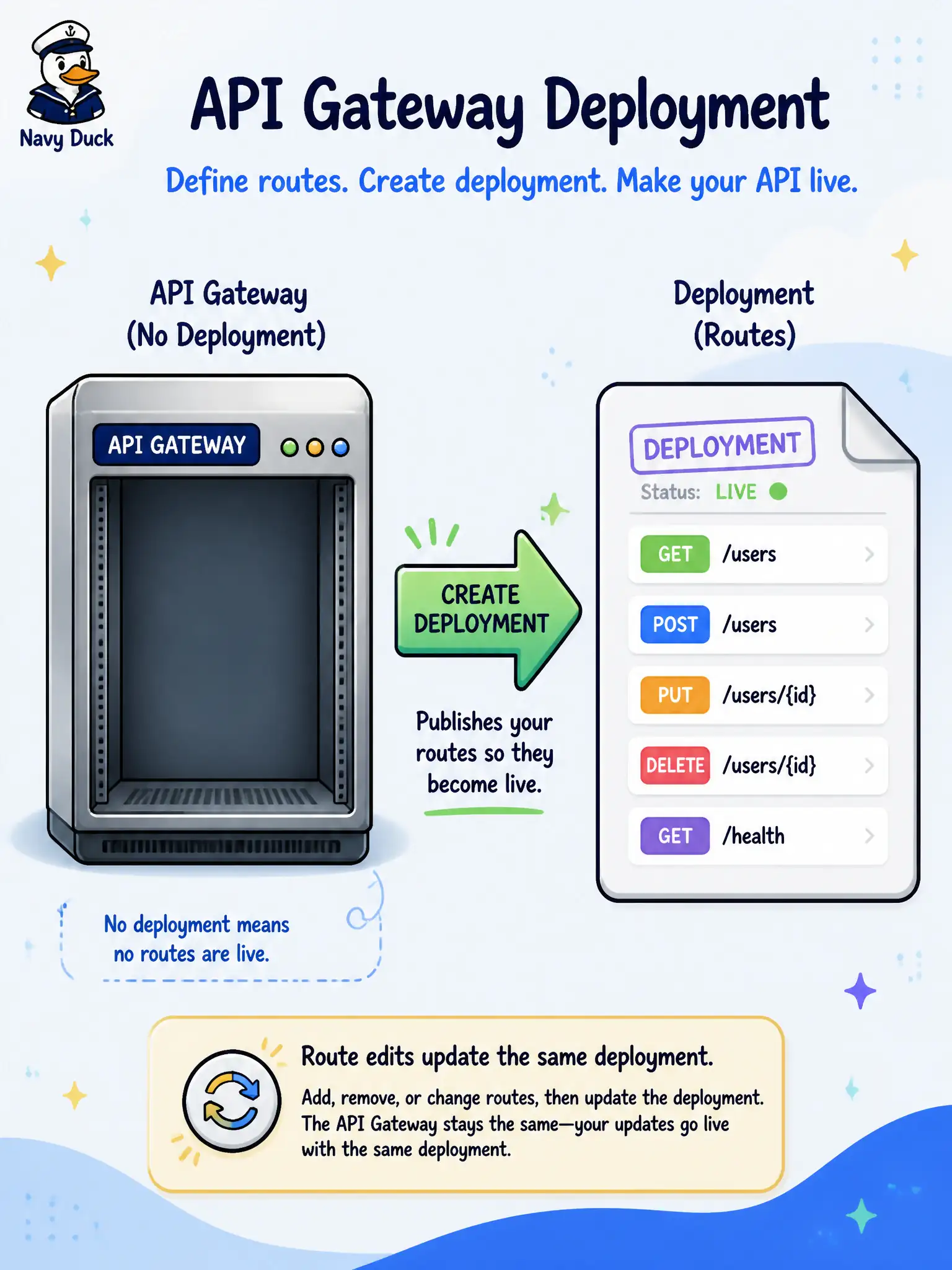
A gateway without a deployment is like a finished storefront with no shelves stocked—nothing for shoppers to match. Until you create an API deployment whose specification has at least one route, the gateway has nothing to serve. Editing routes later updates that deployment; it does not require a brand-new gateway. Think appliance first, then deployment—the same pattern as an Functions application before a function.
Full Explanation
An OCI API Gateway appliance alone does not serve traffic until you create an API deployment whose specification includes at least one route. The deployment is what callers hit: it binds hostname, routes, policies, and back ends. Later route edits update that deployment; you do not create a brand-new gateway every time a path string changes. For an economic-development office that defined routes only on paper, the missing piece is the deployment—the same mental model as needing a Functions application before a function can run.
Requiring a new gateway for every route path change invents unnecessary rebuilds and misunderstands deployment updates. Attaching an OCI Service Mesh control plane before routes can match mixes service-mesh concerns with API Gateway deployments. Linking a stream pool with Kafka auto-create to the gateway hostname is unrelated Streaming configuration and does not publish HTTP routes.
Exam caveat: gateway creation and deployment creation are separate steps. A healthy gateway with zero deployments still serves nothing useful.
Operational check: create a deployment with one simple route to a known back end, call the gateway hostname and path, confirm a response, then edit the route in place and verify the update applies without recreating the gateway.