
A planning department wants official OCI services to invoke a zoning-check Oracle Function. Which set correctly reflects documented invokers for this exam’s common choices?
Select an answer to reveal the explanation.
Short Explanation
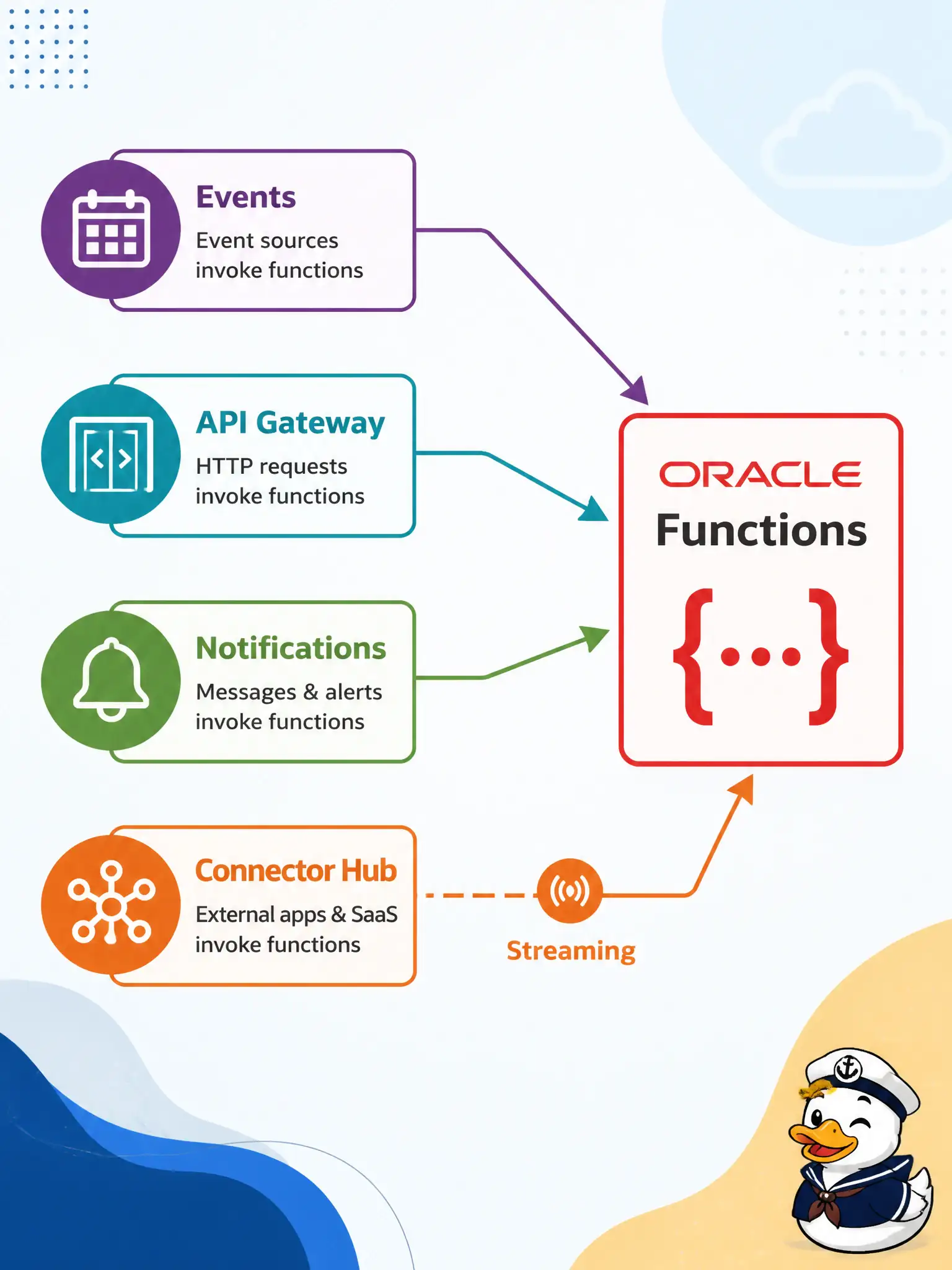
Several official doorbells can wake a function: Events, API Gateway, Notifications, and Connector Hub (Streaming rides through Connector Hub). Stick to that documented list—do not invent a separate S3-style bucket-notification product.
Full Explanation
Documented, exam-relevant ways for official OCI services to invoke a zoning-check Oracle Function include Events rule actions, API Gateway Functions back ends, Notifications subscriptions, and Connector Hub tasks/targets. Streaming commonly reaches Functions through Connector Hub rather than as a vague standalone “bucket notification product” invented from other clouds. That set is what planning-department designs should cite.
Limiting invokers to only raw signed HTTPS against a separately marketed Object Storage bucket-notification product misstates OCI’s model and ignores Events, API Gateway, Notifications, and Connector Hub. Claiming OKE Ingress alone works because Functions cannot be Events or Notifications targets is false—those services are valid invokers. Service Mesh sidecars are not the primary supported Functions trigger pattern on OCI for this exam’s common choices.
Exam caveat: knowing the invoker list matters more than memorizing every optional integration; Streaming-via-Connector-Hub is the usual exam framing. Operational check: create an Events rule (or Notifications/Connector Hub path) targeting the function, invoke a test event, confirm the zoning-check handler runs with resource-principal access as needed, and separately validate an API Gateway Functions back-end route if HTTP clients must call the same logic.