
Public works receives occasional Object Storage uploads of inspection photos and needs a short, stateless transform with scale-to-zero between jobs. Which runtime choice best fits?
Select an answer to reveal the explanation.
Short Explanation
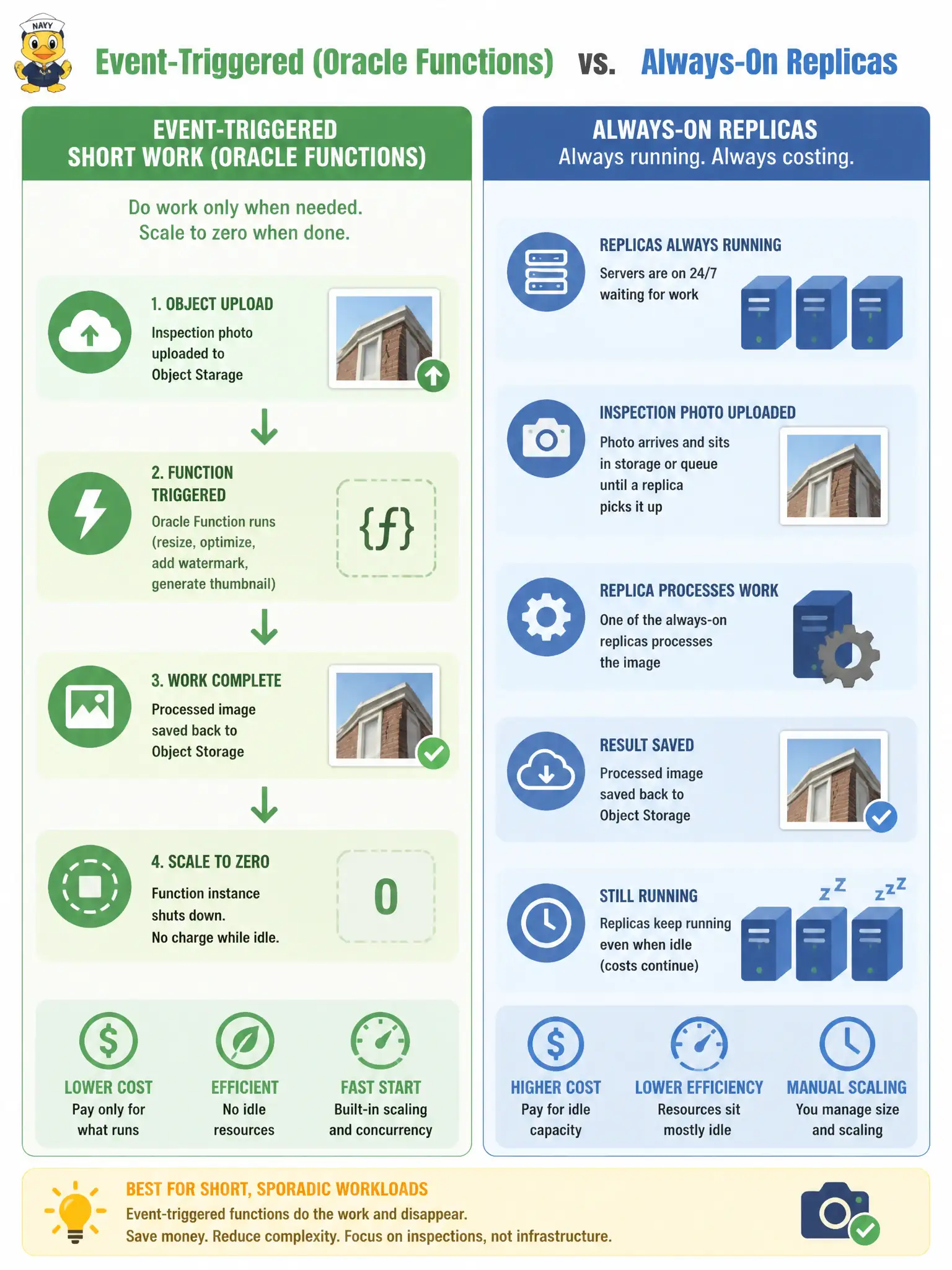
When the job is a brief, triggered chore—like stamping a form when a photo lands—Functions shine: scale to zero and pay per invoke. Continuous listeners and heavy always-on processes belong elsewhere.
Full Explanation
Occasional Object Storage uploads of inspection photos that need a short, stateless transform are a classic Oracle Functions fit: event-shaped work, brief runtime, and scale-to-zero between jobs so public works pays per invoke instead of for idle replicas. Functions own neither always-on pods nor long-lived cursors; they excel when each photo triggers a bounded transform and then quiesces.
An always-on OKE Deployment holding a large in-memory model all day burns capacity whether photos arrive or not and is aimed at continuous or heavyweight services. Keeping three cluster replicas of a five-line handler warm “in case a request arrives someday” invents permanent cost for sporadic work. A persistent Streaming consumer that must hold a cursor open continuously is a long-lived process pattern—better on OKE (or similar always-on compute), not as the primary Functions use case.
Exam caveat: Functions still have timeout, memory, and payload limits; oversized transforms or continuous listeners push you toward containers. Operational check: wire Object Storage events (or Connector Hub) to the function, process a sample inspection photo end-to-end, confirm scale-to-zero when idle via metrics, and compare monthly cost against an always-on Deployment for the same sporadic load.