
A 311-call triage function must keep sub-second starts during morning peaks; cold starts are unacceptable. Which Oracle Functions capability should the team configure?
Select an answer to reveal the explanation.
Short Explanation
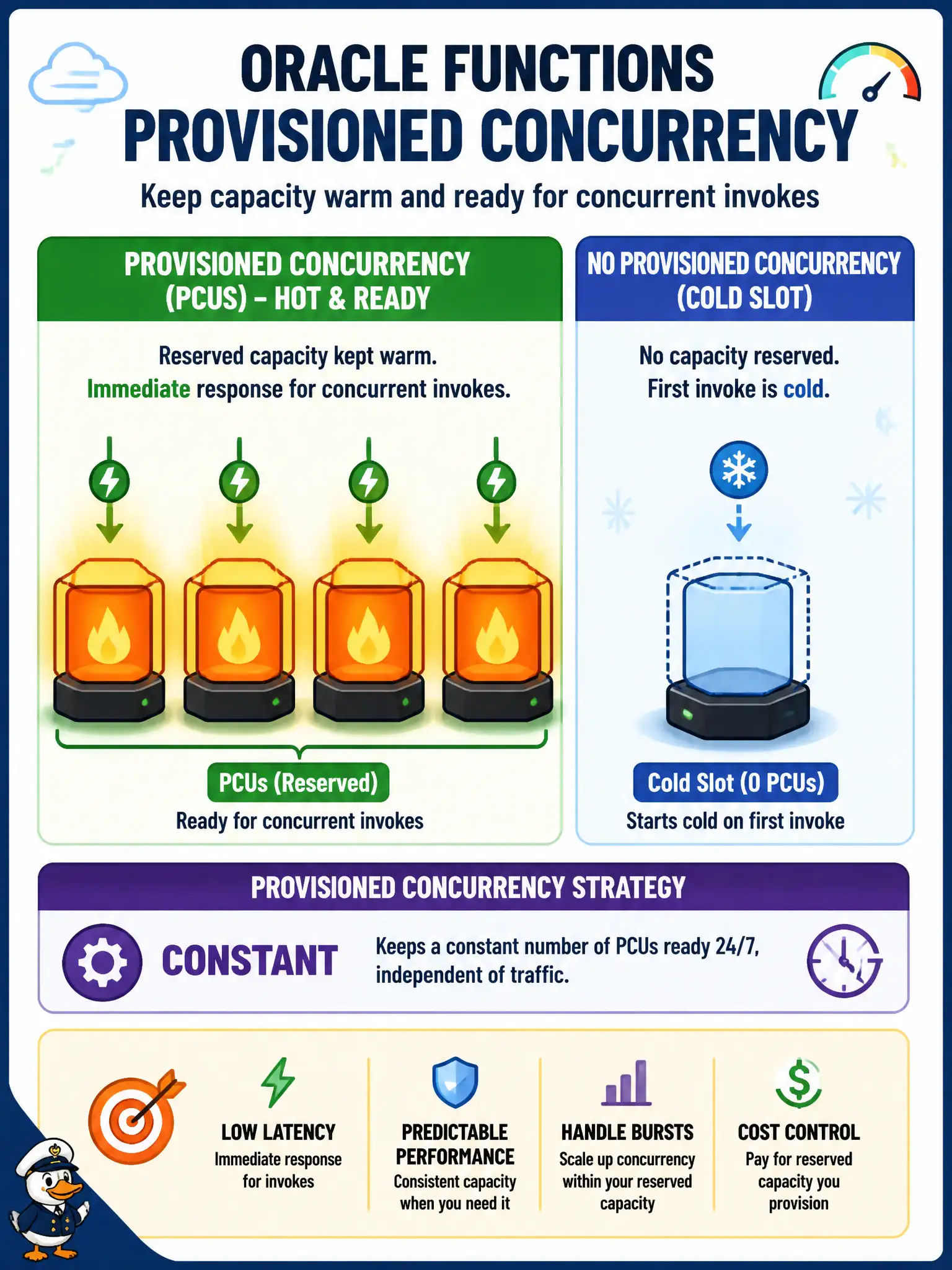
Provisioned concurrency is like keeping a few clerks already at the counter before the doors open. You reserve hot capacity (PCUs) so peak callers skip cold-start delays, and you pay for that readiness.
Full Explanation
When a 311 triage function must keep sub-second starts during morning peaks, provisioned concurrency is the Oracle Functions capability that keeps hot execution capacity ready. Configuring PCUs with a CONSTANT strategy reserves a minimum concurrent hot footprint so peak callers avoid cold-start provisioning delays. The team pays for that readiness, which is the intended trade-off for latency-sensitive municipal workloads.
Raising only the function timeout does not eliminate cold starts; it merely allows a slow cold start more wall-clock time before failure, which still violates a sub-second SLO. Increasing memory alone can change cold-start characteristics modestly but does not permanently remove cold-start latency. An invented autoscaler SKU that pre-pulls Docker layers into every availability domain is not the documented control—stick to provisioned concurrency as the exam-relevant readiness feature.
Exam caveat: provisioned concurrency reduces cold starts for the reserved concurrency depth; burst beyond that can still cold-start, and idle cost remains. Operational check: set PCUs to cover measured morning concurrent invokes, load-test after overnight idle, confirm p99 latency meets the triage SLO, and review cost versus peak concurrency so the CONSTANT reservation is neither undersized nor wastefully oversized.