
Three municipal teams keep one shared database schema “to keep transactions easy,” so every migration needs a coordinated release window. What is the main design cost of that shared-schema anti-pattern?
Select an answer to reveal the explanation.
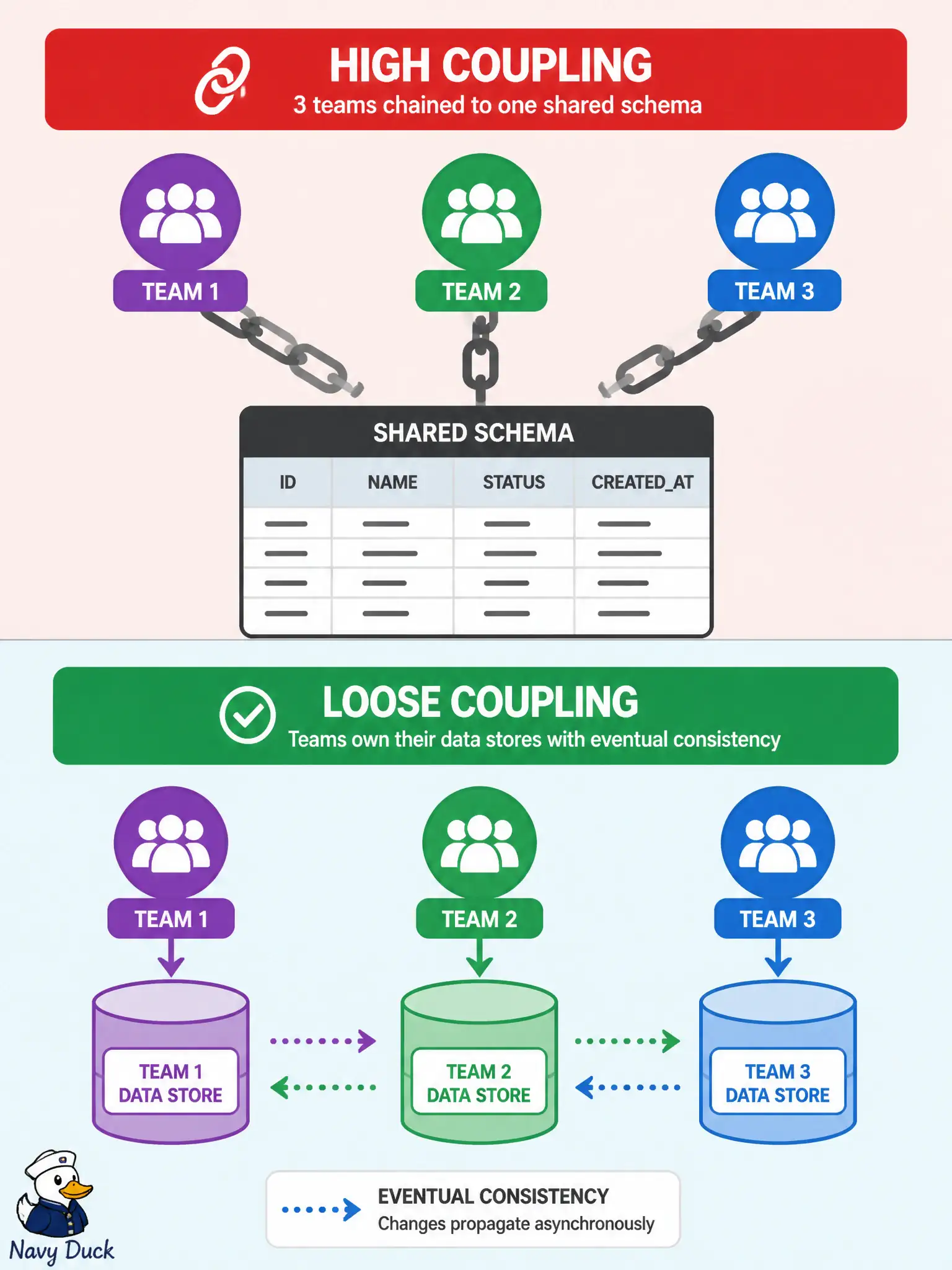
Short Explanation
A shared schema is a single town ledger every department must revise together—migrations become city-wide events. You lose independent evolution and invite lock contention. Eventual consistency is often the price of separating ownership, not something a shared schema magically removes forever.
Full Explanation
The main design cost of one shared database schema across three municipal teams is coupled release trains and noisy-neighbor row locking: every migration becomes a city-wide event, and independent evolution is traded for a false sense of transactional simplicity. Teams cannot change their slice of the model without negotiating a shared window, and locks or heavy queries from one service stall work other services need. That coupling is the persistence anti-pattern opposite of service-owned data.
A shared schema does not automatically enable multi-region active-active writes without application changes—distributed write topology is a separate, harder problem. It does not guarantee that eventual consistency is never required; many cross-team workflows still need asynchronous reconciliation even when tables are shared, and separating ownership often makes consistency trade-offs explicit rather than magical. It also does not force every service to run only as an Oracle Function with no persistent store—that runtime mandate is unrelated to the shared-schema anti-pattern.
Exam caveat: shared schema is called out as an anti-pattern because of release and contention coupling, not because of Functions packaging or automatic multi-region myths.
Operational check: attempt a migration owned by one team without a coordinated release window; if every team must attend and lock risk crosses boundaries, plan a move toward service-owned persistence and API/event integration.