
A city emergency-alert API must stay available if a single data-center event occurs, while callers need low latency and data residency in one geography. Which application-level placement approach best fits that goal on OCI?
Select an answer to reveal the explanation.
Short Explanation
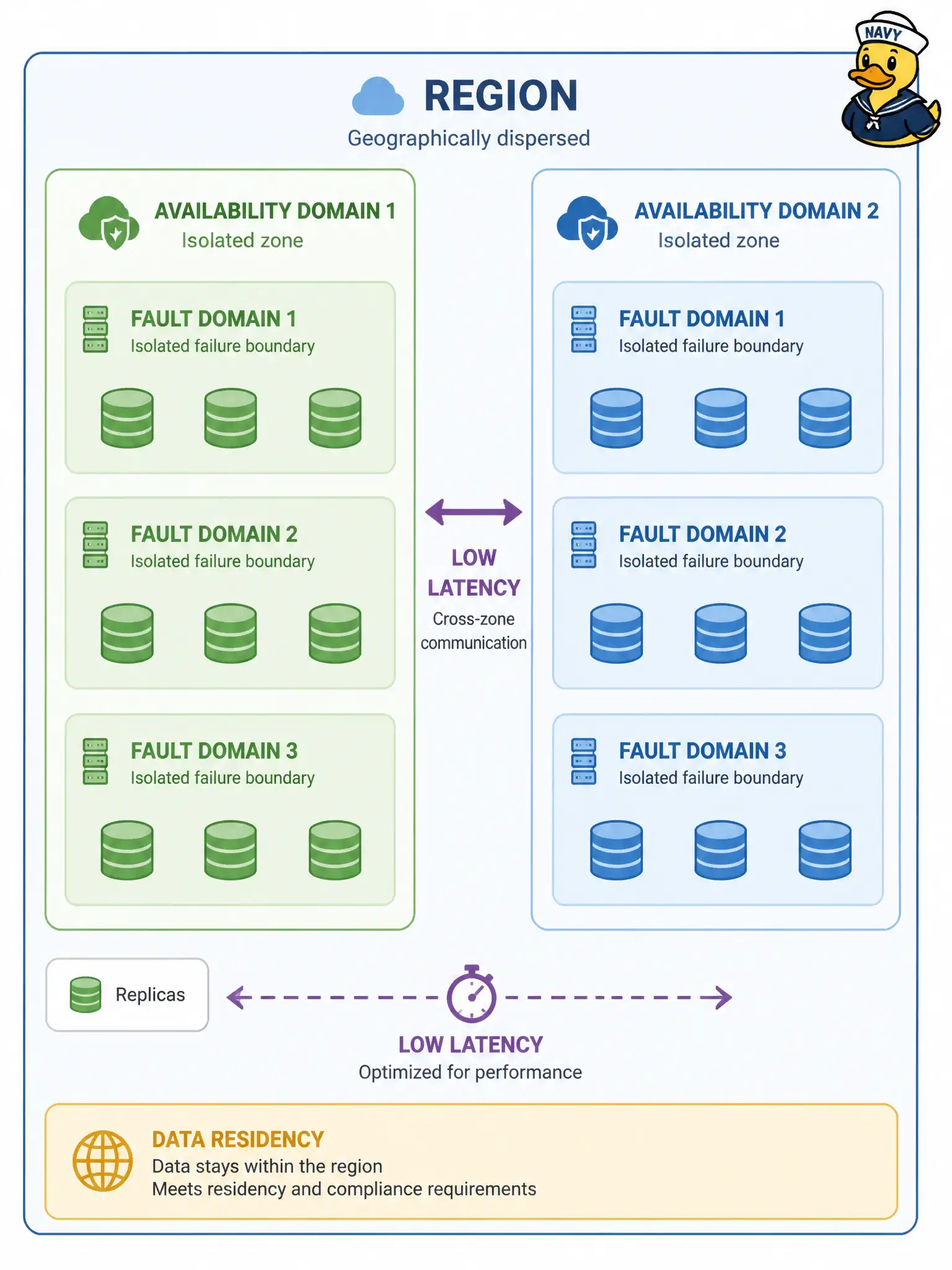
Think of availability domains like separate fire stations in the same city and fault domains like different truck bays—so one maintenance event does not take every responder. Pick a region for latency and residency, spread replicas, and remember some OCI resources are regional while others are AD-local.
Full Explanation
Application-level placement for the city emergency-alert API starts by choosing a region that meets caller latency and data-residency needs, then spreading stateless replicas across fault domains and across availability domains where the topology allows. That design keeps a single data-center or maintenance event from taking every replica offline. Developers must also remember that some OCI resources are regional while compute instances and block volumes are availability-domain local, so stateful attachments and replica placement have to be planned together.
Placing every replica and every block volume in one availability domain simplifies networking while maximizing correlated failure when that AD has an event. Ignoring fault domains because they “only apply to billing” is false—fault domains exist to reduce blast radius inside an AD for application availability. Pinning all stateful and stateless components to a single Compute instance for easier SSH management collapses every failure domain into one host and abandons both AD and fault-domain diversity.
Exam caveat: this is app-level placement thinking for developers—not a Foundations trivia dump and not a full hub-and-spoke multi-region DR architecture design.
Operational check: deploy at least two replicas in separate fault domains (and separate ADs if the service design allows), confirm volumes and instances respect AD locality rules, and simulate loss of one FD/AD to verify alerts still serve from survivors in the chosen region.