
A records-search team wants the simpler overlay model where pod IPs stay inside the cluster rather than as native VCN addresses. Which network type should they pick?
Select an answer to reveal the explanation.
Short Explanation
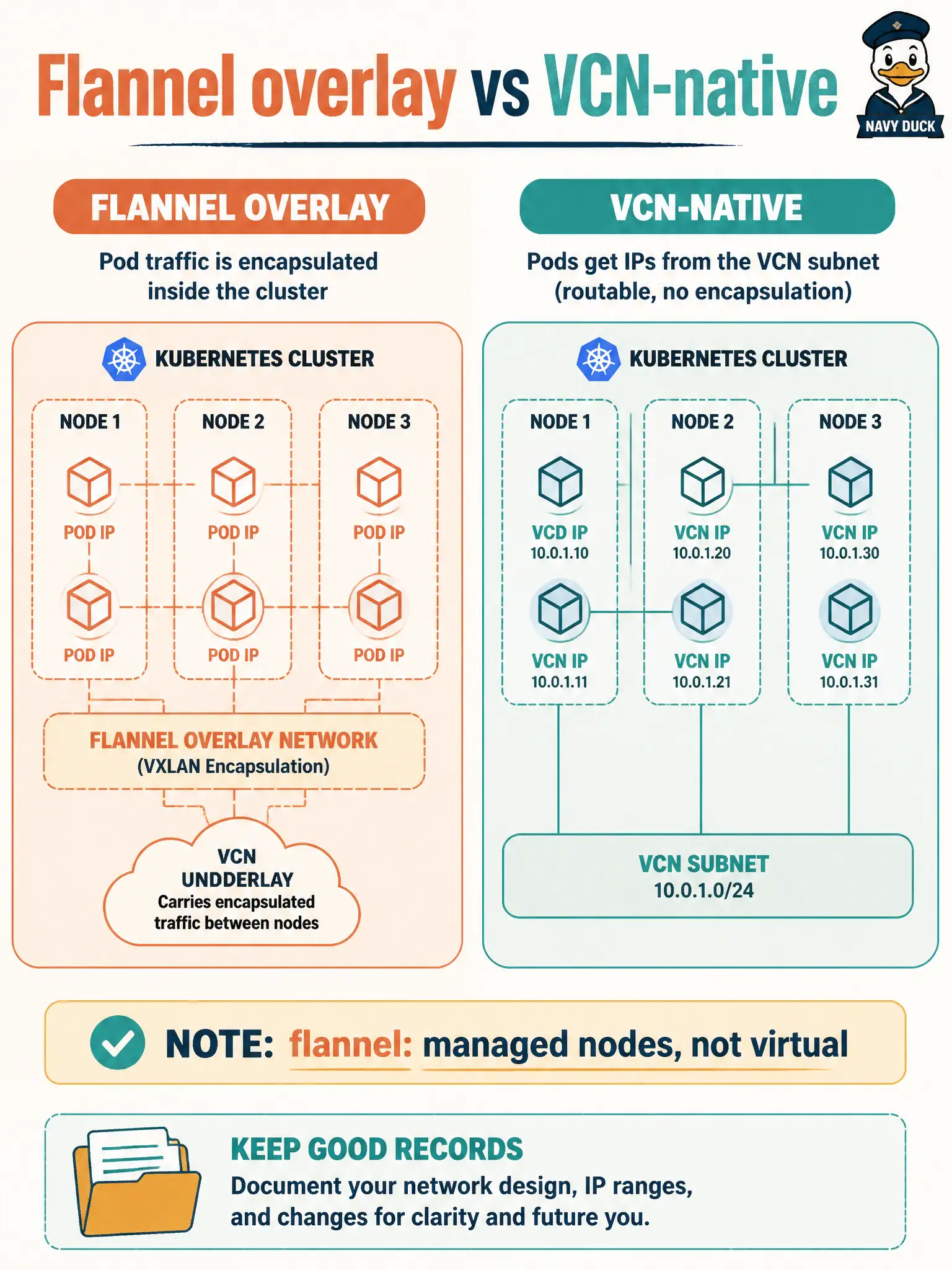
Flannel is the overlay backpack: pod traffic is encapsulated, and pod IPs stay meaningful inside this cluster—not as native VCN addresses. It supports managed nodes, not virtual nodes. Pick it for the simpler overlay model, not because VCN-native is "deprecated."
Full Explanation
Flannel overlay encapsulates pod traffic so pod IPs remain meaningful inside the cluster rather than as native VCN addresses. That matches a records-search team that wants the simpler overlay model. Flannel supports managed-node topologies where overlay addressing is acceptable and peered-VCN native pod routing is not required. VCN-native only is wrong here: flannel has not been removed from all OKE clusters, and the stem explicitly wants overlay semantics rather than native VCN pod IPs. Virtual nodes with flannel is incompatible with OKE's networking rules—virtual node pools require VCN-native networking, not the overlay CNI. You cannot satisfy 'virtual pools require flannel' because the platform requirement is the opposite. Service Mesh sidecars add mTLS and traffic policy; they do not replace CNI addressing for Pod IPs. Mesh assumes an underlying network plugin still assigns addresses. Exam caveat: choosing flannel means giving up virtual node pools and native pod IPs in peered VCNs—trade deliberately if the team later needs those features. Operational check: create or inspect the cluster network type as flannel, deploy records-search Pods, confirm pod IPs are overlay/cluster-scoped rather than pod-subnet VCN addresses, and document that virtual node pools are unavailable on this networking choice.