
A municipal GIS renderer needs GPU shapes that managed and virtual pools do not offer. Which enhanced-cluster node option joins custom Compute instances to OKE?
Select an answer to reveal the explanation.
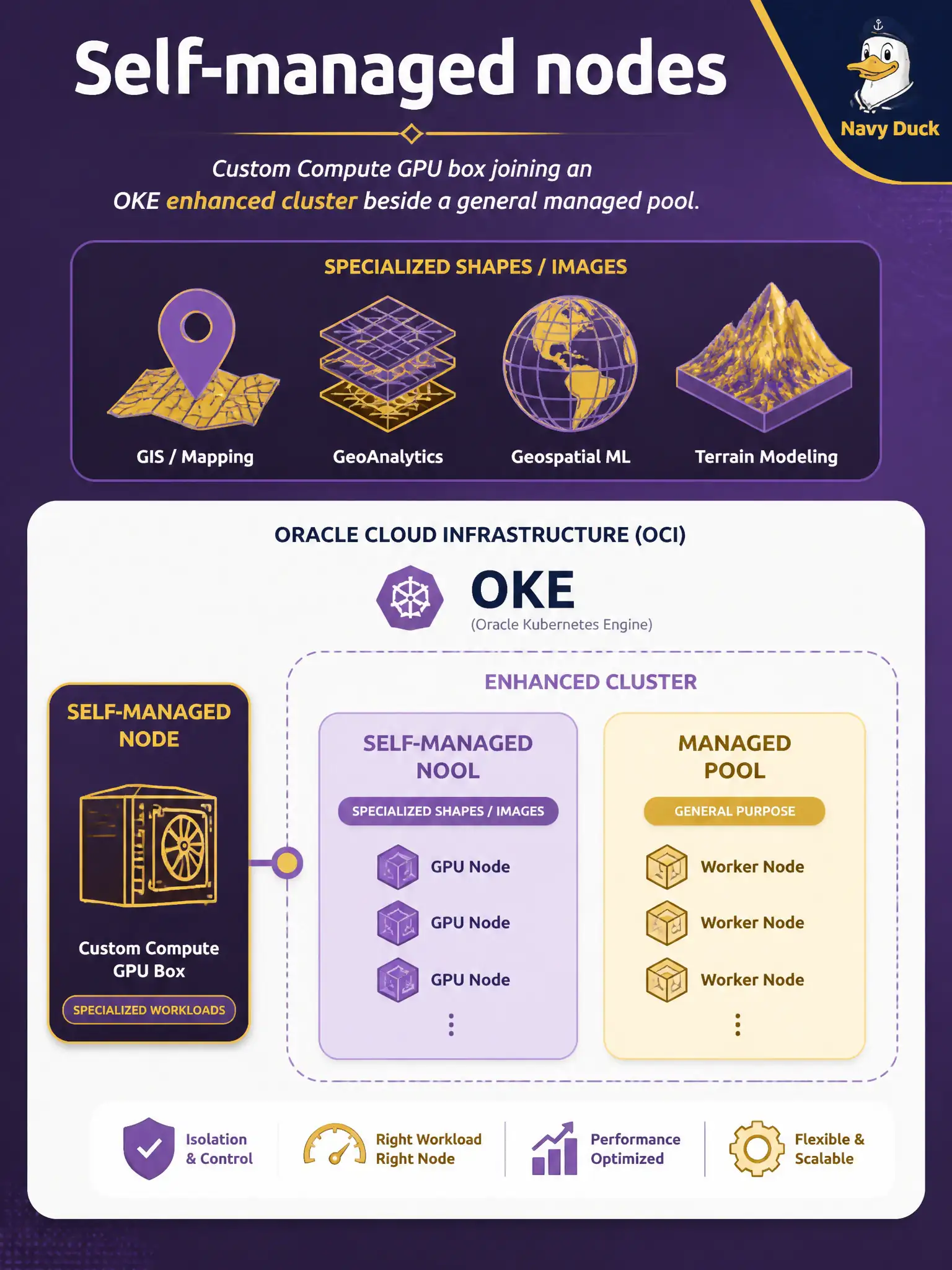
Short Explanation
Self-managed nodes are the specialty tool drawer: you create the Compute instance (GPU, specialized networking) and join it because managed/virtual pools do not offer that hardware. Use them when the GIS workload needs it—not as the default web-service pool.
Full Explanation
Self-managed nodes are Compute instances you create and join to an enhanced OKE cluster when managed and virtual pools cannot offer the required shape or image—such as GPU workers for a municipal GIS renderer. You own the instance lifecycle and Kubernetes join, gaining specialized hardware while still scheduling Pods onto those nodes with labels and taints. Replacing OKE with only Oracle Functions does not magically provide GPUs for a Kubernetes GIS renderer. Functions is a different compute model and does not satisfy joining custom GPU Compute to OKE. Virtual nodes plus a GPU annotation do not provision bare-metal GPU workers. Virtual nodes abstract away worker VMs; they are not the path for specialty GPU shapes you must bring yourself. Scaling a managed CPU pool with HPA never emulates GPUs in software for rendering workloads that require GPU shapes. More CPU Pods do not substitute for GPU devices the workload needs. Exam caveat: self-managed nodes increase operational burden—image patching, join tooling, and compatibility with the cluster version are yours—and they are an enhanced-cluster capability, not something to assume on every basic cluster. Operational check: provision the GPU Compute instance, join it as a self-managed node, label/taint appropriately, schedule the GIS Pods with matching tolerations and resource requests, and confirm nvidia.com/gpu (or equivalent) allocation succeeds.