
Public-works crews want one versioned bundle for the work-order Deployment, Service, Ingress, and ConfigMap on OKE. Which packaging approach fits that need?
Select an answer to reveal the explanation.
Short Explanation
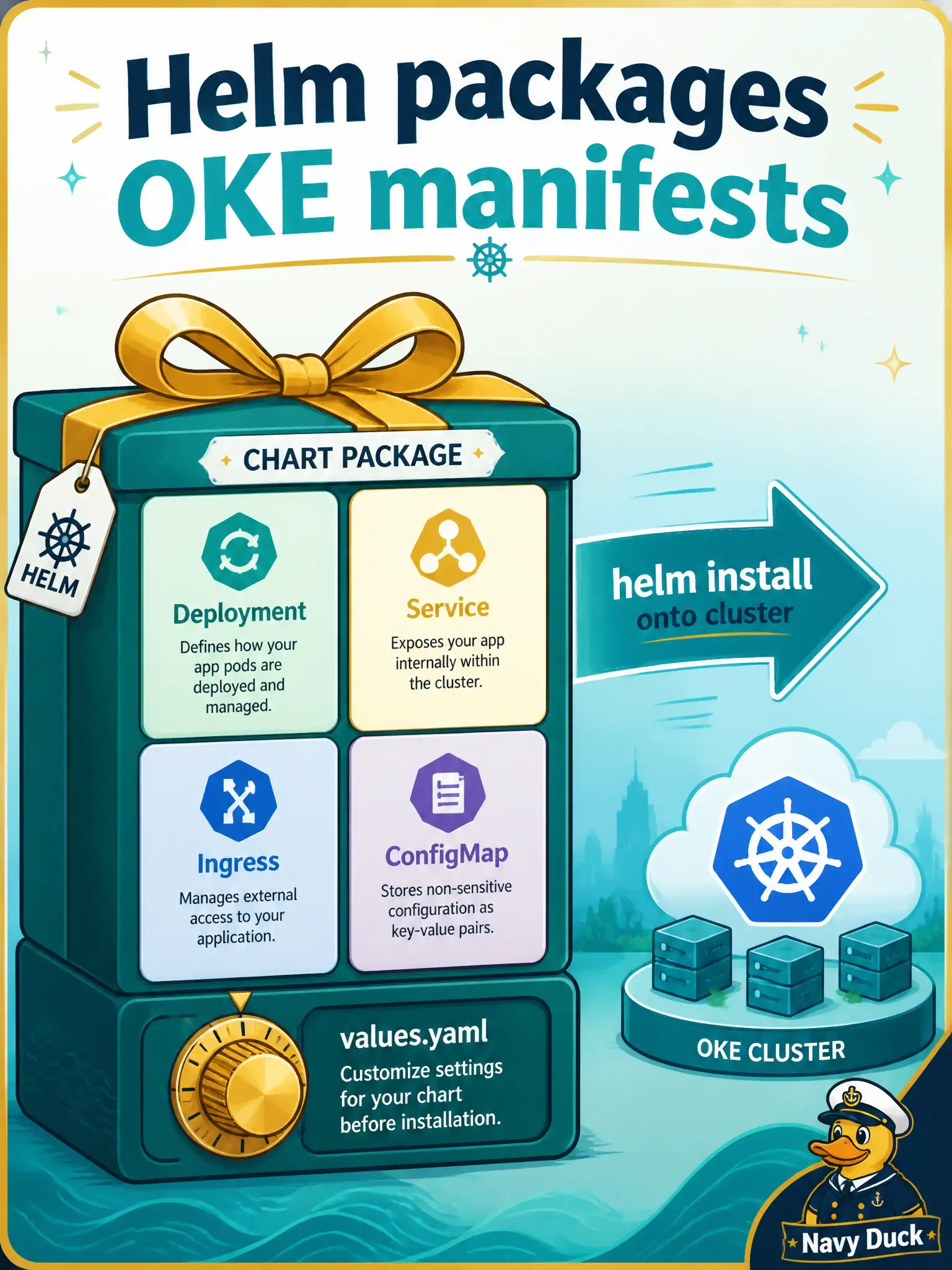
Helm is the gift box for a set of OKE objects: Deployment, Service, Ingress, ConfigMap, plus knobs in values. Official OKE and OCIR tutorials treat Helm as the package manager on the cluster—not a stand-in for inventing a DevOps pipeline exam item.
Full Explanation
A Helm chart packages the work-order Deployment, Service, Ingress, and ConfigMap as versioned, templated Kubernetes manifests. One chart version becomes the installable bundle public-works crews can release consistently onto OKE—shared templates, chart versioning, and values-driven configuration instead of ad-hoc file drift. Hand-applying unrelated YAML files with no shared version loses the bundle semantics: pieces drift independently, rollbacks are manual, and there is no single chart revision that describes the whole work-order stack. An OCI DevOps build pipeline stage can deliver or deploy artifacts, but it is not itself the packaging format for expressing those Kubernetes objects as a reusable, versioned application bundle. Pipelines consume charts or manifests; they do not replace Helm's packaging model as the answer to 'one versioned bundle.' Embedding live etcd state inside a Docker image layer is not how Kubernetes apps are packaged. Images carry application binaries; cluster desired state belongs in manifests or charts applied to the API server—not as a snapshot of etcd in a filesystem layer. Exam caveat: Helm releases still need values hygiene and secret handling—charts template objects, but sensitive material should come from proper Secret sources rather than plaintext committed values. Operational check: helm package/push the chart, helm install or upgrade onto OKE, and confirm Deployment, Service, Ingress, and ConfigMap appear together at the expected release revision for the work-order app.